

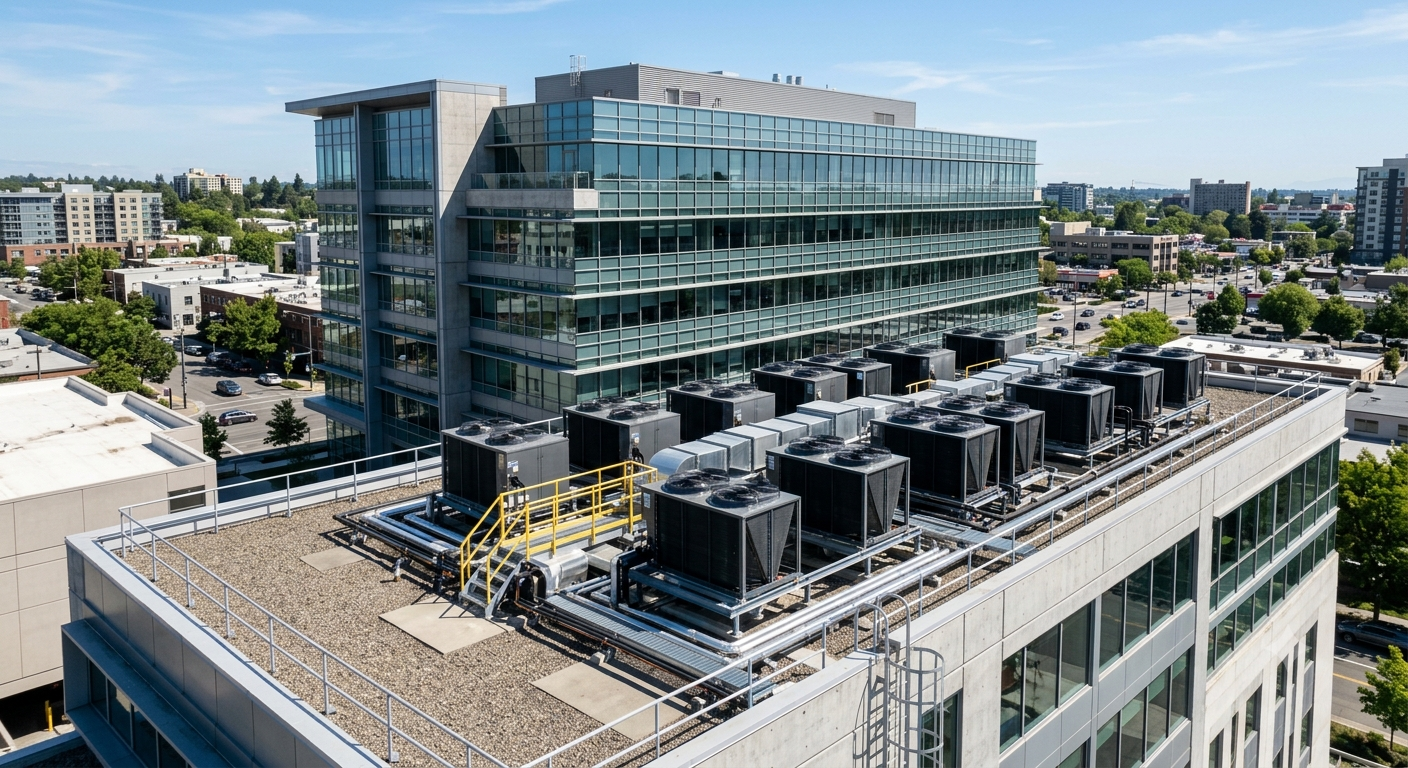
Researchers from Italy’s University of Palermo have developed a model to assess the performance of buildings equipped with heat pumps and PV systems under different demand response (DR) strategies. The buildings were evaluated by adjusting electricity consumption in response to external signals, including energy prices and grid constraints.
“The analysis considers a price-based approach, defined according to Italy’s wholesale electricity market Prezzo Unico Nazionale (PUN), and a PV-driven DR program aimed at improving the integration of variable renewable energy sources,” the researchers said. “Their impacts on energy consumption and occupant comfort are assessed across daily and annual timescales.”
The team first modeled a poorly insulated three-story office building with a conditioned floor area of 4,982.2 m², 18 thermal zones, a window-to-wall ratio of 33%, 652.87 m² of glazing, and 1,977.92 m² of gross wall area. The building was equipped with a reversible air-to-water heat pump, a thermal energy storage (TES) tank, a hydronic distribution system with circulation pumps, mixing and diverting valves, piping, and fan-coil units. In some scenarios, the system also included a PV-battery (PV-B) configuration.
The building and integrated energy system were dynamically simulated in TRNSYS, while the heat pump was modeled separately using IMST-ART v4.0. Annual simulations were carried out for Palermo, Italy.
Using a no-demand-response (No DR) scenario as a baseline, the researchers assessed four DR strategies. The first two were based on PUN electricity prices: DR1 adjusted thermal-zone temperature setpoints during high-price periods to reduce heat pump operation, while DR2 additionally used low-price periods for pre-heating in winter and pre-cooling in summer to shift electricity demand.
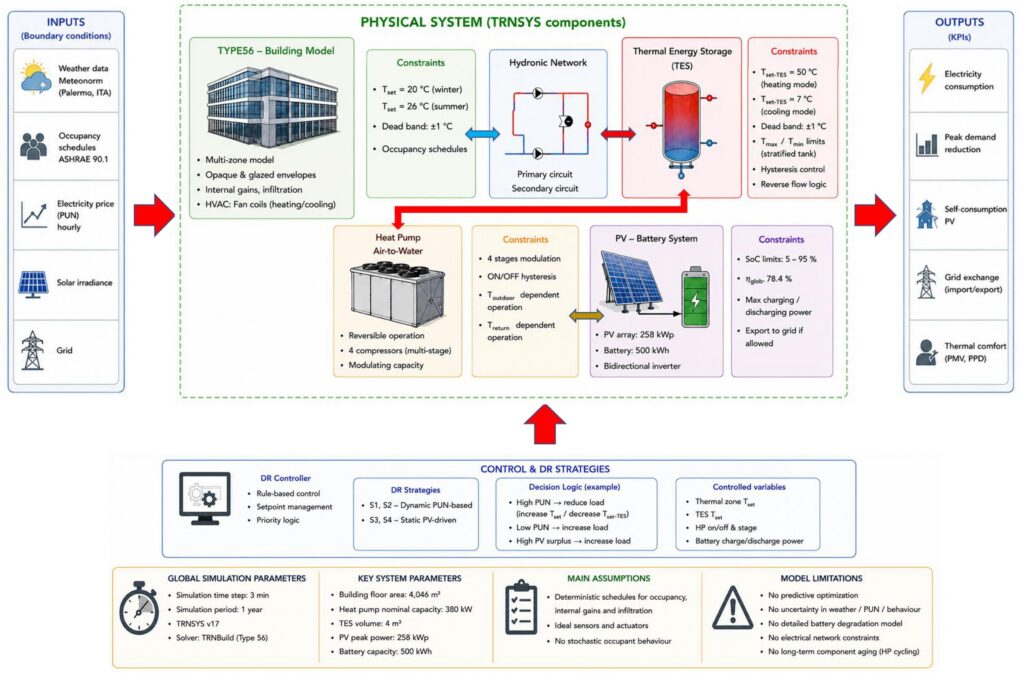
The remaining two strategies were PV-driven. DR3 adjusted thermal-zone temperature setpoints to increase heat pump operation during periods of high PV generation, followed by temporary shutdown periods. DR4 modified the TES setpoint to store thermal energy during surplus PV production and later use it to reduce electricity demand from the grid. After identifying DR4 as the most effective strategy, the researchers further evaluated it in a well-insulated building with night-time natural ventilation and in combination with a PV-battery (PV-B) system.
“The annual analysis highlights that the dynamic price-based strategy DR no. 1 severely degrades indoor environmental quality, causing the Comfort Compliance Ratio (CCR) to fall to 23.82% compared with the 34.71% baseline, while providing only modest energy savings of 3.42%,” the researchers reported. “Conversely, DR no. 2 successfully shifts loads, slightly improving annual comfort availability to 36.14% and reducing annual electricity consumption by 2.14%.”
According to the results, the static PV-driven DR3 strategy delivered an intermediate performance, lowering the CCR to 31.18% while achieving a significant reduction in electricity consumption of 14.73%. By contrast, DR4 applied to the uninsulated building resulted in a major performance mismatch, failing to maintain acceptable indoor conditions and reducing the CCR to 24.11%, while limiting annual energy savings to 4.31%.
“The most remarkable outcome is achieved by introducing structural modifications to DR no. 4,” the researchers said. “The combination of envelope insulation, night-time ventilation, and TES management increases the annual CCR to 81.22%, more than doubling the baseline value. From an energy perspective, this configuration reduces annual electricity consumption by up to 28.22% compared with the reference case. The integration of a PV-B system further improves performance by exploiting the temporal alignment between solar generation and building demand, increasing grid electricity savings by up to 59.89%.”
The their findings were presented in “Exploring the flexibility potential of office building with air-to-water heat pumps in the Mediterranean climate,” published in Energy Conversion and Management.
Source link