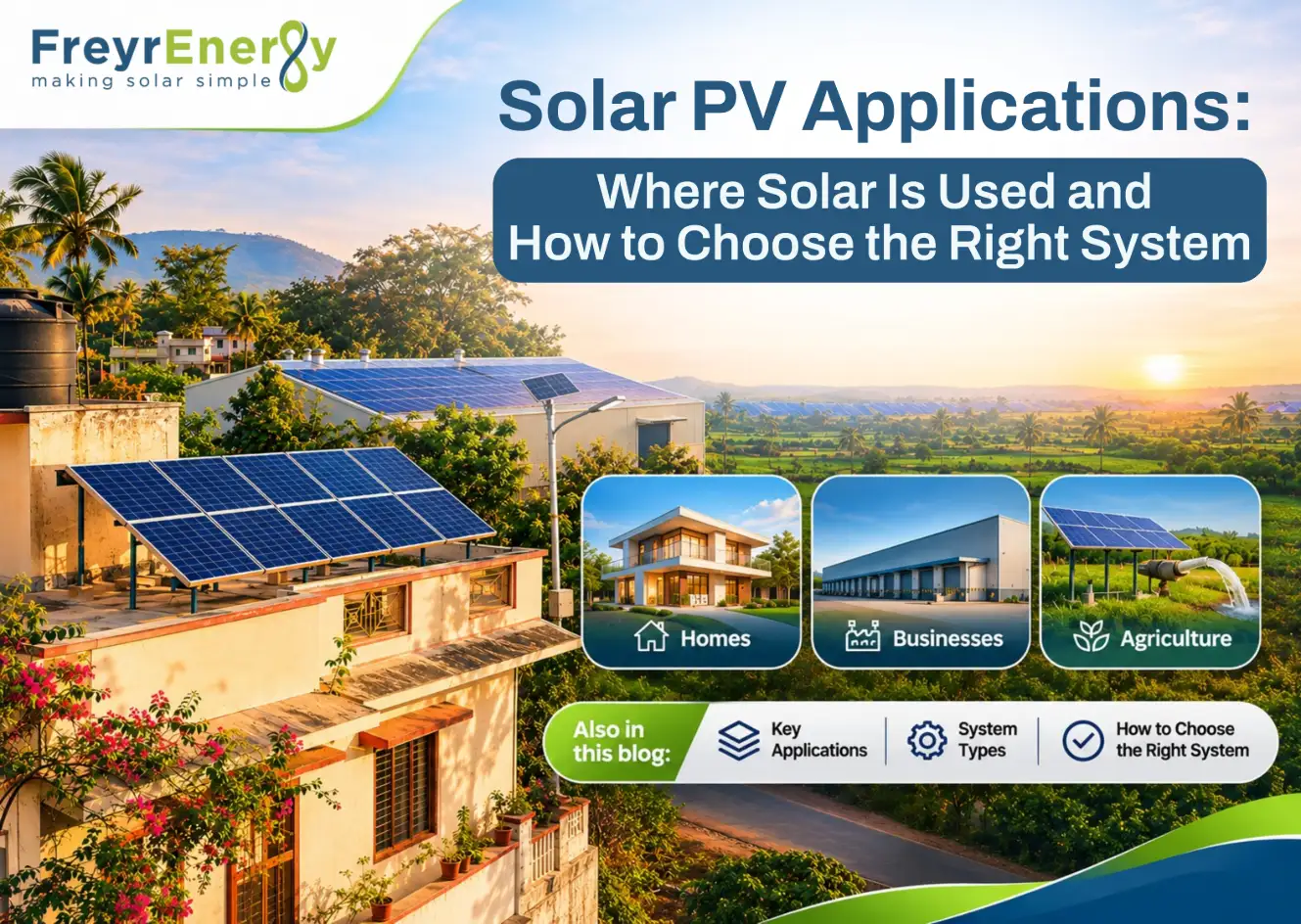
Overview: A solar PV application is any use of solar photovoltaic panels to turn sunlight into electricity. The most common ones are rooftop solar for homes, power for shops and factories, solar water pumps for farms, big solar farms that feed the grid, off-grid power for remote places, and small things like streetlights and chargers. Which one suits you depends on how much power you use, whether you have a reliable grid, and how much sun your place gets.
If you came here wondering where solar can actually be used, and which kind of system fits your situation, this guide will help. I’ll keep it simple and use real numbers where I can.
What Is a Solar PV Application?
A solar PV application is a particular job that a solar photovoltaic system does.
PV stands for photovoltaic. Solar panels have cells, usually made of silicon, that make electricity when sunlight falls on them. That electricity can run your fan, pump water, light a street or go into the grid.
So when people say “pv solar application” or “application of photovoltaic technology”, they mean the use. A panel on a house roof is a residential application. A panel running a borewell pump is an agricultural application. The panels are the same. The job is different.
What is the difference between solar PV and solar thermal?
Solar PV makes electricity. Solar thermal makes heat.
Your rooftop panels that run the fridge and the AC are solar PV. A solar water heater on the roof is solar thermal. People mix these up all the time, and it matters when you ask for a quote.
How Does a Solar PV System Work?
A solar PV system catches sunlight, turns it into electricity, and sends that electricity where you need it. It happens in four steps:
- Panels catch sunlight. The cells make direct current (DC) electricity. This is called the photovoltaic effect.
- The inverter converts it. Your home runs on alternating current (AC), so the inverter changes DC into AC.
- You use the power. Lights, fans, the fridge, the AC, motors, whatever is running.
- The extra goes somewhere. It can go to the grid, into a battery, or be managed by the system, depending on the setup.
Most modern systems also have monitoring, so you can see how much power you are making from an app. Freyr Energy customers, for example, can do this with the Freyr Energy Solar App.
What are the main parts of a solar PV system?
| Part | What it does |
| Solar panels | Turn sunlight into DC electricity |
| Inverter | Converts DC into AC |
| Mounting structure | Holds the panels on the roof or ground |
| Wiring and protection devices | Connect everything and guard against faults |
| Energy meter | Measures what you use, make or send to the grid |
| Battery (optional) | Stores power for night or power cuts |
| Monitoring | Shows how the system is performing |
A normal on-grid rooftop system does not need a battery. People often assume it does and end up paying for something they don’t need.
What Are the Main Applications of Solar Photovoltaic Technology?
Solar PV is used almost everywhere there is sunlight and a need for power. Here are the main uses, from the biggest to the smallest.
1. Homes (residential solar)
This is the one most people know. You put panels on your roof, and they cover part or most of your daytime electricity use.
Say your family uses about 400 units a month. A properly sized system can cover a big part of that, depending on your sunlight, roof space and how the system is built. If you have an on-grid system, the extra power can go to the grid under net metering, and you pay less to the electricity company.
Your final bill still depends on your tariff, fixed charges and your DISCOM’s rules. Solar rarely brings it to exactly zero, so don’t plan on that.
2. Businesses and factories (commercial and industrial solar)
Shops, offices, schools, hospitals, hotels, warehouses and factories use a lot of power during the day. That is exactly when solar makes power, so the match is very good.
A warehouse is a good example. It usually has a big flat roof that is not being used for anything. Putting panels there means no extra land and a lower power bill.
Before you size a system for a business, look at your real daytime load. Don’t size it just by how much roof you have. Also have someone check roof strength, electrical safety and how people will reach the panels for cleaning.
3. Farms (agricultural solar)
Farmers need power for irrigation, cold storage, processing and more. In many places the grid is unreliable and diesel is expensive, so solar helps a lot.
Common uses:
- Solar water pumps. Panels run the pump directly during the day. No battery is needed, because the water itself gets stored in a tank.
- Cold storage. Solar can run refrigeration for fruits and vegetables. Since cooling is needed at night too, you need the grid, a battery or another backup.
- Greenhouses. Fans, ventilation and irrigation controls.
- Processing. Cleaning, sorting and drying equipment.
- Electric fencing. Small solar units can power it.
In India, the PM-KUSUM scheme supports solar pumps for eligible farmers. Rules and subsidy details differ by state, so check the current terms before you apply.
4. Solar farms (utility-scale solar)
These are large solar power plants, often called solar parks. Thousands of panels are connected to inverters, and the power goes into the grid for everyone to use.
Building one takes serious planning. You need land, good sunlight, a grid connection nearby, and an environmental review. Many large plants also use trackers that tilt the panels to follow the sun and produce more.
5. Remote places (off-grid solar)
Plenty of places have no reliable grid: remote villages, islands, telecom towers, research stations, rural health centres and schools.
An off-grid system works on its own, usually with batteries so there is power at night. Take a rural health centre. It might run lights, a vaccine fridge and a radio on solar plus batteries. In a case like that, the system has to be designed very carefully, because weather changes how much power you get and the loads can’t go down.
6. Streetlights, signals and public infrastructure
Solar streetlights collect energy during the day and store it in a battery for the night. The same idea is used for traffic signals, road warning lights, bus shelters, remote water pumps and monitoring equipment.
The big win here is that you don’t have to lay long cables to reach the spot.
7. Small and portable devices
This is the application most people have used without thinking about it. Solar calculators, lanterns, garden lights, portable phone chargers, camping panels and small sensors all use tiny PV cells. They need very little power, and they work well outdoors.
8. Newer applications
A few uses are growing fast:
- Solar EV charging. Panels on a rooftop or parking canopy help power charging stations. Panels on the car itself won’t run it, because the surface area is too small, so solar works better on the charging side.
- Building-integrated PV (BIPV). Solar cells built into the building, like solar glass, roof tiles or facades. The panel doubles as a building material. It needs special design and costs more than normal panels.
- Floating solar. Panels on reservoirs and ponds. It saves land, and the water can help keep panels cooler. Anchoring and changing water levels need extra planning.
- Agrivoltaics. Panels raised above or spaced between crops, so the same land grows food and makes power. Whether it works depends on the crop, the panel height and how much light the plants need.
- Solar plus battery storage. Some of the day’s power is stored and used in the evening or during a cut. It adds cost, so it needs proper sizing.
What Are the Different Types of Solar PV Systems?
There are three main types: on-grid, off-grid and hybrid. The type depends on how the system connects to the grid and whether it has storage.
On-grid. It is connected to the electricity grid. You use solar power during the day, and the grid fills the gaps. With net metering, extra power can go back to the grid. One important thing: a standard on-grid system shuts off during a grid power cut, for safety reasons. Good for homes and businesses with a reliable grid.
Off-grid. It works completely on its own, usually with batteries. Good for remote homes, isolated sites and places with no grid. Daytime solar pumps are an exception and can run without batteries.
Hybrid. It has solar panels, a battery, and a grid connection. It uses solar in the day, stores some power, and can back you up during a power cut. Good for homes and businesses that face frequent cuts. It costs more than a basic on-grid system, since there is more equipment.
On-grid vs off-grid vs hybrid: which fits which application?
| What to check | On-grid | Off-grid | Hybrid |
| Needs grid? | Yes | No | Usually yes |
| Battery? | Usually no | Usually yes | Yes |
| Works in a power cut? | No | Yes, if designed for it | Yes, for selected loads |
| Cost | Lowest | Depends on storage and load | Higher than on-grid |
| Best for | Homes with a steady grid, offices, shops, factories | Remote villages, telecom, isolated sites | Homes and businesses with frequent cuts |
| Examples | City home, mall, factory with daytime load | Remote health centre, streetlight, island | Home in an area with long outages |
A few quick matches: a solar farm is grid-connected. A farm pump uses a dedicated solar pumping system. A streetlight is a small stand-alone system with a battery. A remote village usually needs an off-grid or a small hybrid microgrid.
How Much Does a Solar PV System Cost in India?
Prices and subsidy rules below are as of October 2026. They change, so always confirm before you decide.
For a home in India, a rooftop solar system usually costs somewhere between ₹55,000 and ₹70,000 per kW installed, before subsidy. Some quotes come in lower and some higher, depending on the city, panel brand, inverter and whether you need a battery. So a 3 kW system often lands in the ₹1.7 to ₹2.1 lakh range before subsidy.
How much subsidy do I get under PM Surya Ghar?
For eligible homes, the central government subsidy works like this:
| System size | Central subsidy |
| 1 kW | ₹30,000 |
| 2 kW | ₹60,000 |
| 3 kW or more | ₹78,000 (this is the maximum) |
Two things to know. The subsidy stops growing after 3 kW, so a 5 kW system still gets ₹78,000. And it is for residential connections. Factories and shops don’t get it. Some states add their own top-up, and the money is usually paid to your bank account after the system is installed and inspected. Check the official PM Surya Ghar portal for the current rules before you apply.
How long does it take to earn the money back?
Here is a simple example. These are rough numbers, not a promise.
- System: 3 kW, cost ₹1.9 lakh
- Subsidy: ₹78,000
- You pay: about ₹1.12 lakh
- Power made: about 4 units per kW per day, so 12 units a day, or about 360 units a month
- Your tariff: say ₹7 per unit
- Monthly saving: 360 × 7 = about ₹2,520
- Yearly saving: about ₹30,000
₹1.12 lakh ÷ ₹30,000 is a little under 4 years. After that, the power is close to free for the rest of the panel life, apart from maintenance and an inverter replacement along the way.
If your tariff is lower, or you use less power than the system makes, the payback takes longer. If your tariff is higher, it is faster. Most homes land somewhere between 3 and 6 years.
How Much Solar Capacity Do I Need?
Start with your monthly units, then work backwards.
Say your home uses 450 units a month.
- Daily use: 450 ÷ 30 = 15 units
- A 1 kW system makes about 4 units a day where you live (this varies by city and season)
- Size needed: 15 ÷ 4 = 3.75 kW
So a 4 kW system is a reasonable starting point. A site survey will confirm it, because shade, roof direction and your usage pattern all change the answer.
It won’t take your bill to zero either, and that’s normal. You will still have fixed charges and some evening use.
Want a quick estimate for your own home? Try the Freyr Energy Solar Calculator.
What Are the Benefits of Solar PV Applications?
- Lower electricity bills. Solar replaces part of what you buy from the grid.
- Clean power. Panels don’t burn fuel to make electricity.
- Flexible. You can put them on roofs, open land, parking areas, even water.
- Less dependence on the grid. Useful where power is unreliable or missing.
- Low routine maintenance. Panels have no moving parts. You still need cleaning and a yearly check.
- Long life. Good panels last 25 to 30 years. Output drops slowly over time, and quality panels usually lose less than about 1% a year.
What Are the Limits of Solar PV?
Solar is good, but it is not perfect. Know these before you buy.
| Limit | What it means for you |
| Needs sunlight | Output changes through the day and across seasons |
| Cloudy weather | Panels still work, but make less |
| Shade | Even a small shadow on part of a panel can cut output |
| Dust | Dirty panels make less power, so cleaning matters |
| Space | Roof or land area limits how big your system can be |
| Upfront cost | You pay a lot at the start, though loans are available |
| Batteries | They add cost and need replacing in time |
| Rules | Grid-connected systems must follow DISCOM and electrical rules |
None of this means solar is a bad idea. It just means design and installation matter.
How Do I Choose the Right Solar PV System?
Go through these steps in order.
- Write down your goal. Lower bills? Backup power? Power where there is no grid?
- Check your usage. Collect your last 12 electricity bills and find your average monthly units. For a business, look at your daytime load.
- Look at your space. You need a shade-free area. Roughly 8 to 10 square metres per kW. Also check the roof condition and direction.
- Think about your grid. If power is steady, on-grid is usually enough. If you face long cuts, think about hybrid. If there is no grid, off-grid.
- Decide on a battery. Only add one if you truly need power during cuts.
- Compare 2 or 3 quotes. Look at panel brand, inverter, warranty and after-sales service, not only the price.
- Check the rules. Net metering, subsidy eligibility and approvals differ by state. Your DISCOM can tell you.
- Plan for upkeep. Ask who cleans, who services, and how you can monitor the system.
What Mistakes Do People Make When Going Solar?
These come up again and again:
- Buying a bigger system than they can use. Size to your consumption, not to your roof.
- Paying for a battery they don’t need. On-grid with a steady grid usually doesn’t need one.
- Expecting power during a cut from a normal on-grid system. It shuts off by design.
- Choosing the cheapest quote. A very low price often means weak panels, a poor inverter or no service.
- Ignoring shade. A tree or water tank that shades the panels for a few hours can hurt output more than you’d think.
- Forgetting about cleaning. Dust builds up, mostly in dry areas.
- Assuming the subsidy applies to everything. It covers eligible homes, not shops or factories.
What About Solar PV Applications in India?
India gets a lot of sun. According to the Ministry of New and Renewable Energy (MNRE), most parts of the country receive about 4 to 7 kWh of solar energy per square metre per day. That makes almost every use I’ve described workable here.
Government schemes support some of them. PM Surya Ghar covers rooftop solar for eligible homes, and PM-KUSUM covers solar pumps for farmers. The details change from time to time, so check the official sources before applying.
What Is the Future of Solar PV Applications?
A few things look set to grow: better solar cells that make more power from the same area, solar paired with batteries, solar built into buildings, agrivoltaics, floating solar on reservoirs, and solar for EV charging. The basic idea won’t change. Panels get cheaper and better, and more people find places to use them.
How Can Freyr Energy Help With Rooftop Solar?
If you are planning rooftop solar for your home or business, the right design depends on your usage, your roof and your local rules.
At Freyr Energy, we design each system around your property. That includes a 3D preview and shadow analysis, so you can see what is planned before anything goes up. We also help with installation, the grid connection process and monitoring through the Freyr Energy App. Financing may be available depending on eligibility.
You can read our solar installation case studies to see how different projects turned out, or start with the Freyr Energy Solar Calculator to see what size might suit you.
Conclusion
Solar PV is used for far more than rooftops. It runs homes and factories, pumps water on farms, lights streets, powers remote clinics and charges small gadgets.
What matters is picking the system that fits your situation. Know how much power you use, when you use it, and whether you have a steady grid. Then size the system to that, and compare quotes carefully.
A good first step takes five minutes. Take your last few electricity bills and try the Freyr Energy Solar Calculator to see what size and savings might look like for you.
Source link