

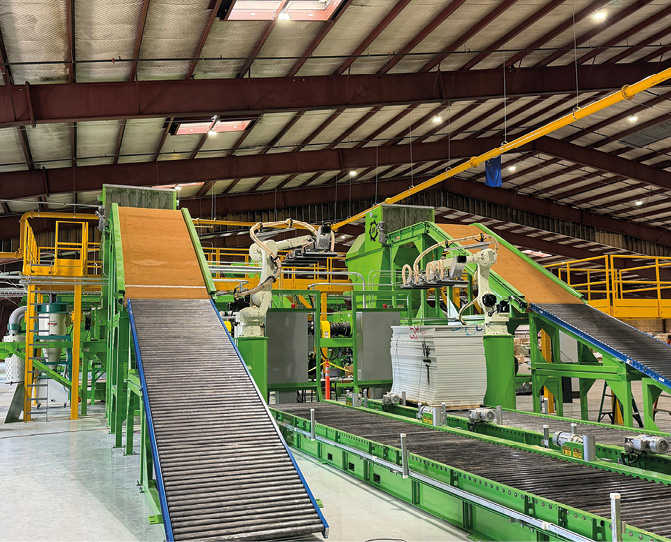
A number of companies in the United States are vying to leverage capital, experience, and new technology ahead of a wave of end-of-life solar panels expected in the coming years.
According to the International Energy Agency (IEA), the annual volume of end-of-life crystalline silicon modules in the US is expected to hit 87,000 metric tons (MT) by 2030 and skyrocket to 820,000 MT by 2050.
With that volume comes economic opportunity. In 2023, analysts at Rystad Energy estimated the global value of recycled solar materials would hit $2.7 billion in 2030, rising to $80 billion by 2050. Assuming a 15-year panel lifespan, Rystad’s research estimated end-of-life solar modules in North America would be worth $1.4 billion in 2037 – about 15% of the global total.
Material values
Most of the material in a solar module is glass, which typically accounts for between 70% and 76% of a module’s weight. The second-largest portion is the aluminum frame, accounting for between 8% and 13%. But the most valuable material inside most solar modules is silver.
Silver now represents an important strategic asset to the United States. Along with silicon, silver was added to the US Critical Minerals List in November 2025.
In solar manufacturing, paste formed with the precious metal is screen printed in thin lines onto the surface of a silicon solar cell to collect and transport electrical current. It accounts for around 60% of the cost of those cells, and 10% of the total cost of a solar module.
According to the IEA, solar silver consumption was around 10 mg/W in 2024, down from 16 mg/W in 2020. While this equates to only about 0.05% of a panel’s total weight, the concentration of silver in a solar module rivals that found in many silver ores currently being mined.
That number was even higher for modules produced further in the past, meaning the coming wave of end-of-life modules will be rich in their most valuable component. The trouble is, once the cells are sealed inside layers of encapsulant, the metal contents have proven very difficult to recover without a high-temperature smelting process.
It is common practice for PV recycling companies to separate the glass and frame on the outside of a module, while the laminated components on the inside are shredded and sent to other recyclers often overseas, or even to landfill.
“The industry as a whole up to now has been on a 1.0 system, if you will,” said Adam Saghei, CEO of We Recycle Solar (WRS), in an interview with pv magazine USA. “It’s about shredding. It is heavily dependent on a mechanical process.”
When that shredded material is exported, the valuable silver, silicon, copper, and other trace metals trapped in the encapsulant are exported, too.
In addition, the recovered glass often contains impurities that make it unsuitable for use in high-temperature, closed-loop remanufacturing, such as new solar glass, instead of being used in “down-cycled” applications such as road base, concrete aggregate, and sandblasting media. All of that is changing now.
Latest technology
A number of US companies have developed alternative technologies to capture a much greater proportion of valuable solar materials and sell them domestically.
In September, WRS announced that it planned to open what it called “the nation’s first end-to-end critical materials recovery facility for retired solar panels” on a 10-acre site in Dallas, Texas, by the third quarter of 2027. The company says its “recycling 2.0” process allows it to recover up to 96% of the silver, copper, silicon, aluminum, and glass from end-of-life solar panels.
“Our approach is a little bit different,” said Saghei. “It’s on a very small footprint with regenerative solvents.” He added that the process results in glass with less than 10 parts per million of impurities. “That is essentially pure enough for you to drink out of. It’s as pure as glass comes.”
Meanwhile, OnePlanet Solar has been operating its commercial demonstration plant in Florida since early 2024. The plant is capable of processing 480,000 end-of-life solar modules in a year, equal to around 19,000 tons of material. According to the company, 100% of the outputs of this facility have been sold and consumed within the United States.
In August 2026, OnePlanet unveiled its new “PRISM” process (short for “Photovoltaic Recycling through Integrated Systems and Mechanics”). The company says PRISM results in 99% pure glass before any size reduction step, for both single side and bifacial modules, and also yields a concentrated silicon product with 95% purity that contains 1% silver.
Recycling of end-of-life modules using the PRISM process is expected to begin in 2027, and OnePlanet’s next goal is to refine its own metallurgical-grade silicon (MGS) while capturing the silver as a secondary finished product.
Another US company building out its recycling capabilities is Comstock Metals, which is now in the beginning stages of operating a solar recycling facility in Silver Springs, Nevada. The facility was first commissioned and tested in August 2026, and the company is working to ramp the plant up to 25% of its rated output capacity of 100,000 tons per year.
Comstock is also practicing a new, proprietary process at the Silver Spring site, designed to completely decompose adhesives, encapsulant, and plastic materials before the remaining components of the panel are sorted and separated for additional processing. Judd Merrill, the company’s chief financial officer, explained that the company’s current strategy is to retain the metal-rich material for its own proprietary metals recovery process.
Comstock’s plans for that metal recovery process start with a pilot-scale metals recovery operation, also planned for Silver Springs. “We are developing proprietary extraction and recovery technologies specifically designed to process the concentrated material generated by our solar recycling system. That material contains multiple valuable metals and other recoverable materials, and our objective is to recover those materials into marketable products for domestic reuse without conventional smelting,” said Merrill.
Comstock’s goal is to have a pilot-scale metal recovery line “operating continuously and reliably” by the end of 2026.
Building relationships
A key step in the success of any business is the development of ongoing relationships with partners. For solar recyclers, those relationships are made with entities on both sides of the recycling process.
On the supply side, this means contracting with manufacturers, EPCs, and re-powering companies. Comstock, for example, has minted deals with RWE for decommissioning aged solar panels as well as agreeing to take manufacturing byproducts from solar manufacturer Illuminate USA.
Similarly, leading recycler Solarcycle has partnered with Silfab, Canadian Solar, and Qcells to recycle factory defects and has inked agreements with major developers including Sunrun, EDP Renewables, AES, Orsted, and Greenbacker. The company has also announced public offtake agreements for the outputs of its recycling process. It has signed agreements with Silfab and Illuminate USA for new solar glass made from recycled modules.
Solarcycle is currently in the process of building a 1.1 million square foot glass plant next to its existing recycling facility in Cedartown, Georgia. With glass production at the facility slated to begin in 2028, the company is targeting enough glass production to support up to 6 GW of domestic panel assembly annually.
Regulation and certification
As of 2025, the NC Clean Energy Technology Center tracked 23 states with mandatory statewide decommissioning policies. Despite the widespread nature of those policies, laws in just four states (California, Maine, New Jersey, and New York) effectively prohibit the disposal of solar panels in landfills and dumps.
Outside those states, and in the absence of federal regulation, entities seeking to responsibly offload those products usually engage recyclers based on their own corporate ESG goals.
Obtaining quality and traceability certifications has become a key way recyclers set themselves apart from their competitors. Recyclers often pursue certification under ISO standards 9001 (Quality Management Systems), 14001 (Environmental Management Systems), and 45001 (Occupational Health and Safety).
In addition to obtaining those certifications, many companies seek listing under the Solar Energy Industries Association (SEIA) National PV Recycling Program, which requires a facility audit and analysis of a company’s operations. SEIA currently lists 16 companies as partners under the program.
Recyclers seeking to go one step further obtain a certification from Sustainable Electronics Recycling International (SERI), which certifies PV recyclers under Appendix G of the third version of its Responsible Recycling (R2v3) standard. R2v3 requires annual surveillance audits by accredited certification bodies and complete chain of custody documentation for all materials. It also enforces safe handling procedures for panels, solar glass processing standards, and silicon wafer recovery protocols.
At the time of writing, SERI lists 30 facilities with active R2v3 certifications in North America, including the Comstock and OnePlanet facilities.
“Our view of certifications is pretty straightforward,” Connor Hogan, CFO of OnePlanet, told pv magazine USA. “If you can get a certification, you should just get a certification rather than say that you can attest to it.”
Other companies aren’t as keen on R2v3. “One issue with R2 certification is that it’s kind of open source, and when you spend years cultivating a relationship with a downstream partner, you don’t want to just give that up so everyone knows who you’re selling material to,” said Saghei, adding that “certifications are like a driver’s license – just because everyone has one doesn’t mean they’re a good driver.”
In the coming years, solar recyclers will find many ways to differentiate themselves based on the effectiveness and economics of their logistics and recovery processes, as well as the adaptability of those processes and how quickly they can scale operations.
The relationships recyclers build with manufacturers, developers, downstream offtakers, and policymakers will also be essential. They will face questions from those stakeholders about their certifications and material tracing practices and will likely be presented with new challenges as state governments take action to ensure solar module waste is recycled properly.
Source link