

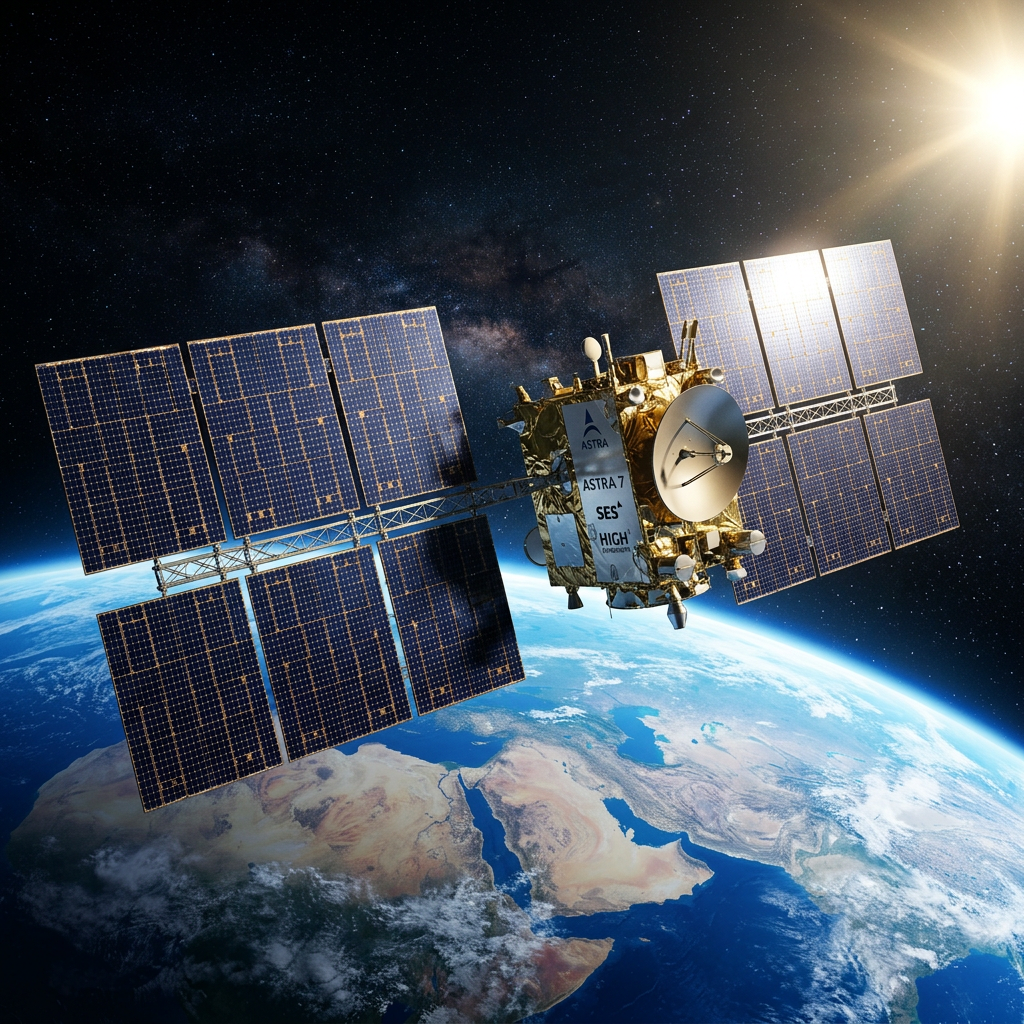
Space-based power generation has long depended on solar cells made from III-V compound semiconductors because of their high efficiency and reliability. However, these materials are expensive and have limited supply, creating challenges for the growing commercial satellite industry, especially for Low Earth Orbit (LEO) missions. To address this issue, US-based Source Energy has partnered with Germany’s Fraunhofer Institute for Solar Energy Systems (ISE) to develop a new generation of space-grade silicon solar arrays that promise lower costs while maintaining dependable performance.

The new solar arrays are based on silicon photovoltaic technology, which is widely used in terrestrial solar power systems. By adapting this proven technology for space applications, the companies aim to provide a more affordable alternative to conventional III-V semiconductor solar panels. The development is expected to support the increasing demand for cost-effective satellite power systems as the commercial space sector continues to expand.
A major feature of the project is its automated manufacturing process. M10 Solar Equipment GmbH developed a specialized industrial stringer for assembling shingle-matrix solar cells. After successful testing at Fraunhofer ISE’s Module-TEC facility in Freiburg, the production system was installed at Source Energy’s manufacturing facility in Colorado in June 2026. The automated production line reduces manufacturing costs to less than $5 per watt and significantly shortens delivery times. According to the company, complete solar arrays can now be supplied within six months of receiving an order, compared to the much longer production timelines associated with traditional III-V solar technologies.
The prototype solar modules have also demonstrated strong technical performance. Each module weighs only 64 grams and measures 321 mm by 209 mm, covering a total surface area of 629 square centimetres. The panels generate an average power output of 15.6 watts, while the best-performing prototypes have reached 16.1 watts. They achieve an active area efficiency of 18.8 percent under Air Mass Zero (AM0) conditions at 25 degrees Celsius, which represents the sunlight environment in space. In addition, the modules provide a specific power of 252 watts per kilogram, making them competitive with existing space-qualified silicon solar technologies.
The solar arrays use shingle-matrix interconnection technology, where silicon cells are cut into thin strips and arranged in an overlapping pattern similar to brickwork. These strips are connected using electrically conductive adhesive. This design improves the durability of the solar panels in space. If part of the array is damaged by a micrometeorite or space debris, electricity can flow around the damaged section, reducing the risk of complete power loss.
The technology also offers flexibility for satellite manufacturers. Engineers can configure the arrangement of cells to meet different voltage and current requirements. The manufacturing process is compatible with standard front-and-back contact silicon wafers, including Passivated Emitter and Rear Cell (PERC) and silicon heterojunction technologies, without requiring significant changes to production equipment. The low-temperature bonding process also makes the technology suitable for future integration with advanced perovskite-silicon tandem solar cells.
The solar modules have undergone environmental qualification testing to ensure they can withstand the harsh conditions of space, including repeated thermal cycling and extreme temperature variations. Source Energy reported that the modules meet space qualification standards and are expected to retain around 76 percent of their original power output after seven years of continuous operation in orbit, highlighting their potential as a reliable and cost-effective solution for future satellite missions.
Discover more from SolarQuarter
Subscribe to get the latest posts sent to your email.
Source link