

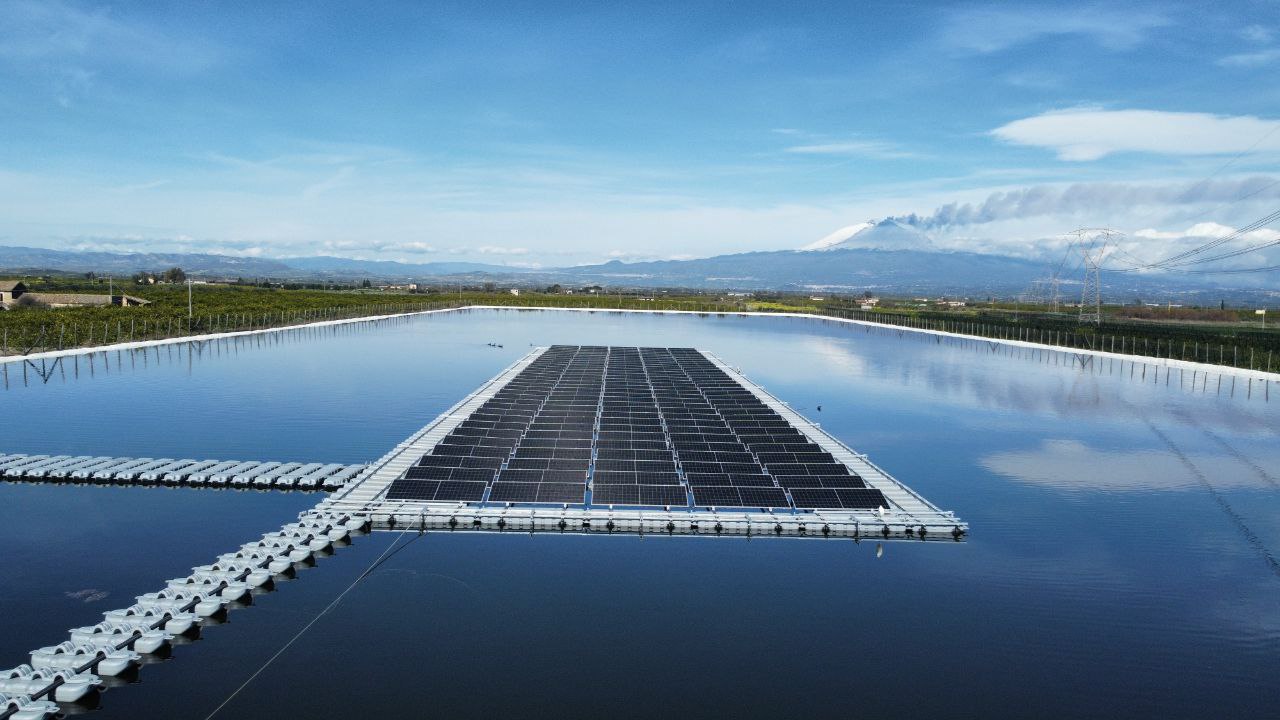
A computational fluid dynamics study of a proposed floating PV installation at the Occhito Dam reservoir in southern Italy has found that spacing module rows approximately 0.5 meters apart delivers the best cooling performance in a three-row configuration. The researchers found that the intermediate spacing outperformed both narrower and wider arrangements, highlighting the importance of airflow management in floating PV system design.
At a wind speed of 3.5 m/s, the optimal configuration achieved an average module temperature of 27.16 C, compared with 31.07 C for the most compact arrangement. Under weaker wind conditions of 1.5 m/s, the same configuration recorded an average module temperature of 37.02 C.
The study notes that the efficiency of crystalline silicon PV modules typically decreases by approximately 0.3% to 0.5% for every 1 C increase in cell temperature. The findings underscore the importance of airflow management in floating PV design and challenge the assumption that proximity to water alone ensures better cooling.
The researchers said row spacing should be considered not only in terms of installed capacity, shading, and floating platform requirements, but also as a key thermal design parameter.
The research, conducted by scientists from the University of Naples Parthenope and the University of Campania Luigi Vanvitelli, also identified a less intuitive aspect of floating PV cooling. Although the widest spacing allowed airflow to recover more fully between rows, it did not consistently produce the lowest module temperatures. The researchers attributed this to reduced airflow acceleration between rows.
The findings suggest that effective cooling requires a balance between aerodynamic wake recovery and airflow acceleration, with the optimal configuration depending on site-specific conditions.
Airflow acceleration and differences between module rows
Cooling performance depends on several interacting factors, including wind speed, array geometry, airflow pathways, and the formation of aerodynamic wakes behind individual module rows.
These wakes can restrict air movement around the modules, reducing convective heat transfer and increasing operating temperatures. While greater row spacing can allow airflow to recover before reaching the next module, wider gaps do not necessarily improve cooling. The researchers found that excessive spacing can weaken airflow acceleration between rows.
At a wind speed of 1.5 m/s, spacing equivalent to 0.5 times the module length delivered the best performance, with an average module temperature of 37.02 C. The widest configuration, with spacing equal to one module length, performed worst, reaching 37.74 C.
The differences became more pronounced at 3.5 m/s. The configuration with spacing equivalent to 0.5 times the module length recorded an average temperature of 27.16 C, compared with 29.26 C for spacing of 0.75 times the module length, 29.75 C for the widest arrangement, and 31.07 C for the most compact configuration.
The study also found that cooling performance varied between module rows. The middle row was particularly sensitive to changes in spacing.
At 3.5 m/s, the middle row reached a temperature of 23.30 C with spacing equivalent to 0.5 times the module length, compared with 29.66 C in the most compact configuration and 30.17 C in the widest arrangement. According to the researchers, this behavior reflects the middle row’s exposure to the competing effects of upstream wake formation and airflow recovery.
The simulations also showed that the relationship between row spacing and module temperature is nonlinear. An analysis of airflow velocities under different operating conditions helped explain these differences.
At the lower wind speed, airflow velocity between the first two rows remained below 0.5 m/s in the most compact configuration. Increasing the spacing to 0.5 times the module length raised local airflow velocity to approximately 0.9 m/s to 1.1 m/s.
At the higher wind speed, the difference was even more pronounced. The intermediate spacing produced airflow velocities between rows of approximately 2.5 m/s to 3.0 m/s, compared with 1.0 m/s to 1.5 m/s for the most compact arrangement.
Four configurations
The researchers developed a two-dimensional conjugate heat transfer model to simulate interactions between PV modules, the surrounding air, and the underlying water.
The proposed installation was modeled using three consecutive rows of modules, each tilted at 15 degrees and positioned 25 cm above the water surface. The modules were approximately 0.99 meters long.
Four row-spacing configurations were examined, corresponding to 0.25, 0.5, 0.75, and 1.0 times the module length. The simulations considered two incoming wind speeds, 1.5 m/s and 3.5 m/s, representing relatively weak and stronger convective cooling conditions.
Meteorological inputs were derived from hourly ERA5 reanalysis data for 2024 covering the Occhito reservoir, which lies on the border between the Italian regions of Apulia and Molise.
The model used an annual average air temperature of 15.37 C, a water temperature of 14.67 C, and a net shortwave radiation flux of 146.65 W/m2.
Further research needed
The findings are particularly relevant to inland reservoirs in Mediterranean climates, where high summer temperatures and variable wind conditions can affect PV module operating temperatures.
However, the researchers cautioned against treating the identified spacing as a universal design recommendation.
The analysis was limited to a two-dimensional model comprising three module rows and two wind speeds. It did not account for three-dimensional turbulence, changes in wind direction, shading effects, detailed floating support structures, or the full range of meteorological conditions experienced over a year.
The study, “Influence of row spacings on the thermal performance of floating photovoltaic arrays at the Occhito Dam reservoir, Italy: A numerical study,” published in Solar Energy, focused on thermal behavior rather than directly calculating electricity generation or annual energy yield.
The authors recommended extending the research through three-dimensional computational fluid dynamics simulations, additional wind speeds and directions, and integrated electrothermal modeling to determine how the observed temperature differences translate into actual electricity generation gains.
Source link