

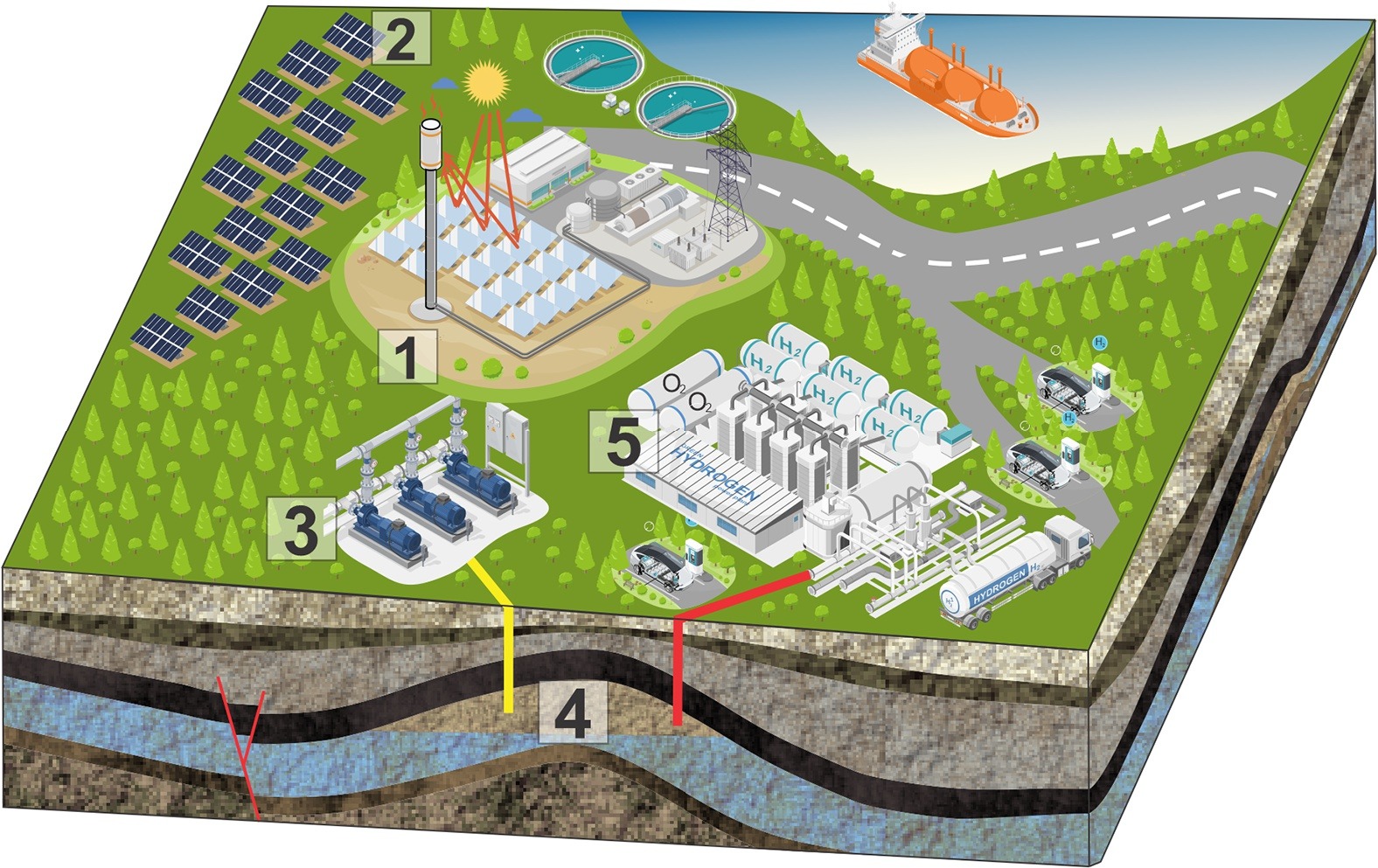
Australian scientists compared hydrogen fuel cells and hydrogen gas turbines as backup power sources during periods of low solar availability, finding that hydrogen turbines could offer lower capital expenditure and a levelized cost of hydrogen storage (LCOHS) of around AUD 0.90/kg ($0.62/kg) under modeled conditions of 10% porosity, 50 mD permeability, a 30-year project lifetime, and a 7% discount rate. “This paper demonstrates that the optimisation of integrated reservoir and surface systems could lower the LCOHS and enable the extensive implementation of solar-driven hydrogen production,” the researchers said in “Feasibility assessment of solar-driven underground hydrogen storage through integrated surface and subsurface modelling.” The paper, published in Applied Energy, assesses an integrated system encompassing hydrogen injection, geological storage, purification, and pipeline delivery. It highlights how reservoir characteristics affect hydrogen recovery and overall costs. Higher permeability improves injectivity and recovery rates but can increase purification and compression requirements, while lower porosity can improve gas displacement at the expense of higher injection pressures and equipment costs. The researchers said that interactions between reservoir properties and surface facility strategies are key to the performance of repurposed geological reservoirs for hydrogen storage, providing a basis for designing commercially viable, large-scale underground hydrogen storage (UHS) systems. Previous research has also examined alternative approaches to hydrogen storage in lakes and reservoirs.
Air Products reported significant charges related to business and asset restructuring, primarily associated with previously announced project exits. “During fiscal year 2026, we recorded pre-tax charges of approximately $3.2 billion ($2.4 billion attributable to Air Products after tax, or $10.95 per share). These charges primarily related to project exit actions announced on 30 June 2026, including the exit of a clean energy complex under construction in Louisiana, a green hydrogen production facility under construction in Casa Grande, Arizona, and certain other clean energy projects,” the Pennsylvania-based company said in its fiscal 2026 full-year results.
Everfuel has signed a €245 million grant agreement with the German government to support its planned Project Frigg green hydrogen facility in Denmark. The funding, awarded through the European Hydrogen Bank’s Auctions-as-a-Service scheme, provides production support of €0.98/kg of renewable hydrogen. The Danish hydrogen developer has also reserved capacity in the Danish and German hydrogen pipeline networks equivalent to 400 MW of electrolyzer capacity. The project is designed to scale up to 2 GW of electrolyzer capacity as the market develops. Previous research has highlighted Denmark’s potential role in European green hydrogen corridors.
Germany has awarded contracts for 11 new hydrogen-ready combined-cycle gas turbines (CCGTs), with a combined capacity of around 5.1 GW, under the Electricity Supply Security and Capacity Act (StromVKG). RWE secured contracts for 2.1 GW of capacity in the first long-term capacity auction. The Federal Network Agency (Bundesnetzagentur) is preparing a second auction, with the date scheduled to be announced on Nov. 10, 2026. The awards follow the European Commission’s approval of Germany’s capacity mechanism in September, which cleared the way for state support for new generation, storage, and demand-side flexibility, including hydrogen-ready gas-fired power plants.
Nippon Steel has produced more than 1,000 metric tons of direct reduced iron (DRI) using 100% hydrogen as the reducing agent at its pilot-scale facility in Japan. The company completed more than 300 hours of continuous operation at its Hasaki Research and Development Center, using lower-grade iron ore pellets instead of the high-grade material typically required for direct reduction. The 60-meter-high furnace has a production capacity of 1 metric ton per hour and began operating in March 2026.
Asahi Kasei and Power to Hydrogen (P2H2) have signed a memorandum of understanding (MoU) to evaluate the scale-up of manufacturing and commercialization of anion exchange membrane (AEM) water electrolysis systems. “Under the MOU, the companies will explore how to combine P2H2’s expertise in AEM electrolysis with Asahi Kasei’s broad capabilities developed across its existing electrolysis businesses within the next few years,” the Tokyo-based company said. P2H2 previously completed a 1,250-hour pilot with Repsol, demonstrating its hybrid AEM electrolysis technology under variable operating conditions. The company has also deployed a 500 kW AEM electrolyzer at the Port of Antwerp-Bruges
Source link