

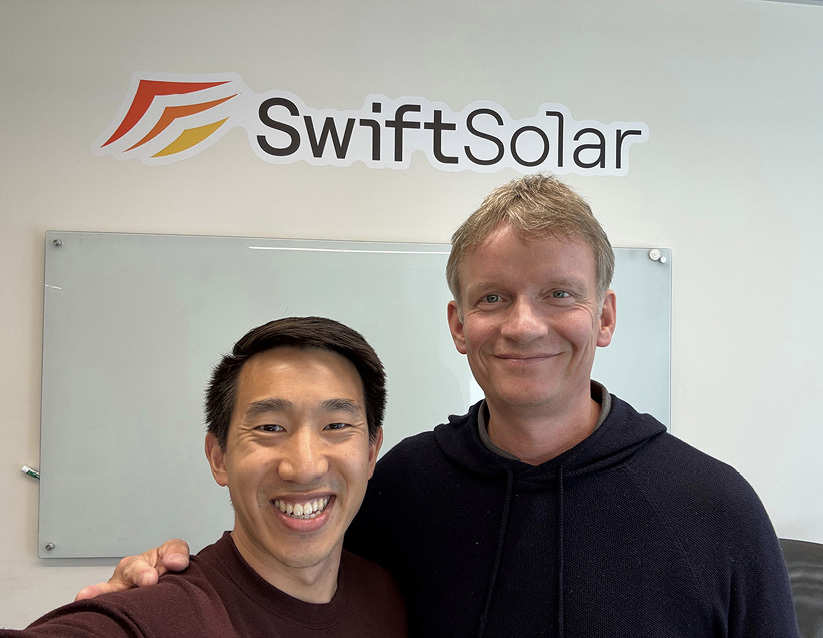
US tandem cell startup Swift Solar acquired an extensive set of intellectual property earlier this year related to heterojunction (HJT) solar cell production from now-defunct manufacturer Meyer Burger. It is also now working with some of the experts who were key to developing the technology.
pv magazine spoke with Swift Solar CEO Joel Jean and former Meyer Burger CEO Gunter Erfurt about the company’s plans to apply its newly acquired knowledge to manufacturing in the United States.
What are your plans following the acquisition of Meyer Burger’s cell technology IP?
Joel Jean: The rationale is all about getting to large-scale production in the US. There’s a big gap in the US cell capacity. That’s something Meyer Burger was attempting to fill, and that Swift Solar is well positioned to continue.
With these assets now, we have a combination of a proven heterojunction (HJT) technology that can help fill that gap in the near term and play a role in the next generation tandem technology that we can bring to market.
Our plan is to reach gigawatt scale here in the US with a heterojunction cell facility, and then build on tandems as they mature – that’s going to be a bit of a longer journey.
How far along are you in that process? Do you have a site for the factory?
We have a lot of planning happening right now. We haven’t selected a site yet, we’re looking across the US. Aside from that, a lot of it is leveraging the work that Gunter and his team over at Meyer Burger had done in terms of planning out and manufacturing the equipment for such a line -that’s what we acquired. So that’s it’s on its way, but there’s a lot of work to be done.
Do you plan to focus on supplying cells to module manufacturers in the US, or are you looking at producing modules as well?
It’s a good question, and we are well positioned to do both. We have module experts in-house and we have the capability to do it. Given the gap in US cell capacity we’re also very open and considering selling cells directly to customers, including module makers and folks who want to be more vertically integrated upstream to be able to make their own modules.
How about upstream supply in the US – primarily wafers, but also things like silver paste and other cell components? Do you see that developing or will you have to rely on other regions initially?
Our North Star is to build out a fully domestic and Western supply chain. The reality today is that there’s very few upstream suppliers in the US and even in the West in some cases. It’s going to take time, but we’re hoping to be a catalyst for a move in that direction.
Do you expect to be focused on the US market for the foreseeable future?
It’s only where we want to start. We see that as the strategic market globally right now, and we’re a US-based company. We want to reindustrialize and bring the supply chain and manufacturing capacity back to the US. But that said, part of the capability here is being well placed to help serve the European market. Longer term, we would love to be more of a global entity and support multiple markets.
Gunter, what does all of this mean for you? What role are you taking on at Swift Solar?
Gunter Erfurt: I joined Swift last year as a member of the advisory board, and we have had a good exchange on various topics since then. When this opportunity came up, it was an easy decision for me to return to a more active role in the PV manufacturing space.
Even though in the end it wasn’t a successful journey with Meyer Burger, I don’t see this as a revival. It’s more an effort, and still a collaboration, that has very good prospects because of Swift’s expertise in tandem cells. With this, the entire project is more future proof. And in combination with conditions in the US market, we have very strong tailwinds.
A big part of my role is making sure that we can get operational in Germany again after Meyer Burger’s insolvency. That comes with various challenges, simple things where we have to make sure we have the functions we need. We have established a German entity – Swift Solar GmbH, and I’m working on getting that fully up and running. We are stationed in the exact same building where Meyer Burger Germany was based, in Hohenstein-Ernstthal.
What I really enjoy about this newly formed team across the US and Germany is that we cover the entire technology readiness and maturity process across all those disciplines. We have factory planning teams, equipment experts, those with experience ramping up a solar cell factory. It’s a very strong combination and I’m happy to be working in this small but powerful team.
Even with the business set up in Germany, do you see your focus remaining on the US as far as PV manufacturing is concerned?
In Europe, there’s still a lot of talk but no action. Nothing is really happening on the industry policy side or to insulate against subsidized prices from China that are way below their manufacturing cost. With very few exceptions, there is no market for European-made PV modules.
If that changes, we can consider many approaches. But currently the US is the best place to be as a Western PV manufacturer. The US has a level playing field, a module in the US costs what it should do everywhere, allowing manufacturers to generate a margin and charge a decent price that values all the effort that goes in. That’s how it should be in Europe, but it isn’t.
PV manufacturers in the US seem to have some concerns around intellectual property, particularly with tunnel oxide passivated contact (TOPCon) technology. Did that play a role in your decision to go with heterojunction, and to acquire Meyer Burger’s set of IP there?
JJ: For any company, the freedom to operate is very important. And we are seeing all kinds of IP cases across different technologies. What’s important for us is that Swift Solar is well positioned with one of the strongest IP portfolios.
We feel confident in our ability to operate freely with HJT, and that certainly isn’t the case for some technologies. Now you have the Section 337 case investigating the TOPCon supply chain, and others that create uncertainty and risk for manufacturers and their customers. From our perspective though, we have a clear path forward, free from issue with IP or foreign entity of concern rules.
At Swift Solar you had initially been investigating all-perovskite tandems. Is that continuing, or do you now plan to focus fully on perovskite-silicon?
We founded the company on this basis that perovskites had a lot of promise, and tandem cells specifically could boost the efficiency in a way that no previous solar technology in several decades has been able to do.
For us the all-perovskite tandem is still the long-term focus, and we expect to get there, but that’s a long journey. You have to develop twice as many solar cells with new materials. Our focus over the last five years has shifted towards perovskite-silicon tandems as the first step into the market.
It’s also the natural next step for the industry, allowing us to leverage the huge industrial base silicon PV has built up, and upgrade rather than replace it, which has always been a pitfall of thin film technologies trying to come to market. We’re seeing evidence that the whole industry is shifting in that direction, and we aim to be at the forefront of that shift. Ultimately, having a mature, bankable perovskite-silicon tandem product is going to set the foundation for the next generation, whether that’s a triple junction or an all perovskite tandem.
How close is a bankable, mature tandem product?
I don’t want to make it sound like it’s uncertain or forever away. We’ve been developing perovskite tandem technology for over a decade now, our team set the first efficiency record in this technology, did a lot of the early work and holds IP that’s critical in this space.
That development within Swift Solar has always focused on making it commercially viable, stable, and scalable. We feel it’s ready, it’s heavily de-risked. That doesn’t mean it’s ready for a 30-year lifetime at gigawatt scale, that may be a step too far right now. But we see it as ready to take that step into commercial volumes, tens to hundreds of megawatts. And we’re doing that in parallel with this HJT scale up. Once the field data is in, the certifications are done, then we feel good about scaling that up to match the capacity of the HJT side to make gigawatts of tandems.
How do you see market reception or perception of perovskite technology right now? Is there still a lot of skepticism around the stability and performance?
Everyone now is looking at this as the inevitable next step. The timeline is still uncertain, there are different views on when it will be bankable. But that will be different for every company. The important part for us is that we chart a steady path. Our goal has always been to bring this technology to market, we don’t say we’re going to have a gigawatt next year.
You’ve said you’ve already completed more than 3,000 hours of high-temperature testing. To demonstrate bankability, what do you see the market asking for in terms of testing or evidence?
Ultimately, the proof is in the field testing, you need to prove years of potential operation in the field, but you’re not going to wait 25 years. No one has for any previous solar technology. The way you get comfortable is a combination of accelerated testing in the lab,
and field data over a couple of years that shows the right trajectory. That’s what we’ve been doing, putting the cells and modules in very aggressive conditions, coupled with outdoor testing and real field conditions.
That combination of real-world outdoor data plus lab tests targeting specific mechanisms that we know perhaps it’s going to struggle with gives us confidence in the path forward. And that’s true of most sophisticated buyers. They are also tracking that, they’re asking for that data, and they’re gaining confidence over time.
Looking again at the more immediate plan for HJT silicon cell production, do you have a timeline there?
JJ: As soon as possible! Is all I can say right now.
GE: Another strength of this new team is that we have exactly the people on board who have done it – and I mean exactly those people who ramped the lines in Germany, who ramped the module line in Arizona, that’s now owned by Waaree.
It takes a lot of time until all process steps are fully aligned and optimized but I strongly believe that the experience of the team can help us tremendously here to execute on an optimized and short ramp up phase.
The post The swiftest route to scale appeared first on pv magazine Global.
Source link