

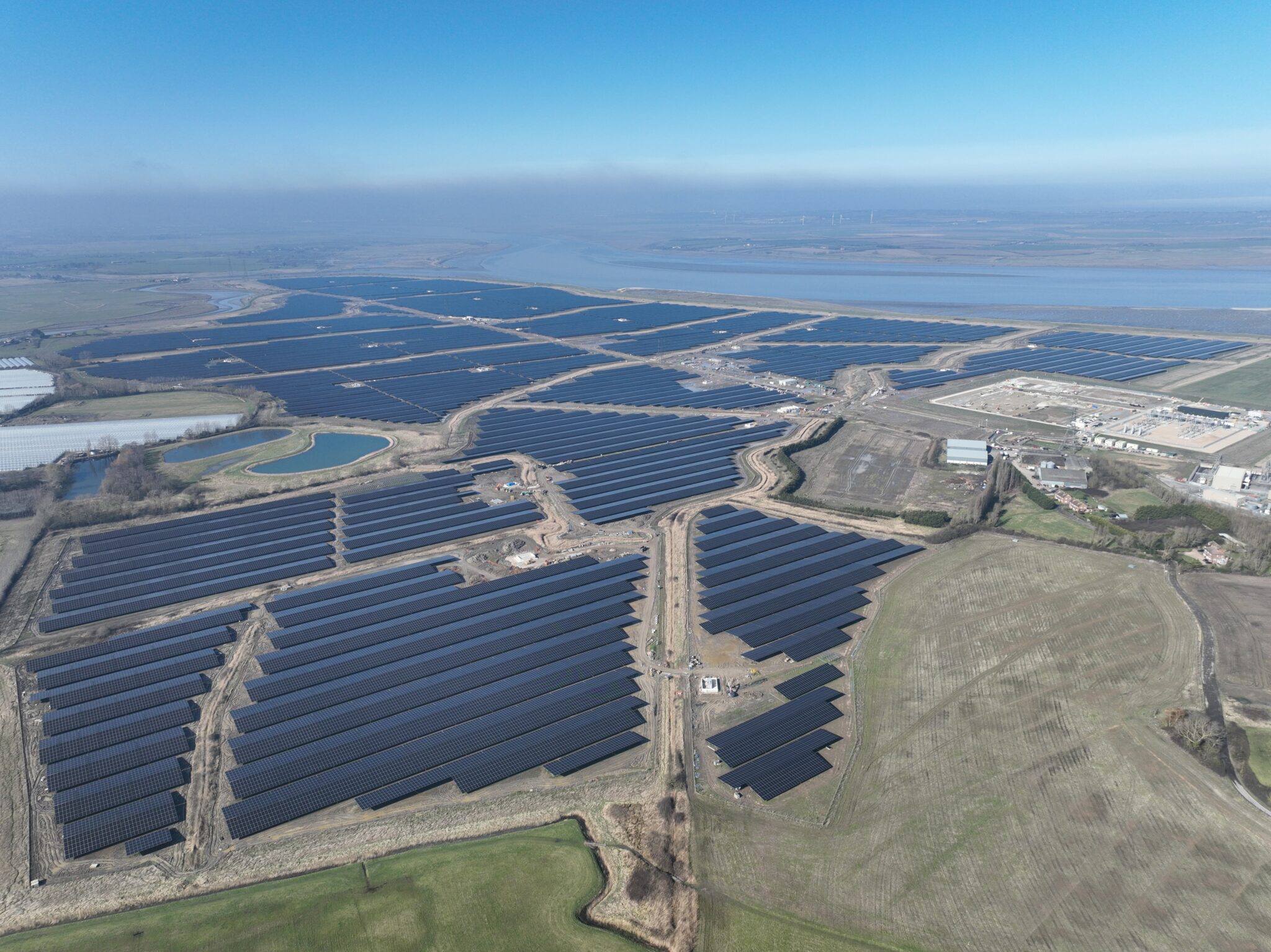
Four utility-scale projects have secured planning permission through the UK government’s pipeline for large infrastructure projects in October, including a co-located plant expected to have 1.12 GW DC installed solar capacity.
Great North Road Solar and Biodiversity Park and Frodsham Solar were both issued development consent orders (DCO) on Oct. 27, while Steeple Renewables Project and Green Hill Solar Farm were granted DCOs on Oct.9 and Oct. 8 respectively.
Developed by Elements Green, Great North Road Solar will be one of the largest in the United Kingdom when commissioned at its site northwest of Newark on Trent, England. The 1.12 GW project has secured a grid connection for import and export of 800 MW and will be built with a co-located 440 MW/880 MWh battery energy storage system.
Frodsham Solar is being developed by Cubico and project documents list the capacity as “around 150 MW”. The project near Chester, England, has a connection agreement with SP Energy Networks to supply up to 100 MW to the existing Frodsham substation.
Steeple Renewables Project in Nottinghamshire is being developed as a 450 MW solar generation project with approximately 150 MW of BESS in power output terms. The project is being developed by RES and is expected to use grid capacity made available from the decommissioning of the adjacent West Burton power station.
Green Hill Solar Farm is being developed by Island Green Power at a site north of Northampton. The project is expected to have a capacity of “up to 500 MW” and will also have a BESS installation.
All four projects were approved through the UK government’s Nationally Significant Infrastructure Project (NSIP) process, continuing a 100% success rate for solar in the NSIP pipeline. Run by the UK Planning Inspectorate, the NSIP process is used to approve or reject large-scale projects across industries – including solar projects in England with capacity greater than 100 MW. The first UK solar project approved through the NSIP process, the 376 MW Cleve Hill Solar Park, was approved in 2020 and entered commercial operations in July 2025.
Source link