

July 17, 2026
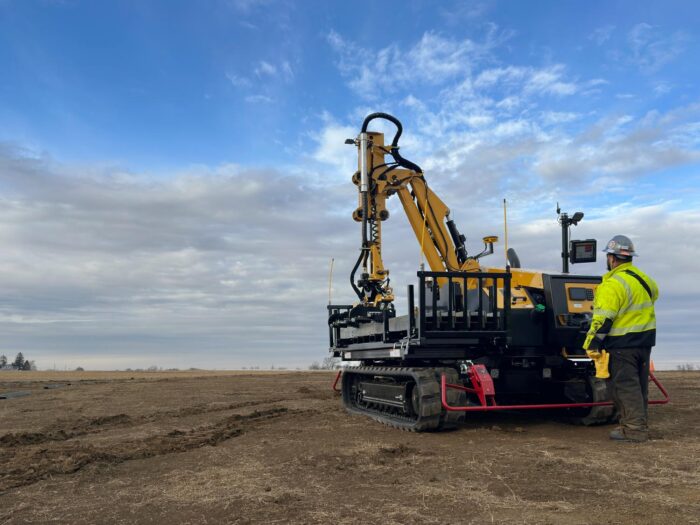
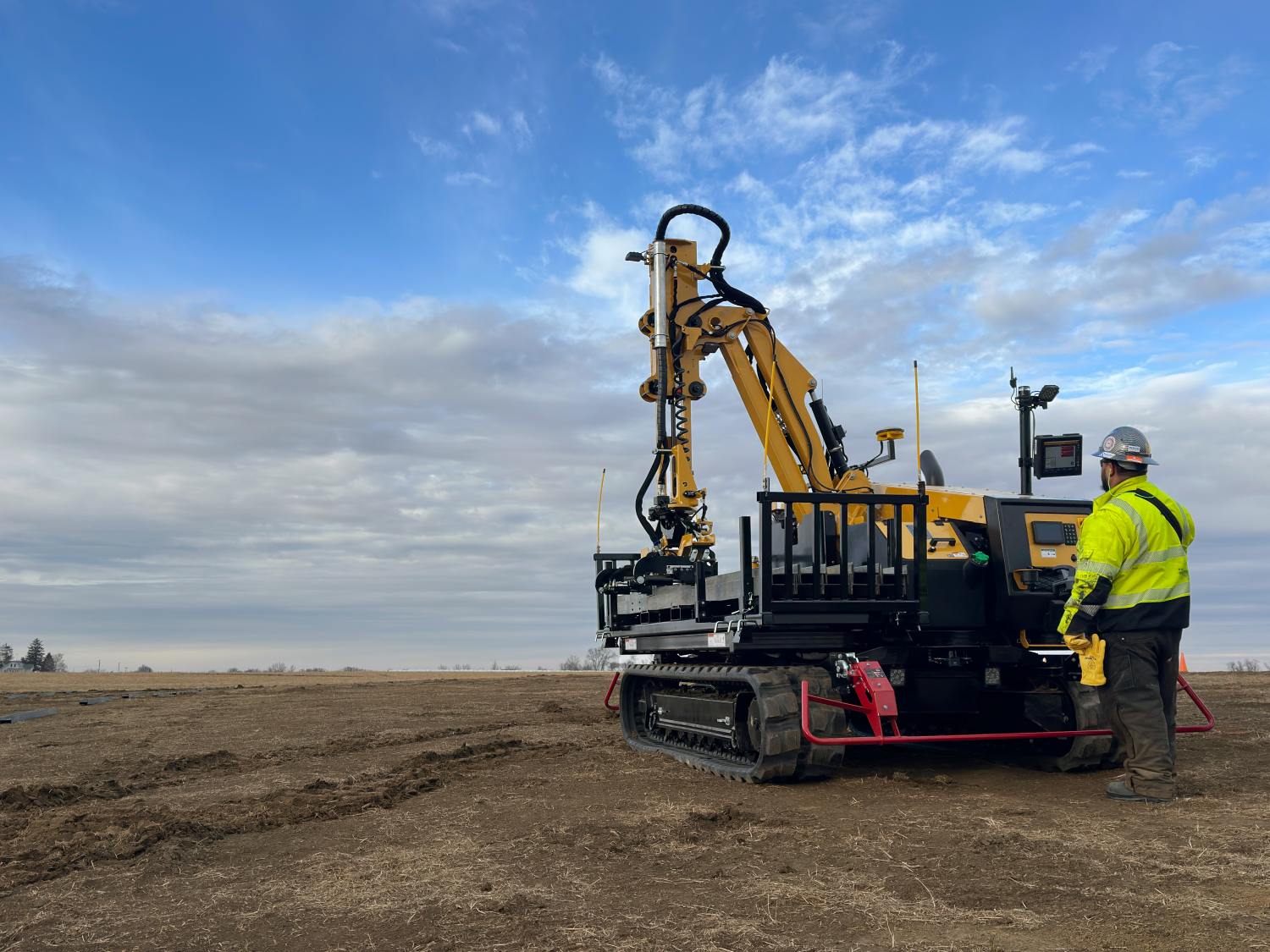
Vermeer has unveiled a new material transporter aimed at improving efficiency and safety on ground-mount solar projects. The new MT500 automates the pile layout process to offer accurate and repeatable placing of 10- to 25-ft long W-beam piles on ground-mount, utility-scale solar jobsites with minimal labor.
Operated by one person with the push of a button, the MT500 eliminates manual pile lifting, helping to eliminate human error in the pile driving process on larger scale solar projects.
“Labor is at the forefront of everybody’s mind, from finding labor, training labor, and then retaining it, especially with solar crews, as travel all over the country where the jobs are,” says Vermeer product manager Ed Savage, adding that certain aspects of installing large-scale solar can get “monotonous for the crews,” negatively impacting a solar contracting company’s ability to retain a quality workforce. “That’s something we’re always talking with customers about, is from the labor perspective, how do we help you with that?”
One aspect of the solar installation process that Vermeer looked at was the laying out of piles ahead of a pile driving machine — also referred to the shakeout process — which Savage described as one of the “big labor draws” for installers. There’s also a heavy safety concern around moving and placing these heavy piles, which can be up to 25 feet long and weight up to 400 pounds.
“They said they get a lot of hand injuries, finger injuries, foot injuries from the piles being dropped,” Savage says about the customers he spoke to. “Currently, either using skid steers or telehandlers with forks, you have one guy running the machine, and then you have one or two people dragging or pulling the piles off, trying to get them in the right positions so that when the pile driver crew comes along, they don’t have to drag those piles very far to get them strapped to pull up under the hammer of the pile driver. That doesn’t always happen, as far as good accuracy when it’s humans involved trying to just drop those piles off.”
The MT500 automates that process, with the aim of alleviating workforce constraints and improving efficiency, accuracy, and safety on the jobsite. Compatible with third-party GPS systems, the MT500 uses point-to-point and row-to-row automation to move accurately across the solar field.
“This, to the best of our knowledge, is the first one that’s going to be commercially available, as far as a machine that mechanizes and automates the process of laying out or shaking out piles on the jobsite,” Savage says. “One of our goals was because of that labor aspect, we know there’s pretty high turnover rate on these crews, is to make this thing easy to learn. How do we make it easy to train on? We really challenged the design team early on to make it one button to push on the remote to go through a complete cycle, from grabbing onto that pile that’s on the MT500, dropping it in the correct waypoint that’s on the digital map, and then moving the machine to the next waypoint and getting ready to start that cycle all over again.”
The machine handles piles 10-25 feet long with a payload of 5,000 pounds, allowing it to carry a full bundle of piles, which Savages says typically weigh 3,500 pounds. The added capacity offers a safety measure in the case of heavier bundles.
Hands free approach
The MT500 operator stands aside the machine during the shakeout process.
“It’s a hands-off approach, as far as hands off the pile,” Savage says. “You have one operator there running that button on the remote. You still have a skid loader or telehandler loading a new bundle on when they run out, but it’s a very hands-off approach, as far as touching the heavy piles. That’s what customers asked for.”
Each bundle contains 23-25 piles, depending on the length and profile being used for the project. A crew may have to refill the MT500 once or twice per row, depending on the scope of the installation. Savage says the goal was to average 600-800 piles placed during a 9-10 hour shift.
“That’s what a good average crew can do manually now with two to three people,” Savage says. “That’s something we’re very upfront about with customers. This might not out-produce your superstar crew out there, but it’s consistent all day long. It’s not going to be tired after lunch or wanting to take a nap. It’s not going to be worn out by the end of the shift. It’s a very consistent process, and they like that, because then it’s easier for them to forecast and budget for their next jobs.”
Pairing machines for accuracy
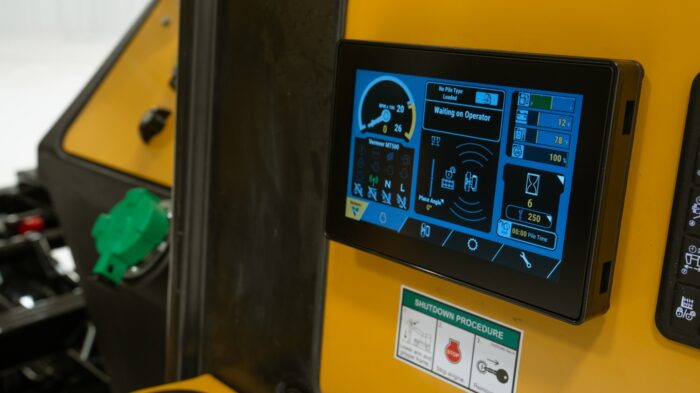
The MT500 pairs with Vermeer’s pile driver machines, such as the PD25R released in September 2024. Both machines work from the same digital maps to ensure accuracy. In addition, the basic layout of the machines is also similar to ensure ease of use for operators.
“We took a holistic approach to this, so everything from the remote control, it’s in the same case remote that the PD25 will be in,” Savage says. “There might be a couple different switches because of the different functionality, but it’s going to be very easy for somebody to go from a PD25R to an MT500 or vice-versa.”
Both machines share similar traits.
“if you set these two machines side by side, a PD25 and MT500, you’ll notice a lot of commonality,” Savage says. “The engine pod is the same, so same engine, same hydraulic system, so your hydraulic filters, your air filters, your service points are the same on all both machines. The undercarriage is the same, so your tracks are the same. From just the customers we’ve showed it to, they loved that. It just eases the service and the training for their mechanics.”
Safety on board
The MT500 has a number of safety features.
“One of the first things is an amber beacon,” Savage says. “As soon as you go into automation mode, an amber beacon is flashing on the machine, so anybody in the general vicinity of the machine knows at any time that arm could be moving automatically, or it could be tracking moving the machine automatically. That amber beacon warning everybody it’s in auto mode.”
The machine also has two methods of detecting obstructions on the jobsite.
“The other thing we do from object detection standpoint is we have mechanical bump bars on each end of the machine,” Savage says. “If they hit something, they pivot down and it shuts the machine down, stops movement. The other thing we have for object detection is Lidar on each end, so it’s sensing a certain distance out from each end of the machine, and as something gets closer, it’ll start slowing down the speed of the machine, and if it keeps getting closer, it’ll stop, so we have redundant safety measures there for object detection. “
Another features is in the hands of the operator.
“The other thing we have, which is pretty common on all of our equipment, is a red emergency stop button on the remote control,” Savage says. “If the operator sees something he doesn’t like, he can hit the red button, and it stops movement.”
Jobsite flexibility
Rubber tracks keep ground pressure at 6.4 psi (44 kPa) reducing ground disturbance and allowing the machine to work in wet conditions. With 12 in (30 cm) of ground clearance, the MT500 handles uneven terrain across a range of jobsite conditions. A 74-hp (55 kW) Tier 4 Final/Stage V Rehlko engine powers the machine without requiring DEF fluid. The machine has a 35-gal (132 L) fuel capacity.
No major disassembly is required to move between sites. Stow the pile rack and arm and the MT500 is ready to go, measuring 88 in (224 cm) wide and 187 in (475 cm) long in transport mode.
The MT500 integrates with the VermeerOne platform, delivering real-time machine data to help operators and fleet managers proactively manage maintenance and performance. The machine is backed by the Vermeer dealer network, with localized service and support available wherever jobs take contractors.
Tags: commercial and industrial, equipment, ground mount, pile driving, utility-scale, Vermeer
Source link