

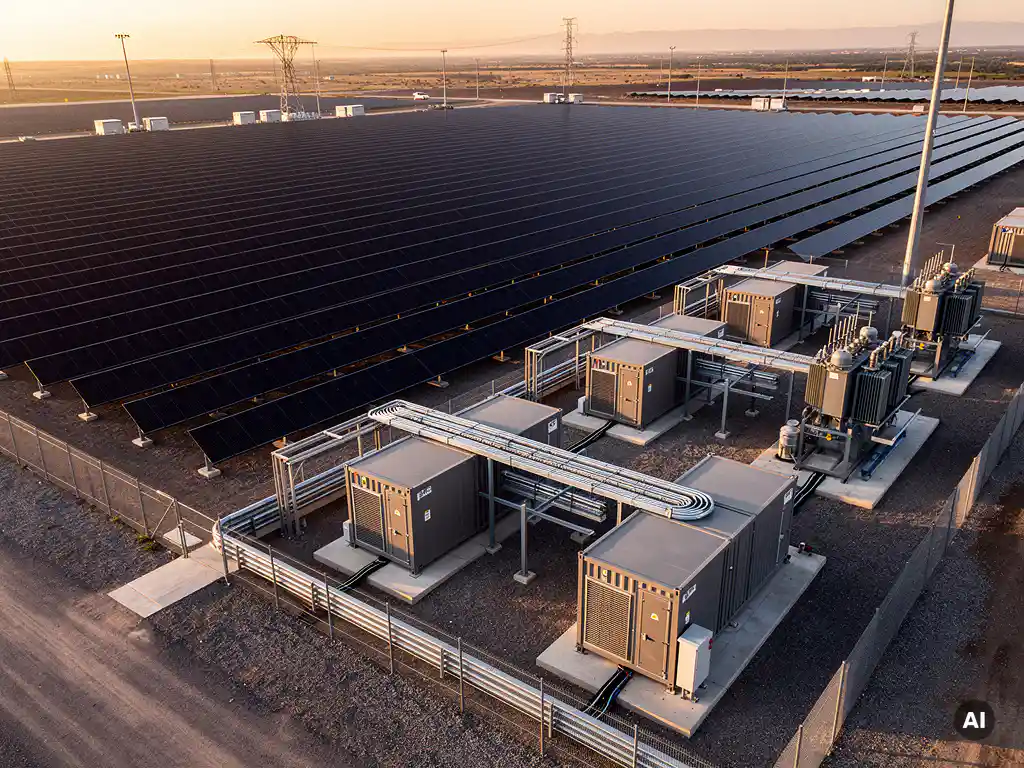
A hybrid BESS (Battery Energy Storage System) is a storage solution that combines battery storage with one or more generation sources, most commonly solar PV, and connects them through a shared inverter or integrated power conversion system. Rather than treating generation and storage as separate systems, a hybrid BESS manages both within a single, coordinated architecture. This article unpacks how hybrid BESS works alongside solar, how it differs from a standard BESS, what it’s made of, when it makes sense to use one, and where its limitations lie.
How does a hybrid BESS work with a solar system?
A hybrid BESS works by coupling battery storage directly with a solar PV array through a shared hybrid inverter, allowing the system to simultaneously manage energy generation, storage, and export or consumption in real time. The inverter acts as the central controller, deciding at any given moment whether solar energy should charge the battery, power on-site loads, or feed into the grid.
In practical terms, the system follows a priority logic that the operator or software defines. During peak solar generation hours, excess energy that exceeds on-site demand flows into the battery instead of being curtailed or exported at low rates. When solar output drops, such as during cloud cover or after sunset, the battery discharges to cover the load gap. This continuous balancing act happens automatically, without manual intervention.
What makes the hybrid configuration distinct from simply pairing a solar system with a separate BESS is the level of integration. Because both systems share the same inverter and control logic, response times are faster, conversion losses are reduced, and the overall system behaves as a single intelligent unit rather than two systems trying to communicate with each other. For utility-scale and commercial projects, this tighter integration also simplifies grid interconnection, since there is one point of common coupling to manage rather than two.
What’s the difference between a hybrid BESS and a standard BESS?
The key difference between a hybrid BESS and a standard BESS is integration. A standard BESS is a standalone storage system that charges and discharges independently of any specific generation source, while a hybrid BESS is architecturally coupled with one or more generation assets, typically solar PV, sharing inverter hardware and a unified control system.
Standard BESS
A standard BESS connects to the AC grid and can receive energy from any source on that grid, whether that’s solar, wind, or conventional generation. It operates independently, with its own inverter and control system. This makes it flexible in terms of where it draws energy from, but it also means it introduces additional conversion steps when paired with a DC solar array, which adds cost and reduces round-trip efficiency.
Hybrid BESS
A hybrid BESS integrates the battery and the solar array on the DC side, before the inverter. This means solar energy can charge the battery directly without first being converted to AC and then back to DC, a process that wastes energy at each conversion stage. The result is a more efficient energy path, a simpler physical installation, and a system that can be optimized holistically rather than managed as two separate assets.
For solar project developers and EPC engineers, the practical implication is that a hybrid BESS typically requires less equipment, fewer protection devices, and a smaller footprint than a retrofitted standalone BESS added to an existing solar plant. However, it also means the solar and storage components are more tightly bound, which has implications for future upgrades or replacements.
What are the main components of a hybrid BESS?
The main components of a hybrid BESS are the battery modules, the hybrid inverter (also called a power conversion system or PCS), a battery management system (BMS), an energy management system (EMS), and the balance-of-system hardware, including protection, metering, and communication equipment.
- Battery modules: The electrochemical cells that store energy, most commonly lithium iron phosphate (LFP) chemistry in modern utility-scale and commercial applications due to its thermal stability and cycle life.
- Hybrid inverter or PCS: The core of the hybrid architecture. This device manages DC-to-AC conversion for both the solar array and the battery, and controls the flow of energy between generation, storage, and the grid or load.
- Battery Management System (BMS): Monitors cell-level voltage, temperature, and state of charge, protecting the battery from conditions that could degrade performance or create safety risks.
- Energy Management System (EMS): The higher-level intelligence layer that determines dispatch strategy, optimizing when to charge, discharge, or export based on tariff structures, grid signals, or contractual obligations.
- Balance of system: Includes DC combiners, protection switchgear, metering equipment, communication interfaces, and the physical enclosures or containers that house the system.
In larger utility-scale hybrid BESS installations, these components are often delivered as pre-integrated, containerized units, which simplifies site installation and commissioning. For commercial rooftop projects, the hybrid inverter and battery may be more compact, wall-mounted units designed for indoor or outdoor installation.
When does a hybrid BESS make sense for a solar project?
A hybrid BESS makes the most sense for a solar project when the goal is to maximize self-consumption, meet grid compliance requirements around curtailment, or capture time-of-use arbitrage value, and when storage is being planned from the outset rather than retrofitted later. It is particularly well-suited to commercial and industrial projects and utility-scale plants where energy dispatch control adds measurable financial value.
Several project conditions point toward a hybrid BESS as the right choice:
- High curtailment risk: In grid-constrained areas where export limits apply, a hybrid BESS allows excess solar generation to be stored and dispatched later rather than wasted.
- Time-of-use tariffs: When electricity prices vary significantly across the day, storing cheap solar energy and discharging during peak price periods improves project economics.
- Capacity firming: Utility-scale projects that need to deliver a predictable output profile to the grid benefit from the dispatchability a hybrid BESS provides.
- Greenfield projects: When storage is included in the initial design, a hybrid architecture avoids the cost and complexity of retrofitting a standalone BESS to an existing plant.
- Behind-the-meter commercial projects: Facilities with high peak demand charges can use a hybrid BESS to shave demand peaks, reducing electricity bills significantly.
For engineers designing these systems, accurate modeling of the solar array, battery sizing, and dispatch logic is essential before committing to a hybrid architecture. Tools like Virto Solar’s design platform help engineering teams work through these parameters efficiently, reducing the time spent on iterative calculations during the design phase.
What are the limitations of a hybrid BESS?
The main limitations of a hybrid BESS are the tighter coupling between solar and storage components, which can complicate future upgrades, combined with higher upfront complexity in design and procurement compared to a standalone BESS added to an existing system. It also introduces the risk of a single point of failure if the shared inverter goes offline.
Understanding these limitations helps project teams make informed decisions rather than defaulting to a hybrid architecture simply because it is the more modern option.
Upgrade and scalability constraints
Because the solar array and battery share a common inverter, expanding either the generation or storage capacity independently can be technically constrained. Adding more battery capacity may require upgrading the inverter, and vice versa. This is less of an issue in greenfield projects where sizing is done holistically, but it becomes a real consideration for projects that anticipate phased expansion over time.
Single inverter dependency
In a hybrid BESS, if the shared inverter fails or requires maintenance, both the solar generation and the storage dispatch capability are affected simultaneously. A standalone BESS with its own inverter, by contrast, can continue operating independently of the solar system during a fault. For projects where uptime guarantees are critical, this risk needs to be addressed through redundancy planning or service agreements.
There are also procurement and engineering complexity considerations. Hybrid BESS systems require closer coordination between the solar PV design and the storage specification, since the two systems must be sized and configured to work together. For engineering teams managing multiple concurrent projects, this added coordination effort is a real cost. Streamlining the design workflow, from string sizing to single-line diagram generation, can significantly reduce that burden. If you want to explore how automated design tools can support this kind of integrated engineering work, get in touch with our team to discuss your project requirements.
Frequently Asked Questions
Can a hybrid BESS operate during a grid outage (islanding mode)?
Many hybrid BESS systems support islanding or off-grid operation, allowing them to continue powering on-site loads during a grid outage using stored energy and live solar generation. However, this capability depends on the specific inverter and system configuration — not all hybrid inverters are designed for seamless islanding, so it must be explicitly specified during the design phase. If backup power continuity is a project requirement, confirm that the hybrid inverter supports anti-islanding override and automatic transfer switching before finalizing your equipment selection.
How do I size the battery correctly for a hybrid BESS paired with solar?
Battery sizing for a hybrid BESS depends on three key factors: the solar array’s generation profile, the site’s load curve, and the intended use case (self-consumption, peak shaving, capacity firming, etc.). A common starting point is to size the battery to cover 2–4 hours of average load or to absorb the expected daily curtailed energy, but this varies significantly by project. Using a dedicated design tool that models solar yield, load demand, and dispatch logic together will give you a much more accurate sizing result than rule-of-thumb estimates.
What happens to the hybrid BESS at night or during extended periods of low solar irradiance?
During nighttime or prolonged low-irradiance periods, the battery discharges to cover on-site loads or fulfill grid dispatch obligations based on the EMS strategy. If the battery reaches its minimum state of charge, the system can fall back to drawing power from the grid, depending on how the control logic is configured. For projects in regions with seasonal irradiance variability, this scenario should be explicitly modeled during design to ensure the battery is sized appropriately and the dispatch strategy accounts for multi-day low-generation periods.
Is a hybrid BESS suitable for retrofitting onto an existing solar plant, or is it only for new builds?
Retrofitting a hybrid BESS onto an existing solar plant is technically possible but comes with significant challenges, since the existing solar inverters typically need to be replaced or supplemented with a compatible hybrid inverter. This can be cost-prohibitive and may require re-engineering the DC wiring and protection systems. In most cases, a standalone AC-coupled BESS is a more practical retrofit solution, while a hybrid architecture is best reserved for greenfield projects where both systems are designed and procured together from the start.
What battery chemistry is most commonly used in hybrid BESS systems, and does it matter?
Lithium iron phosphate (LFP) is the dominant chemistry in modern hybrid BESS deployments, valued for its thermal stability, long cycle life (typically 4,000–6,000 cycles), and relatively lower fire risk compared to other lithium-ion chemistries. The choice of chemistry does matter because it directly affects the system’s round-trip efficiency, degradation rate, and total cost of ownership over the project lifetime. For most commercial and utility-scale solar-plus-storage projects, LFP offers the best balance of performance, safety, and economics, though NMC chemistry may still appear in applications where energy density is a priority.
What are the most common design mistakes engineers make when specifying a hybrid BESS?
The most frequent mistakes include undersizing the battery relative to the solar array’s peak generation, failing to account for inverter clipping losses when the combined DC input exceeds the inverter’s rated AC output, and neglecting to model the dispatch strategy against real tariff structures. Another common oversight is not planning for future capacity expansion at the design stage, which can result in costly inverter upgrades later. Running detailed simulations that integrate solar yield data, load profiles, and grid tariff schedules before finalizing the design is the most effective way to avoid these pitfalls.
How does the EMS in a hybrid BESS interact with grid operator signals or dynamic tariffs?
A well-configured EMS can receive external signals from grid operators — such as frequency response requests, curtailment commands, or dynamic pricing data — and adjust the system’s charge/discharge behavior in real time to comply or optimize accordingly. This capability, often referred to as grid-responsive or smart dispatch operation, is increasingly required for utility-scale projects participating in ancillary services markets. The sophistication of this integration varies by EMS vendor, so project teams should verify communication protocol compatibility (e.g., Modbus, IEC 61850, or SCADA interfaces) with the grid operator’s requirements early in the procurement process.
Related Articles
This content was generated with the help of AI — it may contain mistakes
Source link