

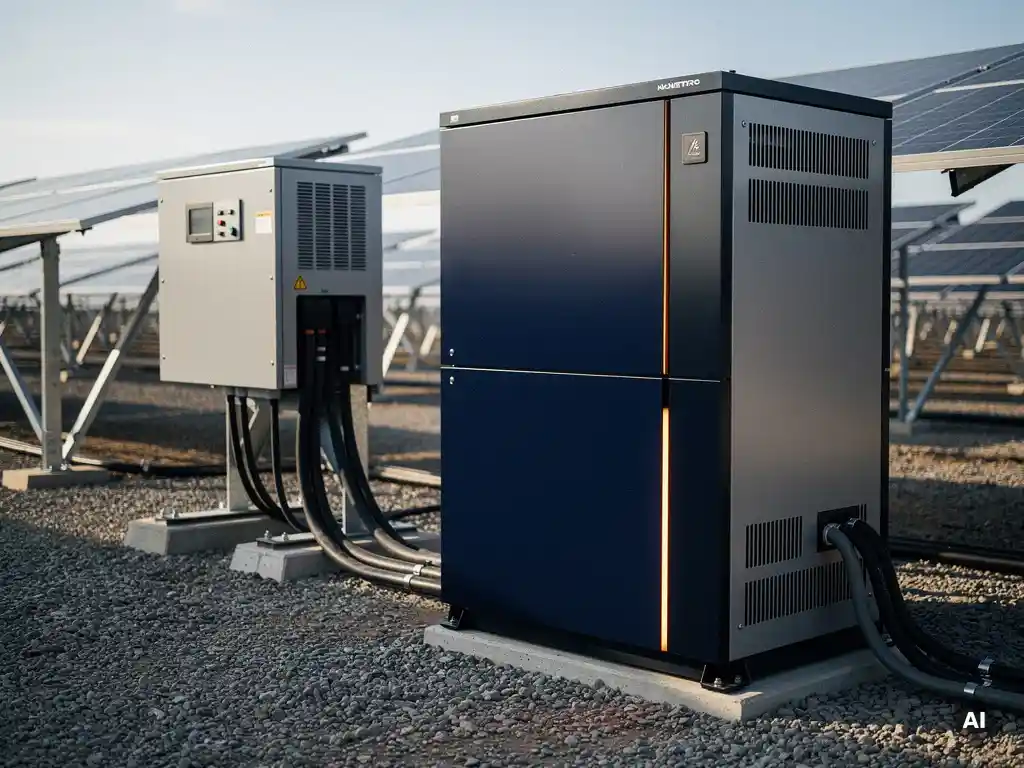
Behind-the-meter (BTM) battery storage refers to energy storage systems installed on the customer’s side of the utility meter, meaning the stored energy is used directly by the building or facility rather than exported to the grid. These systems charge from an on-site solar array or from the grid during low-cost periods and discharge when electricity demand or prices are high. The sections below unpack how BTM storage works, who benefits most, and what drives its financial case.
How does behind-the-meter battery storage actually work?
A behind-the-meter battery storage system sits between your energy source and your loads, storing electricity and releasing it on demand. The battery charges either from a co-located solar PV array during peak generation hours or from the grid when tariff rates are low. A battery management system (BMS) and an inverter control when the battery charges, holds, and discharges based on pre-set rules or real-time signals.
The core operating logic is straightforward. When solar generation exceeds on-site consumption, surplus energy flows into the battery instead of being exported at a low feed-in rate. When the sun goes down or demand spikes, the battery discharges to cover the load. This cycle reduces how much electricity the facility draws from the grid during expensive peak-rate periods.
Modern BTM systems use a bidirectional inverter that converts DC power stored in the battery cells into AC power usable by building equipment. Sophisticated energy management software monitors consumption patterns, weather forecasts, and grid tariff schedules to optimize charge and discharge timing automatically. Some systems can also respond to utility demand-response signals, providing a secondary revenue stream while still prioritizing on-site needs.
What are the main use cases for BTM battery storage?
The main use cases for BTM battery storage are peak shaving, self-consumption maximization, backup power, and demand charge reduction. Each use case targets a different cost driver or reliability requirement, and many real-world installations combine two or more of them simultaneously.
Peak shaving and demand charge reduction
Commercial and industrial electricity bills often include a demand charge based on the highest power draw recorded during a billing period, sometimes over just a 15-minute window. A BTM battery can discharge during those brief demand spikes, capping the peak and significantly reducing the demand charge component of the bill. For energy-intensive facilities, this alone can justify the investment.
Solar self-consumption maximization
Without storage, a solar PV system exports surplus generation to the grid at a feed-in tariff that is typically far lower than the retail electricity price. A BTM battery captures that surplus and makes it available later in the day, increasing the share of solar energy consumed on-site. This is particularly valuable where net metering policies are being reduced or phased out.
Backup power and resilience
BTM batteries can provide emergency backup during grid outages, keeping critical loads running. This use case is growing in importance for facilities where downtime is costly, including data centers, healthcare buildings, and manufacturing plants. When paired with solar, a BTM system can sustain essential operations even during extended outages.
What’s the difference between behind-the-meter and front-of-the-meter storage?
The key distinction is location relative to the utility meter and who the stored energy serves. Behind-the-meter storage is installed at the customer’s site and primarily serves that customer’s own loads. Front-of-the-meter (FTM) storage is utility-scale, connected directly to the transmission or distribution grid, and operated to serve the broader grid rather than a single end user.
FTM systems are typically large installations operated by utilities or independent power producers. They provide grid services such as frequency regulation, voltage support, and bulk energy arbitrage at a system-wide level. Revenue comes from wholesale energy markets and grid service contracts rather than from reducing a single electricity bill.
BTM systems, by contrast, are sized to match a specific facility’s consumption profile. Their financial return is measured against the retail electricity tariff the customer avoids paying, which is generally higher than the wholesale prices FTM systems arbitrage. This makes BTM storage financially attractive even at smaller capacities, particularly when combined with commercial solar PV.
What types of batteries are used in BTM storage systems?
Lithium-ion batteries dominate BTM storage installations today, with lithium iron phosphate (LFP) chemistry being the most widely adopted for commercial and industrial applications. LFP offers a strong balance of cycle life, thermal stability, and cost, making it well-suited to the daily charge-discharge cycling typical of BTM use cases.
Other chemistries appear in specific contexts. Nickel manganese cobalt (NMC) lithium-ion cells offer higher energy density, which matters where space is constrained, though they carry slightly higher thermal management requirements. Flow batteries, particularly vanadium redox flow systems, are gaining traction for longer-duration storage applications where four or more hours of discharge capacity is needed, as their capacity and power can be scaled independently.
Lead-acid batteries, once the default for commercial backup power, are now largely limited to retrofit or budget-constrained projects. Their lower cycle life and higher maintenance requirements make them less competitive against modern lithium chemistries for daily cycling applications. As lithium-ion costs continue to fall, the economic case for alternatives in the BTM segment has narrowed considerably.
How does BTM battery storage integrate with solar PV systems?
BTM battery storage integrates with solar PV either through a DC-coupled or AC-coupled architecture. In a DC-coupled system, the battery connects directly to the solar array’s DC output before the inverter, allowing more efficient charging with fewer conversion losses. In an AC-coupled system, the battery has its own inverter and connects on the AC side, making it easier to add storage to an existing PV installation.
The choice of architecture affects both efficiency and design complexity. DC coupling is generally more efficient because energy passes through fewer conversion stages, but it requires careful sizing coordination between the solar inverter, battery inverter, and array output. AC coupling is more flexible for retrofits and allows the battery to charge from the grid as well as from solar, which is useful for tariff arbitrage strategies.
From an engineering perspective, integrating storage into a PV design requires accurate load profiling, careful inverter sizing, and a clear understanding of the control logic that governs charge and discharge priorities. Tools that automate these calculations and produce construction-ready documentation significantly reduce the design time involved. Virto Solar’s design software is built precisely for this kind of detailed PV engineering work, helping teams move from concept to construction-ready output far faster than traditional manual workflows allow.
What factors determine the ROI of a BTM storage system?
The ROI of a BTM battery storage system is determined primarily by the local electricity tariff structure, the size and profile of the on-site load, the capacity and round-trip efficiency of the battery, and the upfront system cost. These factors interact, meaning a project that is highly profitable in one market may deliver poor returns in another with different tariff rules.
Electricity pricing structure is the single most influential variable. Markets with high demand charges, significant time-of-use price differentials, or low feed-in tariffs for solar exports create the strongest financial case for BTM storage. Where electricity prices are flat and demand charges are absent, the arbitrage opportunity is limited and payback periods extend considerably.
Battery cycle life and degradation rate matter because they determine how many years the system can operate at useful capacity. A battery that degrades rapidly will deliver fewer full-value cycles over its lifetime, reducing the total energy cost savings it can generate. Warranty terms and guaranteed capacity retention figures are therefore important inputs when modeling project economics.
System sizing is another critical factor. An undersized battery leaves peak shaving or self-consumption opportunities on the table, while an oversized system ties up capital in unused capacity. Accurate load analysis and solar yield simulation are essential to finding the optimal size. If you are working through the economics of a specific project, speaking with our team can help you identify the right design approach and tooling to model it accurately.
Finally, available incentives, grants, and tax credits in a given jurisdiction can substantially improve project economics. In 2026, many markets continue to offer investment tax credits or capital allowances for battery storage, particularly when paired with renewable generation. Factoring these into the financial model from the outset gives a more realistic picture of actual payback and return on investment.
Frequently Asked Questions
How do I determine the right battery capacity for my facility?
Start by analyzing at least 12 months of interval meter data to identify your peak demand windows, daily consumption patterns, and solar generation profile if applicable. From there, model different battery sizes against your tariff structure to find the capacity that maximizes cost savings without over-investing in unused storage. Most commercial projects benefit from professional load profiling and simulation tools that account for seasonal variation and degradation over the system’s lifetime.
Can a BTM battery system operate during a grid outage, and what does that require?
Yes, but only if the system is specifically designed for islanding capability — this is not automatic with every BTM installation. Standard grid-tied inverters are required by safety regulations to shut down during an outage to protect utility workers, so you need a hybrid or off-grid-capable inverter with automatic transfer switching to enable backup power. If backup resilience is a priority, make sure this requirement is clearly specified during the design phase, as it affects both equipment selection and installation cost.
What are the most common mistakes made when sizing or designing a BTM storage system?
The most frequent mistakes are relying on average load data instead of interval (15-minute) data, which causes designers to miss short but costly demand spikes that the battery needs to shave. Another common error is failing to account for battery degradation over time, which means the system may underperform its financial model within just a few years. Overlooking the control strategy — specifically, not aligning the battery’s charge and discharge logic with the actual tariff structure — is equally costly and often only discovered after commissioning.
How long does a commercial BTM battery system typically last, and what happens at end of life?
Most commercial lithium iron phosphate (LFP) batteries are warranted for 10 years or a specified number of cycles, typically guaranteeing 70–80% of original capacity retention at end of warranty. In practice, well-managed systems often remain operational and economically useful for 12–15 years depending on cycling frequency and thermal conditions. At end of life, battery modules can often be repurposed for lower-intensity applications before final recycling, and an increasing number of manufacturers now offer take-back and recycling programs as part of their commercial agreements.
Do BTM storage systems require ongoing maintenance, and what does that involve?
BTM battery systems are relatively low-maintenance compared to traditional generation equipment, but they are not entirely maintenance-free. Routine tasks include firmware updates to the battery management system and energy management software, periodic inspection of electrical connections and thermal management components, and monitoring performance data to detect early signs of cell degradation or inverter faults. Most commercial systems include remote monitoring platforms that flag anomalies automatically, and many installers offer service agreements that cover preventive maintenance visits on an annual basis.
What happens to BTM storage ROI if electricity tariffs or incentive policies change after installation?
This is a real risk, and it is worth stress-testing your financial model against scenarios where feed-in tariffs are reduced, demand charge structures are revised, or investment tax credits are not renewed. In practice, BTM systems that serve multiple use cases simultaneously — such as combining peak shaving with self-consumption and backup power — are more resilient to policy changes because they are not dependent on a single revenue stream. Locking in any available incentives before they are phased out, and choosing a flexible control system that can adapt its operating strategy as tariffs evolve, are both important risk-mitigation steps.
Is it better to install battery storage at the same time as solar PV, or can it be added later?
Installing both simultaneously is generally more cost-effective because it allows the system to be designed as an integrated whole, optimizing inverter sizing, DC coupling architecture, and control logic from the outset. Retrofitting storage to an existing solar installation is entirely feasible using AC coupling, but it typically involves additional equipment costs and may result in slightly lower overall system efficiency due to the extra conversion stage. If budget constraints require a phased approach, designing the initial solar installation to be ‘storage-ready’ — with appropriately sized switchgear, conduit, and inverter capacity — significantly reduces the cost of adding batteries later.
Related Articles
This content was generated with the help of AI — it may contain mistakes
Source link