

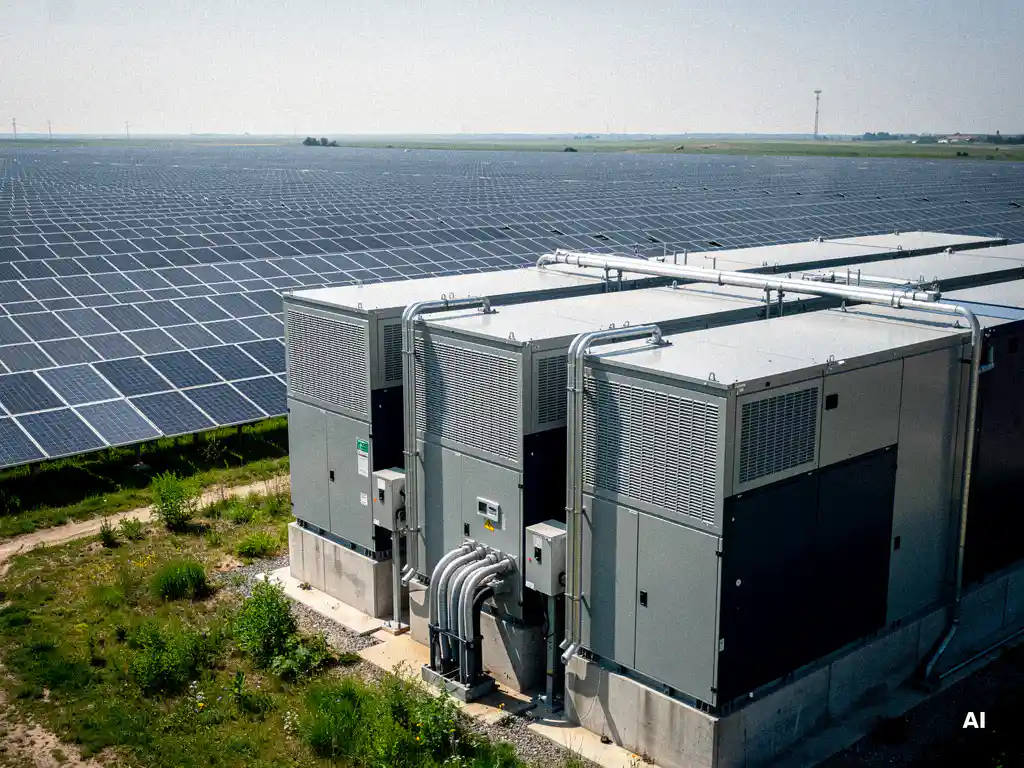
A Battery Energy Storage System (BESS) in solar energy is a technology that stores electricity generated by solar panels so it can be used at a later time. Rather than sending excess solar power back to the grid or losing it entirely, a BESS captures that energy and holds it until it is needed, whether that is after sunset, during peak demand hours, or when the grid goes down. This makes solar systems far more flexible, reliable, and commercially valuable. The sections below break down exactly how BESS works, what it is made of, and when it makes sense to add one to a PV project.
How does a BESS work with a solar PV system?
A BESS works alongside a solar PV system by capturing surplus electricity during periods of high generation and releasing it during periods of low generation or high demand. When solar panels produce more power than the site consumes, the BESS charges. When generation drops, at night, on cloudy days, or during peak load hours, the system discharges that stored energy back into the facility or the grid.
The integration between a solar array and a BESS typically happens at the inverter level. In an AC-coupled configuration, the solar inverter and the battery inverter operate independently, with the BESS connected to the AC bus. In a DC-coupled configuration, the solar array and the battery share a single hybrid inverter, which manages the flow of DC power directly before it is converted to AC. DC coupling is generally more efficient because energy is converted fewer times, but AC coupling offers more flexibility when retrofitting storage onto an existing PV system.
A battery management system (BMS) sits at the heart of the BESS, continuously monitoring cell voltage, temperature, and state of charge. The BMS protects the battery from overcharging, deep discharging, and thermal stress, all of which shorten battery life. Above the BMS sits an energy management system (EMS), which makes higher-level decisions: when to charge, when to discharge, and how to respond to grid signals or site demand patterns. Together, these layers of control are what make a BESS a smart, responsive asset rather than a simple storage tank.
What are the main components of a solar BESS?
The main components of a solar BESS are the battery cells, the battery management system (BMS), the power conversion system (PCS), and the energy management system (EMS). Most utility-scale and commercial BESS installations also include thermal management equipment, fire suppression systems, and a containerized enclosure that houses everything in a weatherproof, grid-ready unit.
Battery cells and modules
The battery cells are the core storage medium. Lithium-ion chemistries dominate the solar storage market today, with lithium iron phosphate (LFP) being the most widely adopted for commercial and utility-scale projects due to its thermal stability, long cycle life, and relatively low cost. Cells are grouped into modules, modules into racks, and racks into battery cabinets or containers. The total capacity of the system is determined by how many cells are connected in series and parallel.
Power conversion and energy management
The power conversion system (PCS) is the inverter component of the BESS. It converts DC power stored in the batteries into AC power that can be used on-site or exported to the grid, and vice versa during charging. The energy management system (EMS) is the software brain of the operation, it orchestrates charging and discharging schedules, responds to grid signals, optimizes for time-of-use tariffs, and provides operators with real-time visibility into system performance. In large-scale projects, the EMS often integrates with SCADA systems and grid operator platforms.
What is the difference between BESS and a standard solar battery?
The key difference between a BESS and a standard solar battery is scale, intelligence, and integration. A standard solar battery, such as a residential unit, is a relatively simple storage device designed to serve a single home or small commercial site. A BESS is a fully engineered system that combines battery storage with advanced power electronics, software controls, and grid-interface capabilities, typically deployed at commercial, industrial, or utility scale.
A standard solar battery stores energy and releases it on a basic charge-discharge cycle, often controlled by a simple inverter with limited programmability. A BESS, by contrast, can respond to real-time grid frequency signals, participate in ancillary services markets, perform peak shaving across complex load profiles, and be remotely monitored and optimized through a dedicated EMS. The BMS in a BESS is also far more sophisticated, managing thousands of individual cells across multiple racks and containers simultaneously.
In practical terms: a residential battery like a home storage unit is a product. A BESS is an engineered system. The distinction matters for solar developers and EPC firms because BESS projects require detailed electrical engineering, grid interconnection studies, and careful integration with the PV array, none of which applies to a plug-and-play residential battery installation.
Why do solar developers add BESS to PV projects?
Solar developers add BESS to PV projects primarily to increase the value and dispatchability of solar generation. Without storage, a solar plant can only deliver power when the sun is shining, which rarely aligns perfectly with when energy is most valuable. A BESS allows developers to shift generation to peak demand periods, capture higher energy prices, and meet grid operator requirements that increasingly mandate storage as a condition of interconnection.
There are several overlapping commercial and technical drivers behind this decision:
- Revenue optimization: Storing solar energy and discharging it during peak pricing windows, rather than exporting it at low midday rates, significantly improves project economics under time-of-use or wholesale market structures.
- Grid services: A BESS can provide frequency regulation, voltage support, and spinning reserve services to grid operators, creating additional revenue streams beyond simple energy arbitrage.
- Interconnection requirements: Many grid operators now require solar-plus-storage configurations as a condition of grid access, particularly for large utility-scale projects where uncontrolled solar injection creates stability challenges.
- Self-consumption and resilience: For commercial and industrial (C&I) sites, a BESS enables higher self-consumption of on-site solar generation, reduces demand charges, and provides backup power during grid outages.
- Power purchase agreement (PPA) structures: Some PPA contracts require a developer to deliver power on a firm or shaped schedule. Storage makes this possible for a solar-only plant that would otherwise be unable to guarantee delivery.
In 2026, the combination of falling battery costs and increasingly favorable regulatory frameworks has made solar-plus-BESS the default configuration for many new utility-scale projects, rather than an optional add-on.
How does BESS affect solar system design and engineering?
Adding a BESS to a solar project significantly increases the complexity of system design and engineering. It introduces additional components, new electrical interfaces, and a layer of control logic that must be carefully coordinated with the PV array, the grid connection, and the site’s load profile. For engineers, this means more calculations, more drawings, and more interdependencies to manage across every design revision.
On the electrical engineering side, the BESS changes the single-line diagram substantially. Engineers must size the PCS, define the AC or DC coupling architecture, design the protection scheme for the battery enclosure, and account for the BESS in cable sizing and fault current calculations. The DC/AC ratio of the overall system also shifts when storage is added, because the inverter may now be shared between the PV array and the battery, or the site may have two separate inverter systems that must be coordinated.
Shading analysis and yield simulation become more nuanced as well. The energy model must account for charging and discharging cycles, round-trip efficiency losses, and the dispatch strategy of the EMS, not just raw solar generation. A PVsyst model for a solar-plus-BESS project is considerably more involved than a standard PV-only simulation.
This is exactly where purpose-built solar engineering software makes a measurable difference. Tools like Virto Solar’s design platform are built to handle the kind of detailed, interconnected calculations that BESS integration demands, automating the repetitive engineering tasks that would otherwise consume days of manual work across spreadsheets and CAD files. If you are scoping a solar-plus-storage project and want to understand how software can streamline the engineering process, get in touch with our team to explore what is possible.
When does adding BESS to a solar project make financial sense?
Adding a BESS to a solar project makes financial sense when the value it unlocks, through energy arbitrage, grid services, demand charge reduction, or contractual requirements, exceeds its capital and operational cost over the project lifetime. This calculation depends heavily on the local energy market structure, the site’s load profile, and the specific revenue streams available to the project.
The clearest cases for BESS investment include:
- High time-of-use spreads: When the difference between off-peak and peak electricity prices is large, storing solar energy and discharging it during expensive hours generates a strong arbitrage return.
- High demand charges: C&I sites that pay significant demand charges based on peak consumption can use a BESS to shave those peaks, reducing monthly bills in a way that is directly measurable.
- Ancillary services markets: In markets where grid operators pay for frequency regulation or capacity, a BESS can earn revenue that substantially improves project IRR.
- Mandatory storage requirements: When interconnection or permitting requires storage, the financial question shifts from “is it worth it?” to “how do we optimize it?”
- Firm delivery contracts: Projects with PPAs that require shaped or firm power delivery cannot meet their contractual obligations without storage, making BESS a prerequisite rather than an option.
Where BESS investment is harder to justify is in markets with flat electricity tariffs, no demand charge structure, and no access to ancillary services revenue. In those environments, the payback period can stretch beyond what most project finance models will accept. As battery costs continue to fall and energy markets evolve, the threshold for financial viability is shifting, but a rigorous project-specific financial model remains essential before committing to storage on any solar development.
Frequently Asked Questions
What is the typical lifespan of a BESS in a solar project, and how does degradation affect performance over time?
Most lithium iron phosphate (LFP) BESS installations are rated for 4,000–6,000 charge cycles, which typically translates to a usable lifespan of 10–15 years depending on operating conditions and dispatch frequency. Battery capacity degrades gradually over time, usually at a rate of 1–3% per year, meaning a system sized at 100 MWh at commissioning may deliver closer to 80 MWh by year ten. Developers account for this in financial models by either oversizing the initial system or including contractual capacity guarantees from the battery manufacturer. Regular BMS firmware updates and thermal management best practices can meaningfully slow the rate of degradation.
How do I determine the right BESS size (power and energy capacity) for a solar project?
BESS sizing is defined by two independent parameters: power capacity (measured in MW or kW), which determines how fast the system can charge or discharge, and energy capacity (measured in MWh or kWh), which determines how long it can sustain that output. The right ratio between the two, known as the C-rate or duration, depends entirely on the intended use case: a system optimized for frequency regulation needs high power and short duration, while one designed for peak shifting or overnight discharge needs lower power but longer duration (typically 2–4 hours). Sizing should be driven by a detailed energy model that incorporates the site’s load profile, the solar array’s generation curve, the target dispatch strategy, and the local tariff or market structure.
What are the most common mistakes engineers and developers make when integrating BESS into a solar project?
One of the most frequent mistakes is treating the BESS as an afterthought, designing the PV system first and then attempting to bolt storage on at the end, which often results in suboptimal coupling architecture, undersized cabling, and protection schemes that need to be redesigned from scratch. Another common error is underestimating round-trip efficiency losses in the energy model: a BESS typically operates at 85–92% round-trip efficiency, and failing to account for this leads to overstated yield projections and revenue forecasts. Developers also frequently overlook the interconnection implications of adding storage, since many grid operators treat solar-plus-BESS as a different asset class with distinct study requirements and timelines.
Can a BESS be added to an existing solar installation, or does it have to be built in from the start?
A BESS can absolutely be retrofitted onto an existing solar installation, and AC coupling is the standard approach for doing so, since it connects the battery inverter to the existing AC bus without requiring changes to the original solar inverter or DC wiring. The main considerations for a retrofit are whether the existing grid connection has sufficient capacity to accommodate the additional power flows, whether the site’s protection and metering equipment needs to be upgraded, and whether the original PV inverter can communicate with the new BESS energy management system. While retrofitting is technically feasible, it is generally less efficient and more costly than designing solar-plus-storage as an integrated system from the outset, so developers planning storage from day one should default to DC coupling where possible.
What permitting and grid interconnection steps are specific to solar-plus-BESS projects?
Solar-plus-BESS projects typically require additional steps in the interconnection process compared to PV-only systems, including updated power flow studies, fault current analysis that accounts for the battery inverter, and in some jurisdictions, a separate interconnection application for the storage component. On the permitting side, BESS installations are subject to fire and building codes that govern battery enclosure placement, ventilation, fire suppression systems, and minimum separation distances from occupied structures, with standards such as NFPA 855 and IFC Section 1207 commonly referenced in the US. It is critical to engage the relevant grid operator and local authority having jurisdiction (AHJ) early in the project development process, as BESS-specific requirements vary significantly by region and can materially affect project timelines and costs.
How does the EMS dispatch strategy affect the financial performance of a solar-plus-BESS project?
The EMS dispatch strategy is one of the most significant levers for maximizing the financial return of a BESS, and a poorly configured strategy can leave a substantial portion of the system’s potential revenue unrealized. An optimized EMS will use day-ahead price forecasts, weather predictions, and load data to determine the ideal charge and discharge schedule, ensuring the battery is full when prices are highest and empty when they are lowest. For projects participating in multiple revenue streams simultaneously, such as energy arbitrage combined with frequency regulation, the EMS must intelligently allocate battery capacity between uses without compromising the system’s ability to respond to grid signals. Many advanced EMS platforms now incorporate machine learning to continuously refine dispatch decisions based on real operational data.
What should I look for when evaluating BESS suppliers or manufacturers for a utility-scale solar project?
Beyond headline metrics like cost per kWh and cycle life warranty, the most important factors to evaluate are the supplier’s track record of deployed projects at comparable scale, the robustness of their BMS and EMS software, and the terms of their capacity and performance guarantees, including how degradation is measured and what remedies are available if the system underperforms. It is also worth scrutinizing the thermal management design and fire suppression system, since these directly affect bankability and insurance costs. Finally, consider the supplier’s long-term service and support capabilities, including remote monitoring, firmware update processes, and spare parts availability, since a BESS is a 10–15 year asset and the operational relationship with the manufacturer matters as much as the hardware specifications.
Related Articles
This content was generated with the help of AI — it may contain mistakes
Source link