

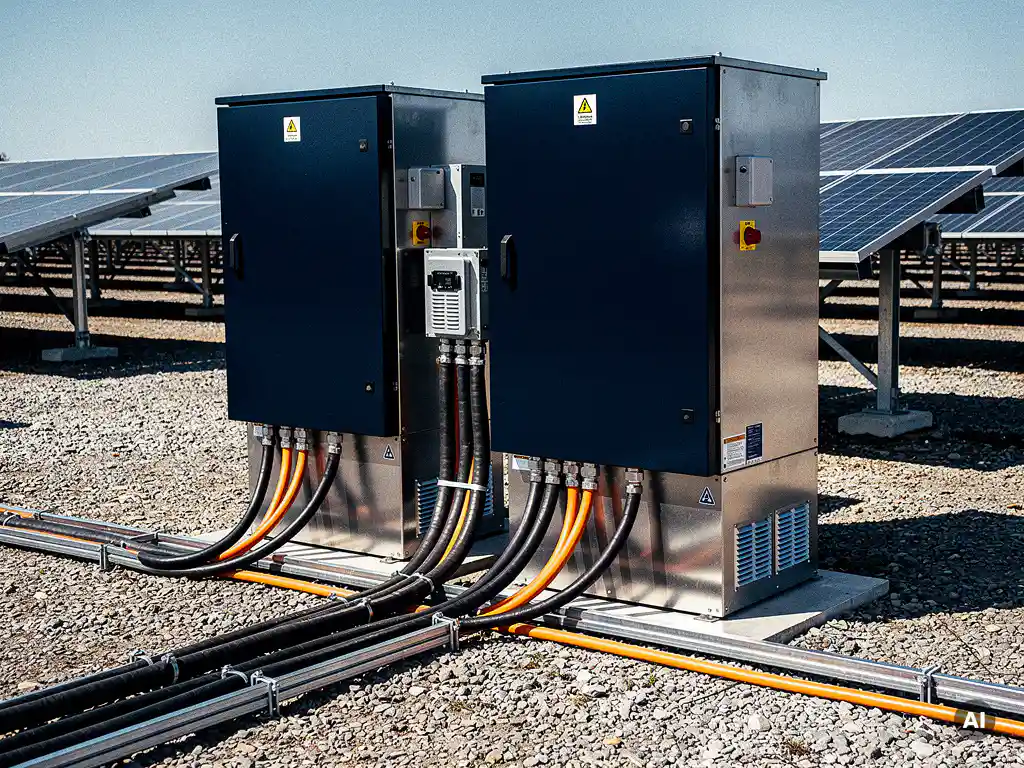
The main difference between AC-coupled and DC-coupled battery storage is where in the system the battery connects and how energy flows between the solar array, battery, and grid. In an AC-coupled system, the battery connects on the AC side of the inverter, while in a DC-coupled system, the battery connects on the DC side before the main inverter. The right choice depends on your project type, whether you are retrofitting an existing installation or designing from scratch, and the efficiency losses you are willing to accept.
For solar engineers working on commercial and utility-scale projects, this distinction has real consequences for system sizing, wiring design, and overall energy yield. The sections below walk through how each topology works, where each one wins, and how to apply that knowledge to your next project.
Which coupling type is more efficient for solar storage?
DC-coupled battery storage is generally more efficient than AC-coupled storage. In a DC-coupled system, solar energy flows directly from the array to the battery without an intermediate conversion step, resulting in fewer energy losses. AC-coupled systems require two conversion steps to charge the battery, which introduces additional losses at each stage.
In practical terms, DC-coupled systems typically achieve round-trip efficiencies in the range of 92 to 96 percent, depending on the components used. AC-coupled systems tend to sit a few percentage points lower because energy must be converted from DC to AC by the solar inverter, and then from AC back to DC by the battery inverter-charger before it can be stored. When the battery discharges, another DC-to-AC conversion occurs. Each conversion step carries an efficiency penalty, and those losses compound over thousands of charge cycles across a system’s lifetime.
That said, efficiency is not the only metric that matters. System design complexity, retrofit feasibility, and inverter flexibility can all shift the balance in favor of AC coupling for specific project scenarios.
How does AC-coupled battery storage work?
In an AC-coupled battery storage system, the solar array connects to a dedicated solar inverter that converts DC power to AC power in the normal way. The battery system is then connected separately on the AC bus, using its own bidirectional inverter to charge from and discharge to the AC side of the system. The two inverters operate independently but are coordinated through a system controller or energy management system.
This architecture means the solar inverter and the battery inverter are decoupled from each other in terms of hardware. The solar inverter does not need to know about the battery, and the battery inverter does not need to be matched to the solar array’s DC characteristics. This independence is what makes AC coupling particularly attractive for retrofit projects, where an existing solar installation can have battery storage added without replacing or modifying the original inverter.
From a design standpoint, AC-coupled systems are also more flexible when it comes to battery technology selection. Because the battery inverter handles its own DC interface, engineers can pair a wide range of battery chemistries and voltages with any AC-side solar inverter. This modularity simplifies procurement and can reduce vendor lock-in on larger commercial projects.
How does DC-coupled battery storage work?
In a DC-coupled battery storage system, the solar array and the battery both connect on the DC side of a shared hybrid inverter or through a DC-coupled charge controller. Solar energy flows directly from the array to the battery without being converted to AC first. The hybrid inverter then converts DC power to AC when energy is needed by the load or exported to the grid.
Because there is only one main inverter handling both the solar input and the battery interface, DC-coupled systems tend to be simpler in terms of component count. The hybrid inverter manages the energy flow between the array, battery, and AC output in a coordinated way, which can simplify commissioning and monitoring.
One important design consideration in DC-coupled systems is that the battery voltage and the solar array’s DC operating range must be compatible with the hybrid inverter’s specifications. This requires careful attention during the string planning and inverter sizing phase. Engineers also need to account for the fact that if the battery is full and the grid is unavailable, the hybrid inverter must curtail the solar array, since there is no separate path for excess energy to flow.
What are the main advantages and disadvantages of each system?
Both coupling topologies offer distinct strengths and trade-offs. The best choice depends on project constraints rather than a single universal rule. Here is a structured comparison of the key factors:
AC-coupled storage: advantages and disadvantages
- Advantage: Easier to retrofit onto existing solar installations without replacing the solar inverter
- Advantage: Greater flexibility in battery and inverter selection from different manufacturers
- Advantage: Each inverter can be independently sized and replaced, which simplifies future upgrades
- Advantage: Scales well for larger systems where multiple battery inverters can be added in parallel
- Disadvantage: Lower round-trip efficiency due to multiple DC-to-AC and AC-to-DC conversion steps
- Disadvantage: More complex wiring and communication setup between two separate inverter systems
- Disadvantage: Higher component cost when two full inverter systems are required
DC-coupled storage: advantages and disadvantages
- Advantage: Higher round-trip efficiency because energy is stored without an intermediate AC conversion
- Advantage: Simpler single-inverter architecture with fewer components and connection points
- Advantage: Better suited for off-grid and self-consumption optimization scenarios
- Advantage: Lower cost in new-build projects where a hybrid inverter replaces two separate units
- Disadvantage: Less flexible for retrofits, as the existing solar inverter typically cannot be reused
- Disadvantage: Battery voltage and capacity must be compatible with the hybrid inverter’s DC input range
- Disadvantage: Scaling beyond the hybrid inverter’s rated capacity can require a full system redesign
When should engineers choose AC-coupled over DC-coupled storage?
Engineers should choose AC-coupled battery storage when retrofitting an existing solar installation, when the project requires flexibility to mix components from different manufacturers, or when the battery system needs to be independently sized and scaled from the solar array. AC coupling is also the practical choice when the existing solar inverter is relatively new and replacing it would not be cost-effective.
In commercial and industrial projects where the solar array was installed in a previous phase and the client now wants to add storage, AC coupling avoids the cost and disruption of replacing a functioning inverter. This is one of the most common real-world scenarios where AC coupling wins on a purely practical basis, even though it carries a small efficiency penalty.
AC coupling also makes sense when the battery system needs to be sized independently of the solar array. For example, a project might require a large battery capacity to cover evening peak demand, but the solar array is constrained by available roof space. In this case, the ability to size the battery inverter separately from the solar inverter gives the engineer more design freedom.
DC coupling, by contrast, is the stronger choice for new-build projects where a hybrid inverter can be specified from the start, for off-grid systems where efficiency losses have a direct impact on energy autonomy, and for projects where simplicity and a lower component count are priorities. If you are designing a system from scratch and efficiency and cost per kilowatt-hour stored are the primary drivers, DC coupling is usually the better starting point.
If you are unsure which topology fits your specific project, speaking with a solar engineering specialist can help you evaluate the trade-offs based on your actual load profile, grid connection, and budget.
Does coupling type affect grid-tied and off-grid system design differently?
Yes, coupling type has different implications depending on whether the system is grid-tied or off-grid. For grid-tied systems, both AC and DC coupling are viable, and the choice is primarily driven by efficiency, cost, and retrofit considerations. For off-grid systems, DC coupling is generally preferred because every percentage point of efficiency loss has a direct impact on energy autonomy and battery sizing.
In a grid-tied AC-coupled system, any excess solar energy that cannot be stored can be exported to the grid, which acts as a buffer. This means the efficiency penalty of AC coupling is partially offset by the ability to monetize surplus generation. The grid also provides a stable AC reference that both inverters can synchronize to, which simplifies system control.
In an off-grid system, there is no grid to absorb excess energy or compensate for storage losses. Every kilowatt-hour that is lost to conversion inefficiency is a kilowatt-hour that must be replaced by a larger battery or a larger solar array. This makes DC coupling’s efficiency advantage more significant in off-grid design, where it directly reduces the capital cost of the battery bank and the array needed to keep it charged.
There is also a technical consideration specific to AC-coupled off-grid systems: the battery inverter must generate a stable AC reference voltage for the solar inverter to synchronize to. This adds complexity to the control logic and requires careful inverter selection to ensure the two units can communicate and manage frequency and voltage correctly. DC-coupled off-grid systems avoid this challenge entirely, since the hybrid inverter manages all energy flows internally.
For engineers working on utility-scale or large commercial projects where these design decisions intersect with detailed electrical drawings and string calculations, tools like Virto Solar’s design software can help automate the downstream calculations and wiring layouts that follow from your coupling topology choice, reducing the risk of errors as the design evolves.
Frequently Asked Questions
Can I switch from AC-coupled to DC-coupled storage after the system is already installed?
Switching from AC-coupled to DC-coupled storage after installation is technically possible but rarely cost-effective, as it typically requires replacing the existing solar inverter with a compatible hybrid inverter and potentially re-engineering the DC wiring and string configuration. In most cases, if the existing solar inverter is still within its service life, the cost of replacement and redesign outweighs the efficiency gains from switching to DC coupling. A more practical approach is to evaluate the coupling topology during the initial design phase, or to plan for a DC-coupled upgrade at the natural end-of-life point of the current inverter.
How do I calculate the efficiency loss of an AC-coupled system over the project lifetime?
To estimate lifetime efficiency losses, start by identifying the round-trip efficiency of your AC-coupled system, which typically falls between 87 and 92 percent depending on inverter specifications, and compare it to a DC-coupled benchmark of 92 to 96 percent. Multiply the annual energy throughput of the battery (in kWh cycled per year) by the efficiency delta to get the annual energy lost to conversion. Projecting that figure over the system’s 20 to 25 year lifetime gives you a cumulative kWh loss, which you can then convert to a financial impact using your local energy rate or avoided cost of generation. This calculation is especially important for projects with high daily cycling requirements, such as commercial peak shaving applications.
What happens to a DC-coupled system if the hybrid inverter fails — does the solar array go down too?
Yes, in a DC-coupled system the hybrid inverter is a single point of failure for both the solar array and the battery, meaning that if the inverter fails, both generation and storage are taken offline simultaneously. This is an important reliability consideration for commercial and industrial projects where uptime is critical, and it is one of the reasons some engineers prefer AC coupling for large-scale applications — a failed battery inverter in an AC-coupled system does not affect the solar inverter’s ability to continue generating and exporting power. When specifying a DC-coupled system, it is worth evaluating the inverter manufacturer’s warranty terms, mean time to repair, and local spare-parts availability to mitigate this risk.
Are there specific battery chemistries that work better with one coupling type over the other?
Battery chemistry compatibility is more of a constraint in DC-coupled systems than in AC-coupled ones, because the battery’s voltage range must fall within the hybrid inverter’s DC input specifications. Lithium iron phosphate (LFP) batteries are the most commonly paired chemistry in both topologies due to their stable voltage profile and cycle life, but DC-coupled systems require closer attention to the battery’s nominal voltage and state-of-charge voltage window relative to the inverter’s MPPT and DC bus range. AC-coupled systems are more chemistry-agnostic because the battery inverter-charger handles its own DC interface independently, giving engineers more freedom to select batteries based on cost, cycle life, or thermal performance without worrying about DC bus compatibility.
How does the choice of coupling type affect grid export and demand response capabilities?
Both AC-coupled and DC-coupled systems can support grid export and demand response, but the control architecture differs in ways that can affect response speed and flexibility. AC-coupled systems, with their independent inverters, can sometimes offer more granular control over solar export and battery dispatch because each unit can be managed separately through the energy management system. DC-coupled systems managed by a single hybrid inverter may have tighter integration but can be limited by the inverter manufacturer’s firmware in terms of how export limits and demand response signals are implemented. Before committing to either topology for a project with active grid services requirements, verify that the inverter’s communication protocols — typically Modbus, SunSpec, or proprietary APIs — are compatible with your utility’s demand response or virtual power plant platform.
What are the most common sizing mistakes engineers make when designing AC-coupled storage systems?
One of the most frequent mistakes is undersizing the battery inverter relative to the peak AC load the system needs to support during grid outages, which results in the battery inverter tripping or throttling at critical moments. Another common error is failing to account for the additional AC wiring, protection devices, and metering required when a second inverter is added to an existing AC bus, which can lead to compliance issues during inspection. Engineers should also avoid assuming that the solar inverter and battery inverter will communicate seamlessly out of the box — verifying protocol compatibility and testing the control handshake between the two units during commissioning is essential to ensure the system behaves as modeled under all operating conditions.
Is DC coupling always the better choice for new-build projects, or are there new-build scenarios where AC coupling still makes sense?
DC coupling is the stronger default for most new-build projects, but AC coupling can still be the right choice in new installations where the battery capacity needs to significantly exceed what a single hybrid inverter can manage, or where the project requires inverters from different manufacturers to meet specific grid compliance or client procurement requirements. Large commercial rooftop systems with multiple solar inverter strings and a separately specified battery block, for example, are often designed with AC coupling from the start because the modular architecture is easier to scale and maintain over a 20-plus year asset life. The key is to run the numbers on both topologies early in the design process, factoring in total installed cost, projected energy yield, and operational flexibility, rather than defaulting to DC coupling simply because the project is new.
Related Articles
This content was generated with the help of AI — it may contain mistakes
Source link