

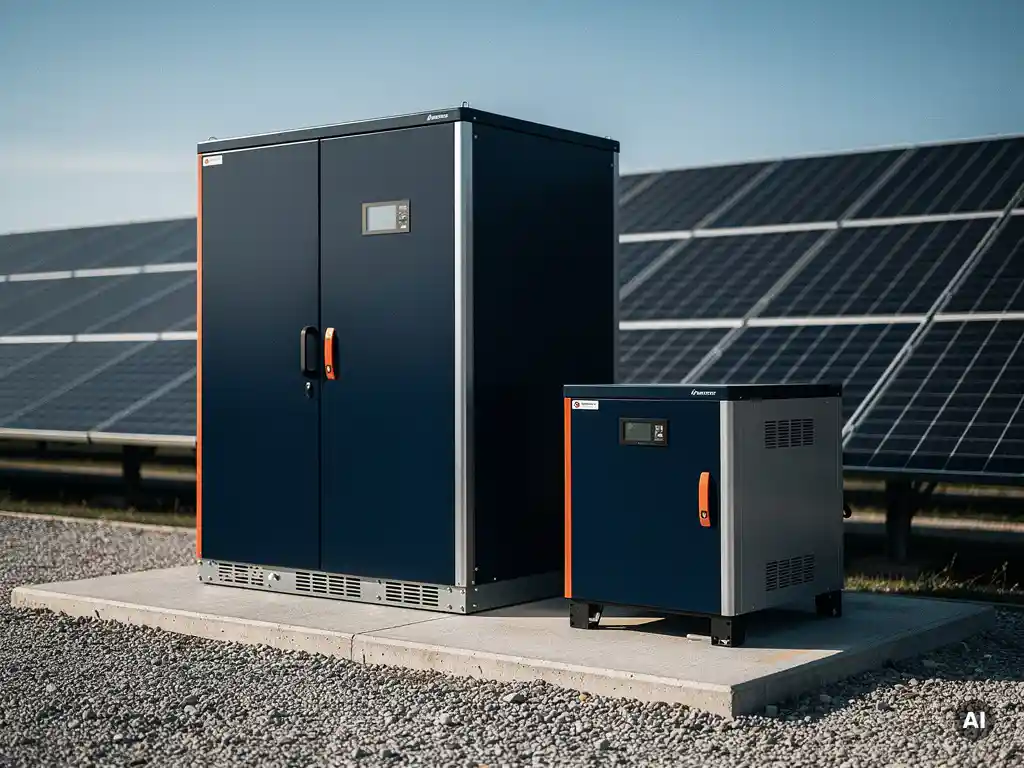
Residential and commercial battery storage systems serve the same fundamental purpose, storing energy for later use, but they differ significantly in scale, chemistry, cost, and complexity. Residential systems are compact, household-scale units designed for simplicity and self-consumption, while commercial systems are engineered for high-capacity, high-power applications that support businesses, industrial facilities, and large-scale solar installations. The sections below unpack each key difference in detail, from how these systems work to which one fits your project.
How do residential and commercial battery storage systems actually work?
Both residential and commercial battery storage systems charge from a connected energy source, typically a solar array or the grid, store that energy in electrochemical cells, and discharge it on demand. The core principle is identical: a battery management system (BMS) controls charging and discharging cycles, while an inverter converts DC electricity stored in the battery into AC electricity usable by loads. The difference lies in how these components are scaled, integrated, and controlled.
In a residential system, the battery, inverter, and BMS are usually packaged together in a single unit, think of an all-in-one cabinet installed in a garage or utility room. The system is designed for straightforward installation, minimal configuration, and automatic operation. A homeowner rarely needs to interact with it beyond monitoring an app.
Commercial battery storage systems, by contrast, are modular and purpose-engineered. They consist of multiple battery racks or containers, separate inverter banks, dedicated thermal management systems, and sophisticated energy management software (EMS). The EMS coordinates charge and discharge cycles based on time-of-use tariffs, demand charge reduction targets, grid services, or backup power requirements. This level of control is essential for commercial operators who need to optimize energy costs across complex load profiles.
What are the main differences in capacity and power output?
The most immediate difference between residential and commercial battery storage is raw scale. Residential systems typically range from 5 kWh to 30 kWh in usable capacity, with power outputs between 3 kW and 10 kW. Commercial systems start where residential systems end, commonly from 100 kWh upward, with utility-scale installations reaching multiple megawatt-hours and power outputs in the hundreds of kilowatts or beyond.
This gap in capacity reflects the difference in energy demand. A household needs enough storage to cover evening consumption after a day of solar generation, or to ride out a short grid outage. A commercial facility, a warehouse, a manufacturing plant, a supermarket, may have peak demand spikes that require rapid, high-power discharge to avoid costly demand charges. A data center or hospital needs enough backup capacity to sustain critical operations for hours, not minutes.
Commercial systems also offer a key technical advantage: scalability. Most commercial battery platforms are modular, meaning capacity and power can be expanded by adding battery racks or inverter units without replacing the entire system. Residential systems are generally fixed at their installed capacity, with limited expansion options.
Which battery chemistries are used in each system type?
Lithium iron phosphate (LFP) has become the dominant chemistry in both residential and commercial battery storage, but the two markets also draw on different chemistries depending on application requirements. LFP is favored for its thermal stability, long cycle life, and relatively low cost, qualities that matter in both home and commercial settings.
Residential battery chemistries
Residential systems predominantly use LFP or nickel manganese cobalt (NMC) lithium-ion cells. NMC offers higher energy density, which makes it attractive for compact home installations where physical space is limited. However, NMC operates at higher temperatures and carries a slightly higher thermal risk than LFP, which is why many manufacturers have shifted toward LFP even in residential products as cell costs have fallen.
Commercial battery chemistries
Commercial systems almost universally use LFP due to its superior cycle life, often exceeding 4,000 to 6,000 full cycles, and its safer thermal profile at large scale. Some utility-scale projects also deploy flow batteries (such as vanadium redox flow) where very long discharge durations and extreme cycle counts are required. Flow batteries are rarely seen in residential applications because of their size, complexity, and cost. Lead-acid batteries still appear in some legacy commercial backup systems, but they are increasingly being replaced by lithium-based alternatives.
How do installation and regulatory requirements differ?
Residential battery storage installation is relatively straightforward. A certified electrician can typically complete a home installation in one to two days. Permitting requirements vary by region but generally involve a standard electrical permit and, in some markets, a grid connection notification. Most residential systems are pre-certified to relevant safety standards, which simplifies the approval process.
Commercial battery storage installation is a substantially more complex undertaking. Large systems are often delivered as containerized units or require dedicated battery rooms with fire suppression systems, ventilation, and structural reinforcement. Installation timelines can run from several weeks to several months, depending on system size and site conditions.
Regulatory requirements for commercial systems are considerably more demanding. Depending on jurisdiction and system size, commercial installations may require:
- Building permits and structural assessments
- Fire safety compliance and suppression system certification
- Grid interconnection studies and utility approval
- Environmental impact assessments for very large installations
- Compliance with industrial electrical codes and standards
Grid operators often impose additional technical requirements on commercial systems that participate in demand response or ancillary services markets, including specific communication protocols and response time capabilities. These requirements add engineering complexity that simply does not exist at the residential level.
What does each system type cost, and what drives the price difference?
Residential battery storage systems typically cost between a few thousand and around twenty thousand euros or dollars installed, depending on capacity, brand, and local labor rates. Commercial systems range from tens of thousands for small C&I installations to several million for large utility-scale projects. The price difference is driven by capacity, engineering complexity, and the additional infrastructure required at scale.
Several factors drive the cost gap beyond simple size:
- Engineering and design: Commercial systems require detailed electrical engineering, load analysis, and system integration work that adds significant professional fees.
- Balance of system components: Commercial installations include industrial-grade inverters, switchgear, monitoring systems, and thermal management equipment that have no residential equivalent.
- Installation labor: Larger systems require more specialized labor, longer installation windows, and often civil works such as concrete pads or container foundations.
- Permitting and compliance: The regulatory process for commercial systems involves more stakeholders, more documentation, and longer timelines, all of which add cost.
- Warranty and service contracts: Commercial operators typically require performance guarantees and ongoing maintenance agreements that are priced into the total cost of ownership.
On a per-kWh basis, commercial systems often achieve lower unit costs than residential systems due to economies of scale in both hardware procurement and installation. However, the absolute capital outlay is far higher, and the business case depends on factors like local energy tariffs, demand charge structures, and available incentives.
Which type of battery storage is right for your project?
The right battery storage system depends on your energy demand, project scale, and financial objectives. If you are designing a system for a single home or small property with a rooftop solar array, a residential battery storage unit is the appropriate choice, it is cost-effective, straightforward to install, and purpose-built for household load profiles. If your project involves a commercial building, industrial facility, or a large-scale solar plant, a commercial battery storage system is the only viable option to meet capacity, power, and regulatory requirements.
For solar engineering professionals working on C&I or utility-scale projects, the battery storage decision is rarely made in isolation. It sits within a broader system design that includes inverter sizing, DC/AC ratio optimization, cable sizing, and grid interconnection planning. Getting these interdependencies right from the start is what separates a well-engineered project from one that creates costly problems at commissioning.
If you are working on commercial or utility-scale PV projects and want to streamline the engineering process, from system layout through to construction-ready documentation, Virto Solar’s design tools are built specifically for that workflow. And if you are unsure which approach best fits your project’s technical requirements, our team is available to help you work through the details, you can reach out to us directly to discuss your specific situation.
Frequently Asked Questions
Can a residential battery storage system be used for a small commercial property, like a small office or retail shop?
In some cases, a residential battery system can serve a very small commercial property with modest energy demands, but it is generally not recommended. Small commercial properties often have higher peak power demands, more complex load profiles, and stricter regulatory requirements than a residential system is designed to handle. A better approach is to conduct a proper load analysis first — if your peak demand regularly exceeds 10 kW or your daily consumption is above 30–40 kWh, you will almost certainly need a commercial-grade solution.
How long do commercial battery storage systems typically last compared to residential ones?
Commercial battery systems, particularly those using LFP chemistry, are typically rated for 4,000 to 6,000 full charge-discharge cycles, which can translate to 15–20 years of operational life depending on cycling frequency. Residential LFP systems are rated similarly in terms of cycle count, but because home systems cycle less frequently (often once per day), the calendar life tends to be the limiting factor, usually around 10–15 years. Commercial systems also benefit from more rigorous thermal management and professional maintenance programs, which help preserve battery health over time.
What are the most common mistakes made when sizing a commercial battery storage system?
The most frequent sizing mistake is focusing solely on energy capacity (kWh) while underestimating the required power output (kW), which leads to a system that cannot respond fast enough to peak demand events. Another common error is failing to account for the battery’s depth of discharge (DoD) limits and degradation over time, meaning the system delivers less usable capacity in year five than it did at commissioning. A thorough load profile analysis — ideally using 15-minute interval data — combined with a clear definition of the system’s primary use case (self-consumption, demand charge reduction, backup, or grid services) is essential before finalizing any sizing decision.
Do commercial battery storage systems qualify for the same incentives and tax credits as residential systems?
In many markets, commercial battery storage systems qualify for incentives, but the programs, eligibility criteria, and application processes are often different from residential schemes. For example, in the United States, the Investment Tax Credit (ITC) applies to both residential and commercial battery systems when paired with solar, but commercial projects may also access additional depreciation benefits like MACRS. In Europe, incentive structures vary significantly by country and region, and commercial projects frequently require more detailed documentation and longer approval timelines. Always consult a local energy finance specialist or your country’s energy agency to confirm which incentives apply to your specific project.
How does a battery energy management system (EMS) optimize costs for a commercial facility?
A commercial EMS continuously analyzes real-time energy prices, demand forecasts, and load data to determine the optimal times to charge and discharge the battery. For facilities on time-of-use (TOU) tariffs, the EMS charges the battery during low-price periods and discharges during peak-price windows, directly reducing the electricity bill. For facilities subject to demand charges, the EMS monitors power consumption and dispatches the battery to shave demand spikes before they register on the utility meter. Advanced EMS platforms can also participate in grid ancillary services markets, generating additional revenue streams that improve the overall return on investment.
What fire safety measures are required for large commercial battery installations?
Commercial battery installations are subject to significantly more stringent fire safety requirements than residential systems, and these vary by jurisdiction and system size. Common requirements include dedicated fire suppression systems (such as clean agent or water mist systems), battery room ventilation designed to prevent thermal runaway gas accumulation, smoke and gas detection systems, and compliance with standards such as NFPA 855 (in the US) or equivalent local codes. For containerized systems, the container itself must often meet specific fire resistance ratings. Engaging a fire safety engineer early in the project design phase is strongly recommended to avoid costly redesigns during the permitting process.
How should a solar engineering professional approach integrating battery storage into an existing commercial PV system?
Retrofitting battery storage into an existing commercial PV system requires a careful review of the current inverter topology, grid connection agreement, and available switchgear capacity, since not all existing inverters are compatible with AC-coupled or DC-coupled battery additions. The grid interconnection agreement may also need to be renegotiated if the battery system will participate in export or grid services, which can add significant lead time to the project. Starting with a detailed site audit and a review of at least 12 months of interval meter data will give you the clearest picture of how the battery should be sized and configured to maximize value within the constraints of the existing installation.
Related Articles
This content was generated with the help of AI — it may contain mistakes
Source link