

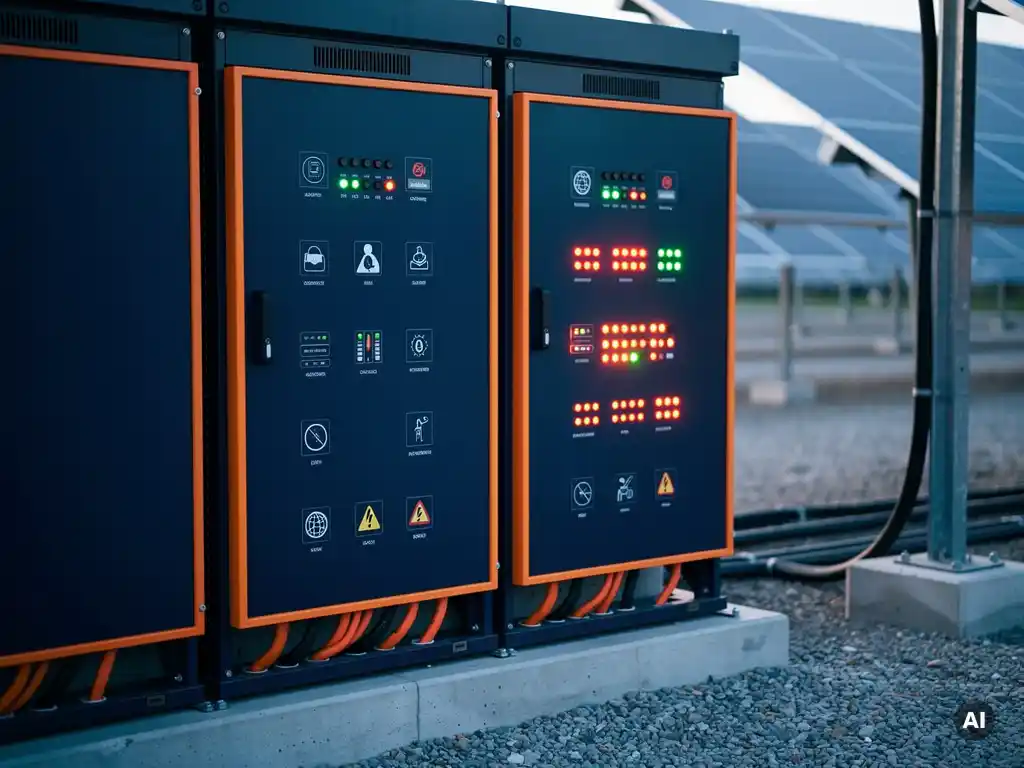
Usable battery capacity is the portion of a battery’s total stored energy that can actually be discharged without damaging the cells or shortening the battery’s lifespan. In most residential and commercial solar storage systems, usable capacity is meaningfully lower than the headline total capacity figure printed on the spec sheet. Understanding this gap is essential for accurate battery sizing in any PV system.
The difference between the two figures is governed by a parameter called depth of discharge, which varies by battery chemistry and manufacturer. The sections below break down how depth of discharge works, why manufacturers impose these limits, and what the usable-to-total capacity ratio means for real-world solar system design.
How much of a battery’s capacity can actually be used?
In most solar storage systems, usable capacity ranges from 80% to 95% of total rated capacity, depending on the battery chemistry and the manufacturer’s settings. A battery advertised as 10 kWh total may deliver only 8 to 9.5 kWh of usable energy per cycle. The remaining capacity is held in reserve to protect the battery’s chemistry and extend its operational life.
This distinction matters enormously in practice. When a solar installer or engineer quotes a storage system’s capacity, they should always clarify whether they are referring to total or usable capacity. Confusing the two leads to undersized storage that cannot cover the intended load, particularly during overnight discharge or multi-day low-irradiance periods. For utility-scale and commercial projects, where battery banks can represent hundreds of kilowatt-hours, even a 10% miscalculation translates into significant energy shortfalls.
The usable capacity figure is the only number that should drive load coverage calculations, backup duration estimates, and self-consumption targets. Total capacity is a manufacturing reference point, not a design input.
What is depth of discharge and why does it matter?
Depth of discharge (DoD) is the percentage of a battery’s total capacity that is discharged during a single cycle. A battery with a 90% DoD rating can be discharged down to 10% of its total capacity before the system stops drawing energy. DoD directly determines how much of a battery’s total capacity becomes usable capacity in day-to-day operation.
DoD matters because discharging a battery too deeply accelerates electrochemical degradation inside the cells. Each charge and discharge cycle causes minor physical and chemical changes to the electrode materials. When a battery is repeatedly discharged beyond its recommended DoD threshold, those changes accumulate faster, reducing the battery’s total cycle count and shortening its calendar life.
Manufacturers specify a DoD rating alongside a cycle life figure, and the two are inseparable. A lithium iron phosphate (LFP) battery rated for 6,000 cycles at 80% DoD will deliver far fewer cycles if routinely discharged to 95% or 100%. Battery management systems (BMS) enforce the DoD limit automatically, cutting off discharge before the cells reach a damaging state of charge. From the user’s perspective, the battery simply stops delivering power at a certain point, even though a small amount of stored energy technically remains.
Why do manufacturers reserve capacity that can’t be used?
Manufacturers reserve a portion of total capacity to protect battery cells from the stress of deep discharge and full charge, both of which accelerate degradation. Holding the battery within a safe operating window, rather than cycling it between 0% and 100%, preserves electrode integrity, reduces heat generation, and allows the battery to meet its warranted cycle life under real-world conditions.
There are two distinct reserves built into most battery systems. The first is the bottom reserve, which prevents the battery from discharging to zero. At very low states of charge, certain chemical reactions inside the cell become irreversible, permanently reducing capacity. The second is the top reserve, which prevents the battery from charging to its absolute maximum. Holding cells at 100% state of charge for extended periods, a condition known as overcharge stress, similarly degrades the electrode materials over time.
Together, these reserves define the usable window. A battery with a 10% bottom reserve and a 5% top reserve effectively offers 85% usable capacity, even if the manufacturer markets it with a higher DoD figure under ideal laboratory conditions. Engineers should always check the warranty documentation and BMS configuration to confirm the actual operating window applied in the field, since manufacturer spec sheets sometimes reflect best-case rather than default settings.
How does the usable vs. total capacity gap affect solar system sizing?
The usable-to-total capacity gap directly affects battery sizing by requiring engineers to oversize the total installed capacity relative to the energy demand they need to cover. If a commercial facility needs 50 kWh of nightly backup energy and the selected battery has 80% usable capacity, the system requires at least 62.5 kWh of total installed capacity to meet that target reliably.
Failing to account for this gap is one of the most common errors in storage system design. It produces systems that appear correctly sized on paper but fall short during actual operation, particularly during high-load periods or extended grid outages. For solar-plus-storage projects, the consequences compound: an undersized battery may not absorb peak PV generation effectively, reducing self-consumption rates and the economic return on the solar array.
Accurate battery sizing also requires accounting for efficiency losses within the battery system itself. Round-trip efficiency, which describes how much energy is recovered from the battery relative to what was put in, typically falls between 90% and 97% for modern lithium-based systems. This loss is separate from the DoD-related capacity reserve, and both must be factored into the energy balance calculation.
For engineers working on C&I or utility-scale projects, tools that automate these calculations reduce the risk of sizing errors and speed up the design process considerably. Virto Solar’s engineering software is built around exactly this kind of precision, helping PV professionals move from manual spreadsheet calculations to automated, construction-ready outputs.
Which battery chemistry offers the best usable-to-total capacity ratio?
Lithium iron phosphate (LFP) batteries currently offer the best usable-to-total capacity ratio among commercially available solar storage chemistries, with typical usable capacity reaching 90% to 95% of total rated capacity. Their stable chemistry tolerates deeper discharge cycles without the same rate of degradation seen in other lithium formulations, making them the dominant choice for commercial and utility-scale solar storage in 2026.
LFP vs. NMC batteries
Nickel manganese cobalt (NMC) batteries offer higher energy density than LFP, meaning more energy stored per kilogram or liter of volume. However, NMC chemistry is more sensitive to deep discharge and high temperatures, so manufacturers typically restrict usable capacity to around 80% to 90% of total capacity to protect cycle life. For applications where physical space is constrained, NMC may still be appropriate, but the effective usable capacity advantage narrows compared to LFP when real-world DoD limits are applied.
Lead-acid and AGM batteries
Traditional lead-acid and absorbed glass mat (AGM) batteries have the most restrictive usable capacity of any common solar storage chemistry. Manufacturers typically recommend a maximum DoD of 50%, meaning only half the total rated capacity is usable in normal operation. Discharging deeper than 50% significantly shortens cycle life, often to the point where the economics of the system deteriorate rapidly. While lead-acid batteries carry a lower upfront cost, their effective usable capacity per euro or dollar of investment is substantially worse than lithium alternatives, and their weight and maintenance requirements add further complexity to large installations.
For most commercial and utility-scale solar projects today, LFP is the chemistry of choice precisely because its high usable-to-total capacity ratio simplifies battery sizing, reduces the total installed capacity required to meet a given energy target, and delivers a predictable cycle life over a decade or more of operation. If you are evaluating storage options for a specific project and want to discuss how battery sizing integrates with your PV design workflow, our team is available to help.
Frequently Asked Questions
How do I find the actual usable capacity of a battery if the spec sheet only lists total capacity?
Check the warranty documentation and BMS configuration guide rather than relying solely on the marketing spec sheet, as these documents typically disclose the default depth of discharge setting and any top or bottom reserves applied in the field. You can also calculate usable capacity by multiplying total rated capacity by the manufacturer’s stated DoD percentage — for example, a 15 kWh battery with a 90% DoD delivers 13.5 kWh usable. If neither document is clear, contact the manufacturer directly and ask for the default state-of-charge window the BMS enforces during normal operation.
What happens if the battery management system (BMS) is configured with a more conservative DoD than the spec sheet suggests?
The BMS configuration takes precedence over the spec sheet figure in real-world operation, meaning your actual usable capacity will be lower than the advertised DoD implies. This is relatively common, as manufacturers sometimes publish best-case DoD values measured under controlled laboratory conditions while shipping units with more conservative default BMS settings to protect warranty claims. Always verify the BMS settings during commissioning and confirm with the manufacturer whether those settings can be adjusted within the warranty terms.
Should I size my battery bank based on worst-case daily load or average daily load?
For backup and resilience applications, size against your worst-case or peak daily load scenario, not the average, to ensure the system can cover demand during high-consumption periods or extended low-irradiance days. For self-consumption optimization on a solar-plus-storage project, sizing closer to the average daily surplus PV generation is often more economically efficient, since oversizing for rare peak events can significantly increase capital cost without proportional benefit. In either case, apply the usable capacity figure — not total capacity — and factor in round-trip efficiency losses before finalizing the battery bank size.
Can I extend a battery’s usable capacity by adjusting the BMS settings beyond the manufacturer’s recommended DoD?
Technically yes, but doing so almost always voids the manufacturer’s warranty and accelerates cell degradation, reducing total cycle life significantly. Pushing an LFP battery from a 90% DoD to 100%, for instance, may seem like a 10% capacity gain, but the resulting increase in degradation rate can cut the battery’s warranted cycle count by a substantial margin, making the economics unfavorable over the system’s lifetime. A better approach is to add capacity to the battery bank rather than overstressing existing cells.
How does temperature affect usable capacity in the field, and should it be factored into system sizing?
Yes, temperature is a critical but frequently overlooked sizing variable. Battery usable capacity decreases at low temperatures — LFP cells, for example, can lose 15–25% of their effective capacity at temperatures near or below freezing — and excessive heat accelerates degradation, which over time reduces the total capacity available. For installations in climates with significant temperature extremes, engineers should apply a temperature derating factor to their usable capacity calculations and ensure the battery enclosure provides adequate thermal management.
At what point does battery degradation over time affect usable capacity, and how should this be accounted for in long-term system design?
All battery chemistries experience gradual capacity fade over their operational life, typically expressed as a percentage of original capacity retained after a set number of cycles or years — for example, 80% capacity retention after 6,000 cycles. This means a battery that delivers 9 kWh usable at installation may only deliver 7.2 kWh usable at end of warranted life, which can create energy shortfalls if the system was sized only for day-one performance. For long-term projects, engineers should size the battery bank to meet load requirements at end-of-life capacity, not initial capacity, or account for planned capacity augmentation over the project’s operational horizon.
Is there a meaningful difference in usable capacity between different LFP products on the market, or are they largely equivalent?
There are meaningful differences between LFP products despite sharing the same base chemistry, driven by variations in cell quality, BMS configuration, thermal management design, and manufacturer-imposed operating windows. Two LFP batteries both marketed at 90% DoD may behave differently in the field if one has tighter BMS tolerances or a more conservative top reserve. When evaluating LFP options for a commercial or utility-scale project, compare warranted cycle life at the stated DoD, end-of-life capacity retention guarantees, and the actual BMS operating window rather than treating all LFP products as interchangeable.
Related Articles
This content was generated with the help of AI — it may contain mistakes
Source link