

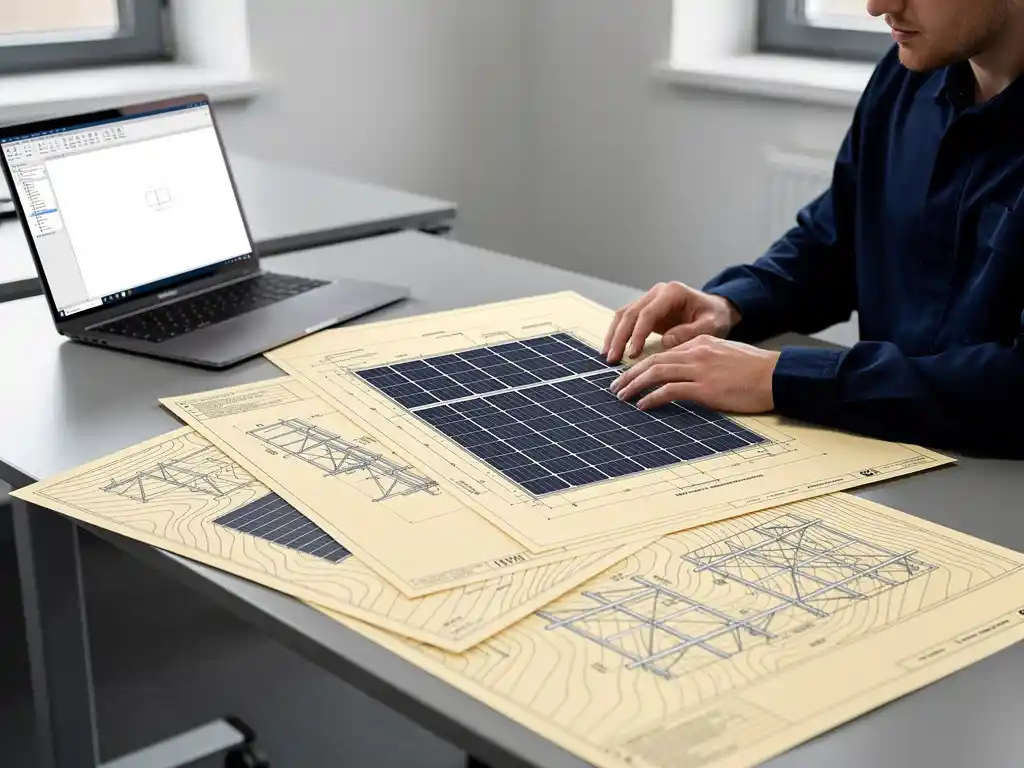
A solar design is construction-ready when it contains every document, calculation, and specification a contractor needs to break ground without requesting additional information. For utility-scale projects, this means going far beyond a preliminary layout: it requires fully coordinated engineering drawings, accurate terrain data, verified stringing configurations, and integrated mounting system details that reflect real site conditions.
The gap between a conceptual layout and a construction-ready package is where most project delays and cost overruns originate. The sections below unpack exactly what that gap looks like and how engineering teams can close it efficiently.
What separates a construction-ready design from a preliminary solar layout?
A preliminary solar layout defines where modules go and estimates system output. A construction-ready design proves that those modules can be installed safely, efficiently, and profitably by providing every technical document needed for procurement, permitting, and field execution. The difference is not just the level of detail; it is a shift from estimation to engineering certainty.
Preliminary layouts are valuable for feasibility and sales. They answer the question “can this site produce X megawatts?” at a high level, using simplified terrain assumptions and generic equipment placeholders. They are fast to produce and useful for early-stage developer conversations, but they are not actionable for a construction crew.
A construction-ready design, by contrast, locks in every variable. Module rows are positioned based on actual graded terrain, not a flat-plane approximation. Cable runs are sized and routed. Structural loads are calculated per the specific racking system being used. Permit drawings meet the authority having jurisdiction’s requirements. Every element has been coordinated so that the team building the project encounters no surprises.
For utility-scale projects specifically, the stakes of this distinction are enormous. A 50 MW ground-mounted plant involves thousands of individual decisions that compound across hundreds of acres. A layout error that shifts rows by a meter can cascade into stringing reconfigurations, additional cabling, and structural redesigns that cost far more to fix in the field than they would have cost to correct during engineering.
What documents must a utility-scale solar design include to be construction-ready?
A utility-scale construction-ready design package must include site plans with precise module placement, single-line electrical diagrams, stringing schedules, cable sizing calculations, structural and ballast calculations for the racking system, shadow analysis, equipment specifications, and permit-ready drawings stamped by a licensed engineer. Together, these documents give every project stakeholder what they need without back-and-forth.
Each document serves a distinct audience and purpose:
- Site plans and layout drawings: Show exact row spacing, setbacks, access roads, and equipment pad locations. Field crews use these to stake out the site.
- Single-line electrical diagrams: Define the electrical architecture from module to grid connection point, including inverter configurations and protection devices.
- Stringing schedules: Specify exactly which modules connect to which string input on each inverter or combiner box, accounting for shading, orientation, and voltage window compliance.
- Cable sizing and routing plans: Detail conductor sizes, conduit runs, and voltage drop calculations to ensure system performance and code compliance.
- Structural and ballast calculations: Confirm that the racking system can withstand local wind and snow loads, referencing the specific manufacturer’s engineering data.
- Shadow and yield simulations: Validate that inter-row spacing and equipment selection will deliver the projected energy output under real conditions.
- Permit drawings: Meet the specific format and content requirements of local authorities and utilities, often requiring a licensed engineer’s stamp.
Missing even one of these elements forces a contractor to pause and request information, which introduces delays that ripple across the entire project schedule.
How does terrain complexity affect construction-ready design accuracy?
Terrain complexity directly determines how accurately a design reflects what will actually be built. On flat sites, simplified assumptions hold reasonably well. On sloped, undulating, or irregular terrain, those same assumptions introduce errors in row placement, pile depths, cable lengths, and shading calculations that can make a design unbuildable as drawn.
Utility-scale sites are rarely flat. Rolling topography, drainage channels, and grade changes across hundreds of acres mean that module rows must be individually adjusted to maintain consistent inter-row spacing and avoid shading conflicts that a flat-plane model would miss entirely. If the design does not account for actual elevation changes, the stringing configuration may violate inverter voltage window limits when strings follow the terrain instead of the idealized flat surface.
Pile depths and racking configurations also vary with terrain. A design that specifies uniform pile embedment across a site with significant grade changes will result in either over-engineering on flat sections or structural inadequacy on slopes. Construction teams discovering this in the field face expensive re-engineering under schedule pressure.
Accurate terrain modeling, using survey data or high-resolution digital elevation models, is what closes this gap. When the design is built on real topographic data, every row position, cable length, and structural specification reflects what the site actually demands rather than what an idealized model assumes.
Why do stringing errors in utility-scale designs cause expensive construction problems?
Stringing errors in utility-scale solar designs cause expensive construction problems because they are discovered during commissioning, after all physical installation is complete. Correcting a stringing configuration at that stage requires re-pulling cables, relabeling conductors, and potentially reconfiguring combiner boxes, all of which consume labor and time on a project where every day of delay has a real financial cost.
The root of most stringing errors is the complexity of matching module strings to inverter input specifications across a site that is not perfectly uniform. Each string must fall within the inverter’s minimum and maximum DC voltage window under all operating conditions, including temperature extremes. On a large site with varied orientations, shading profiles, and terrain-driven row lengths, calculating this correctly for every string by hand is genuinely difficult and error-prone.
A single misconfigured string does not just underperform; it can trip inverter protection, cause ground faults, or create safety hazards. Identifying which string is the source of a fault across a 50 MW plant is a time-consuming diagnostic process. The cost of that troubleshooting, combined with the lost generation during downtime and the labor to correct the physical wiring, can run to hundreds of thousands of dollars on large projects.
This is why automated stringing calculations, validated against inverter specifications before construction begins, are not a convenience feature in PV design software but a financial risk management tool.
What role does mounting system integration play in construction-ready documentation?
Mounting system integration is essential to construction-ready documentation because racking systems are not generic. Every manufacturer’s system has specific load tables, allowable span configurations, pile spacing rules, and installation sequences. A design that specifies a racking system without incorporating that manufacturer’s actual engineering data is not truly construction-ready because the structural calculations cannot be verified without it.
When mounting system data is integrated directly into the design workflow, several critical outputs become accurate automatically. Ballast calculations for flat rooftops reflect the actual weight distribution of the chosen system. Pile spacing and embedment depths for ground-mounted installations match the manufacturer’s structural tables for the site’s wind and snow zone. Bill of materials quantities are derived from the actual system components rather than estimated from generic assumptions.
This integration also simplifies procurement. When the design specifies exact part numbers and quantities from the manufacturer’s catalog, the procurement team can issue purchase orders directly from the engineering package without a separate takeoff exercise. That removes a step that frequently introduces errors and delays between design completion and material delivery.
For engineering teams working at scale, the ability to connect design software to mounting manufacturer data via API or integrated libraries transforms what used to be a manual coordination process into an automated one. We built this capability into Virto.CAD precisely because the gap between generic structural assumptions and manufacturer-specific engineering was one of the most consistent sources of construction-ready failures we observed across utility-scale projects.
How can solar design software reduce the time to construction-ready status?
Solar design software reduces the time to construction-ready status by automating the calculations, document generation, and coordination tasks that engineers would otherwise perform manually. For utility-scale projects, this can compress what previously took weeks or months of engineering effort into a matter of days, without sacrificing the accuracy that construction-ready documentation requires.
The time savings come from several specific automation capabilities:
- Automated stringing calculations: Software validates every string against inverter specifications in seconds, eliminating manual verification across thousands of module connections.
- Terrain-aware layout generation: Designs built on real elevation data automatically adjust row positions and cable routes to reflect actual site conditions.
- Integrated structural calculations: Ballast and pile calculations update automatically when module layout or racking selection changes, keeping structural documentation synchronized with the design.
- Drawing automation: Construction drawings, single-line diagrams, and schedules generate directly from the design model rather than being drafted separately, eliminating the transcription errors that come from maintaining parallel documents.
- Manufacturer data integration: API connections to mounting system manufacturers pull current engineering data into the design, removing the manual step of cross-referencing specification sheets.
The compounding effect of these automations is significant. Each manual task that software handles is not just faster; it is also more consistent and less prone to the errors that require rework. For engineering directors managing teams under pressure to deliver more projects without proportional headcount growth, this is where PV design software delivers its clearest return on investment.
If your team is working toward faster, more accurate construction-ready packages for utility-scale projects, reach out to us to see how our tools fit into your existing workflow.
Frequently Asked Questions
How long does it typically take to produce a construction-ready design package for a utility-scale solar project?
With traditional manual workflows, producing a complete construction-ready package for a utility-scale project can take several weeks to a few months, depending on site complexity and team size. Modern PV design software with automation capabilities — covering stringing calculations, terrain-aware layouts, and drawing generation — can compress this timeline to days. The key variable is how much of the process is automated versus manually coordinated across separate tools and documents.
What are the most common mistakes engineering teams make when transitioning from a preliminary layout to a construction-ready design?
The most common mistake is carrying forward the flat-plane terrain assumptions from the preliminary layout without updating them with actual survey or elevation model data, which causes cascading errors in row placement, stringing, and cable sizing. Another frequent error is treating the racking system as a generic placeholder rather than integrating the specific manufacturer’s structural tables, which leaves ballast and pile calculations unverified. Teams also frequently underestimate the coordination effort between electrical and structural documentation, resulting in drawings that are internally inconsistent.
What type of terrain data should engineering teams use to ensure accurate construction-ready designs?
High-resolution digital elevation models (DEMs) or site-specific topographic survey data are the two most reliable sources for construction-ready terrain modeling. LiDAR-derived DEMs offer excellent accuracy for large sites and are increasingly accessible, while traditional land surveys remain the gold standard for sites with complex grading or drainage features. The critical requirement is that the data resolution is fine enough to capture grade changes that affect row positioning, pile depths, and inter-row shading — typically 1-meter resolution or better for utility-scale sites.
How should engineering teams handle design changes that occur after the construction-ready package has been issued?
Any post-issue design change should trigger a formal revision process that traces its impact across all affected documents — a change to module selection, for example, can alter stringing configurations, structural load calculations, and bill of materials simultaneously. Teams using integrated PV design software have a significant advantage here because linked outputs update automatically when a core parameter changes, reducing the risk of issuing revised drawings that are internally inconsistent. All revisions should be clearly versioned and communicated to contractors before any field work based on the affected documents proceeds.
Which project stakeholders should review the construction-ready package before it is issued, and what should each be checking for?
At minimum, the package should be reviewed by the structural engineer of record (confirming racking and foundation calculations), the electrical engineer (validating single-line diagrams, stringing schedules, and code compliance), and the EPC contractor’s field superintendent (checking that site plans, access routes, and equipment pad locations are buildable as drawn). The utility or interconnection authority may also require review of protection and metering documentation before issuing permits. Involving the contractor’s team early in the review process is particularly valuable because they surface constructability issues that pure design reviewers may overlook.
Can construction-ready documentation be reused or templated across multiple projects to speed up future designs?
Standardized elements — such as single-line diagram templates for a recurring inverter configuration, pre-approved detail drawings for a preferred racking system, or permit drawing formats accepted by a specific jurisdiction — can absolutely be templated and reused to accelerate future projects. However, site-specific outputs like terrain-adjusted row layouts, stringing schedules, and structural calculations must always be generated fresh from actual site data; reusing these without recalculation is one of the fastest ways to introduce errors into a construction-ready package. The most effective approach is to template the document structure and boilerplate content while keeping all calculated outputs tied to site-specific inputs.
How do I evaluate whether our current PV design software is capable of producing truly construction-ready packages, or just detailed preliminary layouts?
The clearest test is whether the software can generate — directly from the design model — a complete set of contractor-ready outputs including terrain-adjusted layouts, verified stringing schedules, manufacturer-specific structural calculations, and permit drawings, without requiring engineers to manually re-enter data into separate tools. If your team is exporting data to spreadsheets for stringing calculations, drafting single-line diagrams independently in CAD, or cross-referencing racking spec sheets manually, those are gaps between your software’s output and a true construction-ready package. Evaluating software against a real project’s document checklist is a practical way to identify exactly where automation coverage ends and manual effort begins.
Related Articles
Source link