

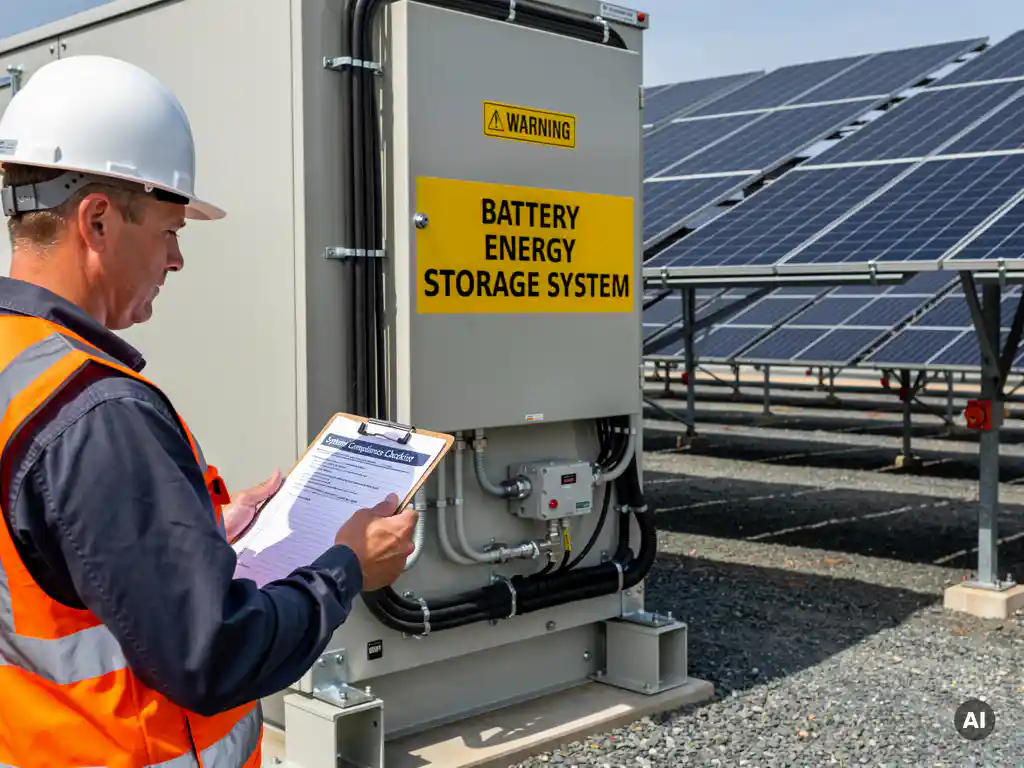
BESS installations are governed by a combination of international standards, national electrical codes, and local fire and building regulations that together define how battery energy storage systems must be designed, installed, and operated safely. The most widely referenced frameworks include IEC 62619, NFPA 855, UL 9540, and the relevant sections of the National Electrical Code (NEC) in the United States, though the exact requirements depend heavily on your jurisdiction and project type. This article walks through the key codes, how they vary by location and installation context, and what they mean in practice for solar-plus-storage projects.
Which codes and standards govern BESS installations?
BESS installations are governed by a layered set of standards covering electrical safety, fire protection, and equipment certification. The most important include IEC 62619 (safety requirements for secondary lithium cells and batteries), NFPA 855 (the Standard for the Installation of Stationary Energy Storage Systems), UL 9540 (the standard for energy storage systems and equipment), and UL 9540A (the test method for evaluating thermal runaway fire propagation). National electrical codes such as NEC Article 706 in the United States and equivalent regulations in other countries add further requirements around wiring, disconnects, and system integration.
These standards do not operate in isolation. A BESS project typically needs to satisfy multiple layers simultaneously. Equipment must be certified to a product standard like UL 9540, the installation must comply with a fire code like NFPA 855, and the electrical design must meet the applicable national or regional electrical code. In Europe, the Low Voltage Directive and relevant EN standards apply alongside IEC frameworks. In Australia, AS/NZS 5139 governs battery installations specifically. Understanding which standards apply in your jurisdiction is the essential first step before any engineering work begins.
Beyond certification and installation codes, grid-connected BESS systems often need to comply with utility interconnection standards such as IEEE 1547 in the US, which governs how distributed energy resources interact with the grid. For utility-scale projects, additional grid codes from the transmission or distribution system operator may also apply.
How do BESS safety requirements differ by installation location?
BESS safety requirements vary significantly depending on whether the system is installed indoors, outdoors, in a dedicated enclosure, or integrated into an existing building. Indoor installations face the strictest requirements because thermal runaway events in enclosed spaces pose a greater risk to occupants and structures. Outdoor and containerized systems typically have more flexibility, but still require careful attention to ventilation, fire separation distances, and access for emergency responders.
Indoor installations
For indoor BESS installations, NFPA 855 and equivalent standards impose strict limits on energy capacity per room, mandatory fire suppression systems above certain thresholds, and requirements for explosion-proof ventilation to prevent the accumulation of flammable gases. Smoke detection, thermal monitoring, and emergency disconnects are typically mandatory. Building codes may also require structural reinforcement depending on the weight and size of the battery system.
Outdoor and containerized installations
Outdoor BESS systems, including containerized units, generally benefit from natural ventilation and physical separation from occupied structures. However, fire separation distances from buildings, property lines, and other equipment must still meet code requirements. NFPA 855 specifies minimum separation distances based on energy capacity. Containerized systems must also meet standards for weatherproofing, seismic restraint where applicable, and accessibility for maintenance and emergency response.
Commercial rooftop installations present a unique challenge because they combine the constraints of both indoor and outdoor environments. Weight limits, roof penetrations, and proximity to HVAC equipment all introduce additional compliance considerations that must be resolved during the engineering phase.
What are the fire safety requirements for battery storage systems?
Fire safety requirements for BESS installations center on three priorities: preventing thermal runaway from spreading, detecting a fire event as early as possible, and enabling safe suppression and evacuation. NFPA 855 is the primary reference standard in the US and is increasingly referenced internationally. It requires battery management system (BMS) monitoring, early warning detection systems, automatic suppression for larger installations, and defined separation distances between battery modules and between the system and surrounding structures.
The UL 9540A test method is particularly important here. It evaluates how a thermal runaway event in one battery cell propagates to adjacent cells, modules, and units. The results of UL 9540A testing directly inform the separation distances and suppression requirements that apply to a specific product in a specific installation configuration. Authorities Having Jurisdiction (AHJs) increasingly require UL 9540A test data as part of the permitting process, especially for large-scale systems.
Fire suppression requirements depend on system size and location. Smaller residential or small commercial systems may only require smoke and heat detection with a manual suppression option. Larger commercial and utility-scale systems typically require automatic suppression systems, which may use water mist, clean agent, or other technologies depending on the battery chemistry. Lithium-ion fires require large volumes of water to cool cells effectively, which influences both suppression system design and site drainage planning.
Ventilation is another critical fire safety element. Lithium-ion batteries can off-gas flammable and toxic vapors during thermal runaway. Adequate ventilation prevents vapor accumulation, while gas detection systems provide early warning before concentrations reach dangerous levels. These requirements are specified in both NFPA 855 and IEC 62619.
Who is responsible for BESS safety compliance on a project?
Responsibility for BESS safety compliance is shared across multiple parties, including the system designer, the equipment manufacturer, the installation contractor, and the project owner. The engineer of record carries primary responsibility for ensuring the design meets all applicable codes and standards. The equipment manufacturer is responsible for certifying its products to relevant standards such as UL 9540. The installation contractor must follow the approved design and manufacturer installation instructions. The project owner is ultimately responsible for maintaining compliance throughout the operational life of the system.
The Authority Having Jurisdiction (AHJ) plays a central role in the compliance process. The AHJ reviews permit applications, inspects installations, and has the authority to impose requirements beyond the minimum code where local conditions warrant it. Engaging with the AHJ early in the project is strongly recommended, particularly for large or novel installations where the AHJ may not have reviewed a similar system before.
For solar-plus-storage projects, the engineer of record is often the same firm handling the PV system design. This makes it essential that the engineering team understands both the solar and storage compliance requirements and how they interact. If your team is working across multiple projects simultaneously, having a structured, repeatable design workflow helps ensure nothing falls through the cracks. Reach out to our team if you want to understand how purpose-built solar engineering tools can support that process.
How do BESS standards interact with solar PV system requirements?
When a BESS is paired with a solar PV system, the compliance requirements of both technologies must be satisfied simultaneously, and in some areas they directly overlap. NEC Article 706 (Energy Storage Systems) works alongside Article 690 (Solar Photovoltaic Systems) to govern DC-coupled and AC-coupled configurations. The interaction between the two systems affects inverter sizing, overcurrent protection, disconnecting means, and grounding requirements, all of which must be coordinated in the electrical design.
DC-coupled systems, where the battery connects directly to the PV array on the DC side, introduce additional complexity because the battery can both source and sink current. This affects string sizing, charge controller selection, and the protection coordination of the entire DC circuit. AC-coupled systems are somewhat simpler from a protection standpoint but still require careful attention to inverter compatibility, anti-islanding behavior, and grid interconnection requirements under IEEE 1547 or equivalent standards.
Shading analysis, yield simulation, and system sizing calculations for the PV side must account for the charging and discharging behavior of the BESS, particularly for self-consumption optimization or peak shaving applications. Getting these calculations right at the design stage prevents costly revisions during commissioning. Tools like Virto Solar’s design platform are built to handle the engineering complexity of integrated PV systems, automating the repetitive calculations that would otherwise consume hours of manual work in spreadsheets.
Fire and electrical safety standards also interact in practical ways. For example, rapid shutdown requirements under NEC 690.12 apply to the PV system and must be coordinated with the BESS disconnect strategy to ensure the entire system can be safely de-energized in an emergency. This coordination needs to be documented in the design and verified during inspection, making clear communication between the electrical engineer, the AHJ, and the installation team essential throughout the project lifecycle.
Frequently Asked Questions
How do I find out which specific BESS codes and standards apply to my project location?
Start by identifying your Authority Having Jurisdiction (AHJ), which is typically the local building or fire department, as they will confirm which editions of codes like NFPA 855 and the NEC have been locally adopted and whether any local amendments apply. From there, cross-reference the national electrical code for your country (e.g., NEC in the US, AS/NZS 5139 in Australia, or EN standards in Europe) and any utility-specific interconnection requirements. Engaging a licensed engineer familiar with your jurisdiction early in the process is the most reliable way to avoid surprises during permitting.
What are the most common compliance mistakes made during BESS installation projects?
One of the most frequent mistakes is treating BESS compliance as a single-standard checklist rather than a layered, multi-standard process — teams often satisfy the electrical code but overlook fire separation distances required by NFPA 855, or vice versa. Another common error is failing to obtain and submit UL 9540A test data for the specific product and configuration being installed, which increasingly leads to permit rejections or AHJ-imposed redesigns. Starting compliance planning after the design is already finalized is also a recurring issue; integrating code requirements from the very beginning of the engineering phase saves significant time and cost.
At what system size does a BESS installation typically require automatic fire suppression?
Under NFPA 855, automatic fire suppression requirements are generally triggered based on energy capacity thresholds and installation type — for example, indoor lithium-ion installations above 20 kWh in certain occupancy classifications may require suppression systems, though exact thresholds vary by system chemistry, configuration, and local code adoption. Outdoor and containerized systems have higher thresholds but are not exempt. Because these thresholds can shift based on AHJ interpretation and local amendments, it is best practice to confirm suppression requirements directly with your AHJ during the pre-application phase rather than relying solely on the base standard.
How should I approach an AHJ that has little or no experience reviewing BESS permit applications?
Request a pre-application meeting before submitting any formal permit documents, and come prepared with a clear project narrative, the relevant code sections that govern your installation, and the manufacturer’s UL 9540 certification and UL 9540A test data. Providing a concise summary of how your design addresses each major code requirement — fire separation, ventilation, detection, suppression, and electrical disconnects — helps an inexperienced AHJ build confidence in the submission and reduces back-and-forth. In some jurisdictions, bringing in a third-party peer reviewer or fire protection engineer to co-sign the submission can also accelerate approval.
Can an existing solar PV installation be retrofitted with a BESS without a full redesign?
It depends on the existing system’s configuration, age, and the size of the BESS being added, but a full redesign is rarely required — however, a thorough engineering review almost always is. The engineer of record must verify that the existing inverter supports AC or DC coupling with the new battery, that overcurrent protection and disconnecting means meet current NEC Article 706 requirements, and that rapid shutdown compliance under NEC 690.12 is maintained across the combined system. In some cases, adding a BESS triggers a full NEC compliance review of the existing PV system, particularly if the original installation predates current code editions.
What documentation should be prepared and retained for BESS compliance throughout the system’s operational life?
At minimum, you should retain the as-built electrical drawings, the equipment certification documents (UL 9540 listing, UL 9540A test reports), the approved permit and inspection records, the manufacturer’s installation and maintenance manuals, and the BMS configuration and commissioning reports. Ongoing operational compliance also requires maintaining inspection and maintenance logs, as many AHJs and insurers require documented evidence that the system is being serviced per manufacturer specifications. For utility-scale projects, grid operator interconnection agreements and any site-specific safety plans should also be kept on file and updated whenever the system is modified.
How do BESS compliance requirements change for projects in seismic zones?
In seismic zones, both the structural mounting of the BESS and the integrity of its electrical connections must meet additional requirements to ensure the system remains safe and does not become a hazard during or after an earthquake. NFPA 855 references seismic restraint requirements, and local building codes — particularly in regions like California — impose specific anchorage and bracing standards for heavy equipment like battery racks and containerized systems. Manufacturers typically provide seismic certification data for their enclosures, but the site-specific anchorage design must still be engineered and stamped by a structural engineer licensed in the project jurisdiction.
Related Articles
This content was generated with the help of AI — it may contain mistakes
Source link