

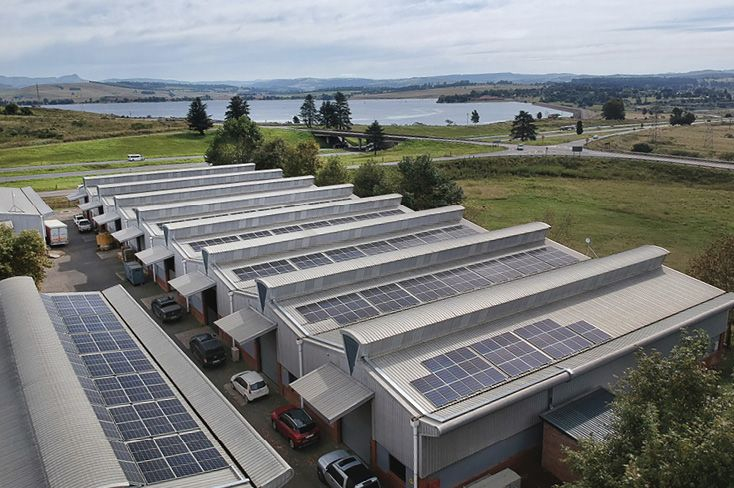
Anyone looking at the official figures for solar energy expansion in Africa is likely to massively underestimate the actual pace of development. While international databases continue to focus primarily on large, publicly announced solar parks and mini-grid projects, a much more dynamic reality is emerging in the background: a decentralized, privately financed, and economically driven solar boom that is spreading across the continent.
A look at import/export data from China tells the story: according to analyses by the African Solar Industry Association (AfSIA), annual expansion figures nearly quadruple once these data are taken into account. There is little evidence of large inventories so far—so there is strong reason to believe that the modules being shipped to countries across the continent are largely being bought and installed in-country.
This has far-reaching consequences: the actual solar boom in Africa is taking place not primarily in state-planned large-scale projects, but on thousands of homes and businesses across the continent: on factory roofs, at shopping centers, hotels, cell towers, farms, and in residential complexes. It is a market that is developing largely outside the radar of traditional energy planning processes.
Solar does not compete with grid power—but with diesel power
The logic of the African solar market differs fundamentally from that of European or North American markets. In countries like Nigeria, solar energy does not primarily compete with cheap grid power. It competes with gasoline or diesel generators.
In many African countries, power outages are a daily occurrence. The result is that for years, businesses, hospitals, hotels, and manufacturing plants have had to purchase (and service) expensive back-up generators—often at enormous cost. Diesel power is expensive, noisy, maintenance-intensive, and dependent on volatile import prices.
Against this backdrop, solar-plus-storage systems are fundamentally changing the economic equation. With pay-back times of one to two years in certain parts of the continent, a market is emerging that is not reliant on subsidies but instead that is driven by commercial self-interest.
This also explains the market’s remarkable structure: According to AfSIA, around 85 percent of newly installed solar capacity is in the commercial and industrial (C&I) sector. Private households have so far played only a minor role. The driving forces are companies whose business models depend on a reliable power supply. For such companies, solar is increasingly becoming a matter of competitiveness and operational reliability.
Mini-grids, battery storage, and private solar systems can scale much faster and more cost-effectively than traditional power plants and grid expansion plans. This does not mean that central grids will become obsolete.
However, their role is likely to change: away from being the sole backbone of the supply system, toward becoming part of an increasingly hybrid energy system.
China’s Key Role
China plays a key role in this context. Chinese manufacturers not only dominate the global solar market but are also redefining energy relations with Africa. Falling module and battery storage prices are what make solar power economically attractive in the first place. At the same time, China’s recent decision to allow duty-free imports of African goods points to a deepening economic partnership that extends beyond purely energy-related issues.
It is also noteworthy how broadly this growth is now spreading. While South Africa remains the continent’s largest solar market, import analyses show that around 82 percent of solar modules were recently shipped to other African countries. This suggests that the momentum is now spreading far beyond individual pioneer markets—particularly to West and East Africa.
The open question: What will happen to the energy supply companies?
As with all profound shifts, this development also raises difficult questions.
Many state-owned energy utilities on the continent are already operating at a loss. Electricity rates are often kept low for political reasons and generally do not cover actual costs. Investments in grid expansion is trailing the growth in demand, while technical losses and payment defaults remain high. If the most financially profitable customers—businesses, commercial entities, and wealthier households—increasingly set up their own solar power systems, utilities face the threat of spiralling revenue losses.
This creates a potentially dangerous cycle: as the more profitable customers start to defect from the grid, the more difficult it becomes to finance power system infrastructure, particularly grid expansion and reliability improvements. And as power quality suffers, the more attractive decentralized solar solutions become.
How governments and energy suppliers will respond to this development remains to be seen. Possible solutions include financing the energy infrastructure through public funds and subsidies, new grid fees, regulatory interventions, or import restrictions. Equally possible, however, is a strategic shift in which energy suppliers themselves increasingly become platforms for decentralized energy supply.
Opportunities for rapid, cost-effective development:
The narrow focus on the negative consequences for energy utilities obscures the enormous opportunities for economic development.
In many African countries, the lack of access to energy and electricity has been the reason for stagnant economic development. The solar+storage revolution is now enabling rapid and cost-effective access to energy—one of the key drivers of economic development and rising living standards.
A quiet PV revolution with global significance
One thing is certain: Africa’s solar boom is no longer a vision of the future. It is already happening—and since this transformation is predominantly driven by market forces, decentralization, and pragmatism, it could prove more sustainable (both financially and environmentally) than many state-planned expansion programs.
The crucial question is therefore no longer whether solar energy will grow massively in Africa. The crucial question is how quickly political, regulatory, and infrastructural systems can adapt to this new reality.

About the authors: Toby Couture is the founder and director of E3 Analytics, an independent renewable energy consultancy in Berlin, Germany. He has 15 years’ experience in the sector and has advised dozens of national and state governments throughout the world on renewable energy policy, strategy, and finance.

David Jacobs is the managing director and founder of International Energy Transition GmbH (IET). He has 20 years’ experience in energy policy design, authoring more than 100 publications. He has advised policymakers in more than 40 countries.
Source link