

From ESS News
China Huadian has completed the first grid connection of a 100 MW/1,000 MWh compressed carbon dioxide (CO₂) energy storage plant in Mulei County, Xinjiang, marking a significant milestone for this emerging long-duration storage technology.
The facility achieved its initial grid connection on Sept. 30, according to China Huadian. Located in the Gobi Desert of Changji Prefecture, the project forms part of a renewable energy development comprising 600 MW of wind and 400 MW of solar capacity.
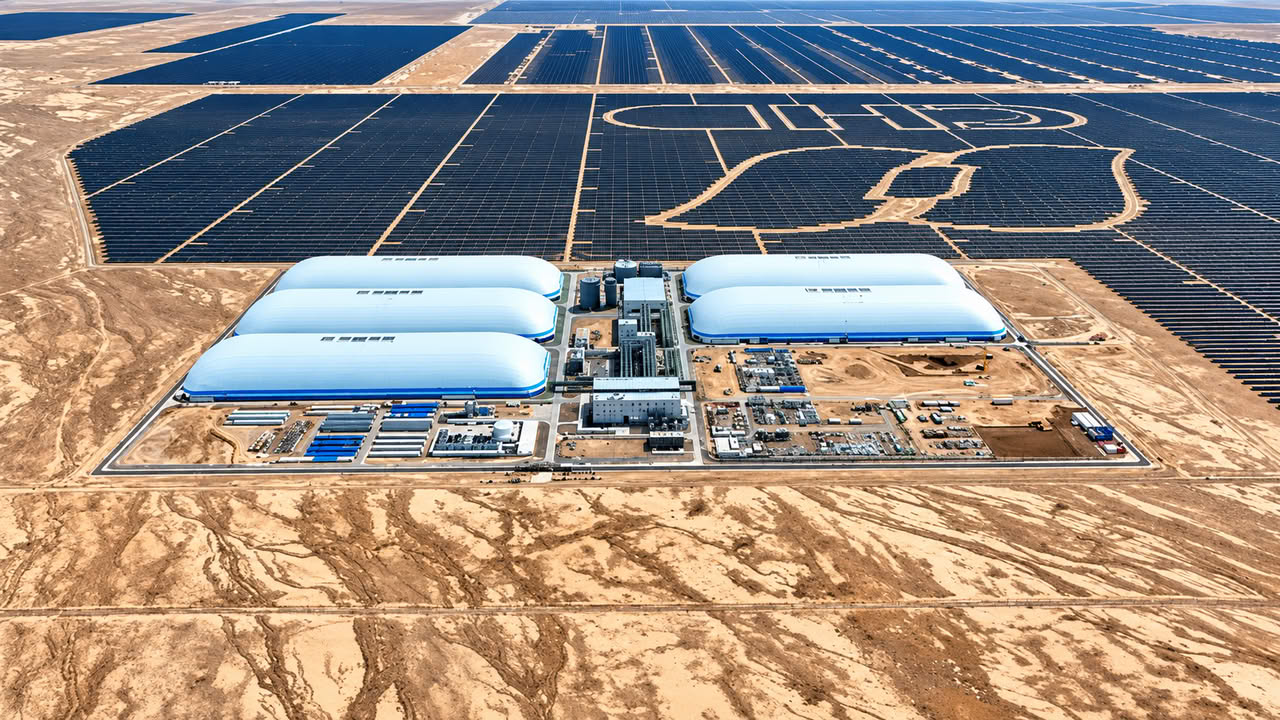
The storage plant occupies approximately 565,000 square meters and incorporates five gas storage enclosures, 141 liquid CO₂ storage units and 97 thermal storage units. Its rated capacity of 100 MW/1 GWh corresponds to a nominal discharge duration of 10 hours.
Unlike conventional compressed air energy storage (CAES), which typically stores high-pressure air in underground salt caverns or other engineered storage spaces, the Mulei system uses CO₂ as a working fluid in a closed thermodynamic cycle.
During charging, surplus electricity powers compressors that raise the pressure of gaseous CO₂. The heat generated is recovered and stored, while the compressed gas is cooled and liquefied for storage in pressure vessels. During discharge, the liquid CO₂ is evaporated, reheated using the recovered thermal energy and expanded through a turbine to generate electricity. The gas then returns to storage for reuse.
CO₂ can be liquefied at comparatively moderate pressures, allowing more compact high-pressure storage than compressed air. The system also avoids the need for suitable underground caverns, potentially expanding deployment opportunities in geographically constrained locations. However, it still requires substantial above-ground gas storage infrastructure, heat exchangers and specialized turbomachinery.
The technology was developed by a research team led by Professor Xie Yonghui at Xi’an Jiaotong University and commercialized through Shenzhen-based Exax Energy, also known as Bairang New Energy. Dongfang Electric served as EPC contractor and supplied major equipment, including compressors, turbines, generators, heat exchangers and control systems.
According to Huadian, the plant’s CO₂ turbine has a design efficiency exceeding 92%, while the system is designed for at least 30 years of operation, more than 20,000 start-stop cycles and a startup-to-full-load time of less than 20 minutes.
The 92% figure refers to turbine efficiency, not the electricity-to-electricity round-trip efficiency of the complete storage system. Huadian has not disclosed independently verified system-level efficiency or levelized storage costs.
The company expects annual generation of approximately 200 GWh once the facility reaches full operation, potentially avoiding around 50,000 metric tons of standard coal consumption and 170,000 metric tons of CO₂ emissions annually.
The Mulei project represents a substantial step beyond earlier Chinese demonstrations of the same technology, including a 10 MW/20 MWh verification system completed in 2022 and a 10 MW/80 MWh installation connected to the grid in Anhui province in December 2023. Internationally, Italy’s Energy Dome has also developed commercial-scale CO₂ storage, including a 20 MW/200 MWh facility in Sardinia.
Compressed CO₂ storage is therefore advancing from pilot systems into utility-scale deployment, although it remains considerably less commercially established than conventional CAES. Mulei’s initial grid connection demonstrates engineering integration at the 100 MW scale.
Source link