

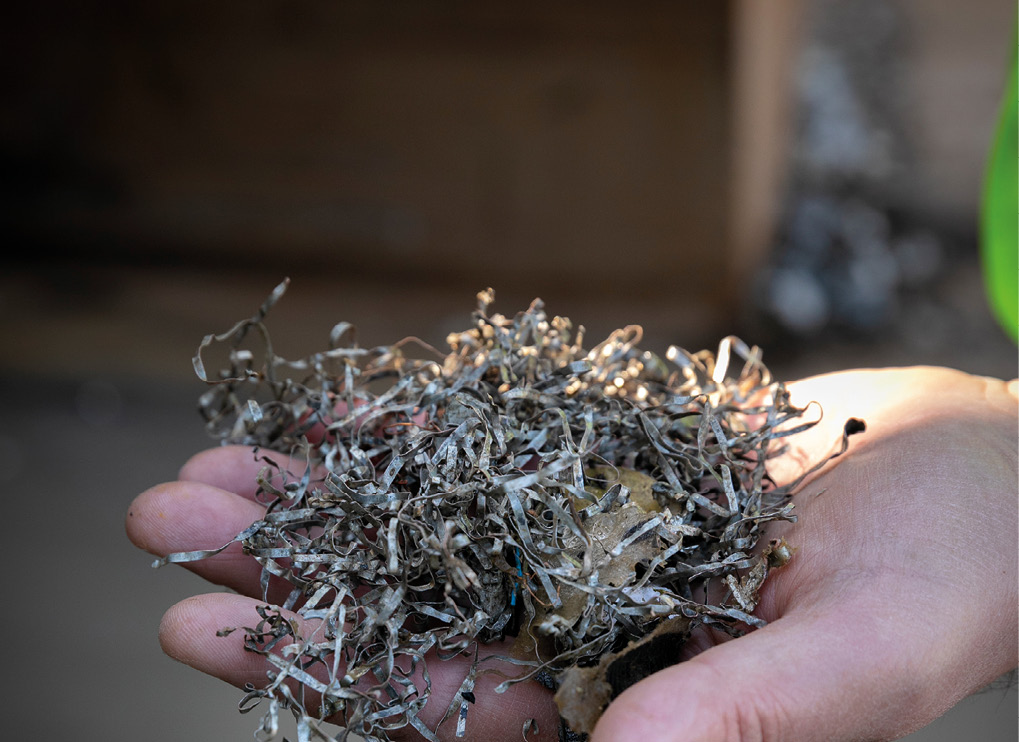
By weight, recycling a solar module can look deceptively simple. Separate the glass and get it to a specialist recycler, and you’re already 70% of the way there. The small quantities of silver and other valuable materials wrapped up in a module are much harder to recover. This creates a problem: a high recycling rate may reveal little about the value, purity, or the eventual use of materials.
“Glass accounts for more than 70% of a PV module but has a raw material value of only around €50 ($58) per ton. Silver makes up less than 0.05% of the module but is worth approximately €1.77 million per ton,” said Andreas Obst, head of recycling at Germany’s Fraunhofer Center for Silicon Photovoltaics (CSP). “As a result, one metric ton of PV waste may yield around 700 kg of glass, worth €35, and approximately 0.5 kg of silver, worth €885.”
Yet a module’s value does not determine whether it can be recovered economically. That also depends on other factors related to the route it takes after decommissioning. A study led by Jian Zuo of Australia’s Adelaide University modeled 1,708 PV recycling pathways across 32 regions and found that these local conditions can substantially alter the economic and environmental benefits of recycling. “It is unlikely that a one-size-fits-all policy can work everywhere,” Zuo told pv magazine.
Ahead of the curve
Regional differences are already producing distinct recycling models worldwide. France, for example, has one of Europe’s most developed systems. It uses an extended producer responsibility scheme that requires manufacturers and importers to finance end-of-life management through a contribution paid in advance.
“The model is centralized in terms of governance, financing, contractual standards and traceability, while remaining operationally decentralized through a network of collection, logistics and recycling partners,” explained Nicolas Defrenne, general director of Soren, the nonprofit organization responsible for the system.
In 2025, the organization collected 13,760 metric tons (MT) of end-of-life modules, and expects to exceed 18,000 MT this year. Soren has selected six operators with combined annual capacity exceeding 45,000 MT. It forecasts France’s annual end-of-life volume to reach 200,000 MT by 2040.
“The acceleration in the volume of end-of-life modules will not be linear, because installations have grown rapidly from one period to the next,” explained Defrenne. “This creates a major industrial planning challenge. Recycling capacity cannot simply follow current collection volumes. It must be developed ahead of the waste curve, with facilities capable of scaling up quickly while maintaining high standards of material recovery.”
Preparing for larger waste volumes is therefore not only a question of more processing capacity, but also of deciding which materials to focus on. Soren assesses treatment costs, material revenues, recovery quality, and environmental performance. “The percentage of recovered mass is not the only relevant indicator. We must also consider the quality of the recovered material and whether it genuinely substitutes for new raw materials,” Defrenne noted.
Despite France’s centralized approach, traceability remains a European problem. Researchers Ässia Boukhatmi and Stefan Grösser are developing digital product passports that track modules and lifetime events by serial number. “PV traceability mainly fails because data is fragmented, systems are not connected, and PV stakeholders use different documentation formats,” they said.
Premature retirement
Some Australian projects are approaching the waste treatment from a different direction – instead of focusing on recycling, they look at reuse in early processing. System upgrades, roof renovations, inverter failures and other issues cause solar modules designed to operate for about 25 years to be decommissioned after half that, even though they still have some juice left in them.
“We increasingly describe this as premature retirement rather than end-of-life,” said James McGregor, chief technology officer of Second Life Solar. “Removal from the first installation should be seen as a decision point, not the end of the product’s life.”
In a Queensland campaign run by the company, about 58% of 5,067 decommissioned modules met performance criteria for reuse. In that campaign, the company used a rapid portable current-voltage measurement and electroluminescence imaging system developed with the Commonwealth Scientific and Industrial Research Organization (CSIRO). Yet a study by CSIRO, together with the Australian National University, found that around 14% of the modules that passed performance tests failed wet-leakage tests.
“A module can appear suitable from a performance perspective, yet still have insulation-related issues that require additional testing,” said Marco Ernst of the Australian National University. He said viable reuse will require affordable safety testing, standardized grading criteria and savings to compete with inexpensive new modules.
For McGregor, such testing should determine a module’s place within a broader waste hierarchy. “Ideally, when a solar system is decommissioned, the equipment would first be considered for continued use, followed by repair, testing and reuse, component or material recovery, and finally recycling,” he said. “Panels that are damaged, unsafe or genuinely at the end of their useful life should absolutely be recycled. However, panels capable of safely producing electricity for another five to 15 years should not automatically be destroyed simply because recycling is the easiest pathway.”
Non-regulation
The United States takes a more fragmented approach. Scott Behmer, associate economist at research institute RAND, said the federal government has no regulatory framework specifically for PV waste, while only a few states have introduced module-specific requirements. Behmer warned, however, that landfill restrictions and extended producer responsibility could increase the lifetime cost of solar and marginally reduce deployment, potentially outweighing benefits.
“Because the greenhouse gas benefits of solar adoption are so large relative to the greenhouse gas benefits of recycling, even very small reductions in solar adoption, less than 0.2%, could cause greenhouse gas emissions that offset the reductions caused by recycling,” he claimed.
Cost is not the only unresolved issue. Isaac Nichelson, circular supply chain analyst at Sustainable Source Studios (S3), said domestic dismantling or shredding does not establish where recovered fractions are ultimately refined or how they are used. “‘Recycled in the USA’ may accurately describe the initial processing step while revealing nothing about where final recovery takes place,” he said. “A chain can be mostly domestic by weight and still send its highest-value fraction abroad.”
Tony Sample, chair of IEC Technical Committee 82, noted that modules may legitimately cross borders when suitable facilities are unavailable locally, although traceability remains essential. “Suitable documentation will be needed to ensure that the material has been recycled to a minimum specification,” he said. For now, he expects broader harmonization to become more feasible as waste volumes grow and recycling technologies improve.
The post End-of-life is just the beginning appeared first on pv magazine Global.
Source link