

The European long-term power purchase agreement (PPA) market showed divergent trends in July amid energy market volatility, a rebound in gas prices and varying levels of renewable energy penetration. According to the latest index from Swiss consultancy Pexapark, the Euro Composite rose 2.3% to €45 ($52.5)/MWh, although performance varied by country.
Great Britain recorded the largest monthly increase, at 5.8%, followed by Italy at 4.3%. In both markets, higher PPA prices were supported by strengthening forward electricity prices, as gas markets continued to price in risk premiums linked to geopolitical instability.
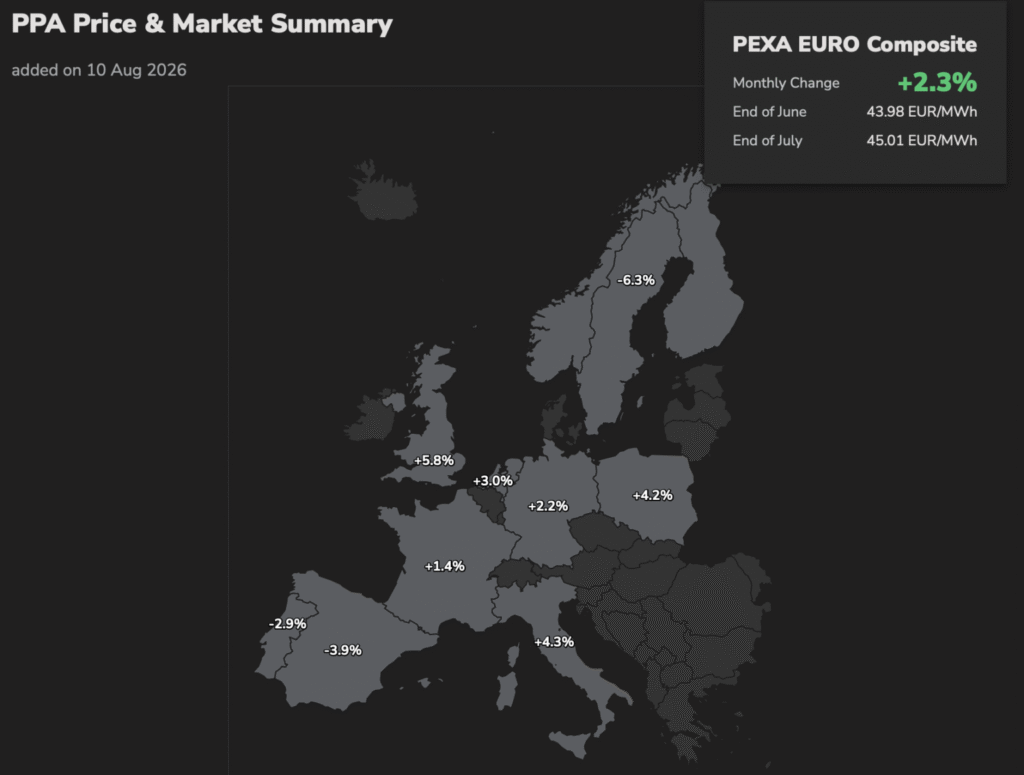
By contrast, PPA prices declined in several markets with high levels of renewable energy penetration. Prices fell 6.3% in the Nordic countries, 3.9% in Spain and 2.9% in Portugal. The declines largely reflected the impact of high renewable generation on long-term electricity price expectations and, consequently, renewable energy contract values.
In the Nordic countries, the decline was primarily linked to a recalibration of PPA “fair values” for Denmark, incorporating an updated market price of risk and new forward capture price curves. High renewable generation and healthy hydropower reserves also continued to put downward pressure on long-term price expectations.
24 PPAs representing 1.1 GW
Despite price volatility, contracting activity remained robust. Twenty-four PPAs were publicly announced across Europe in July, representing approximately 1.1 GW of contracted capacity.
Corporate buyers accounted for 21 agreements, representing around 770 MW of disclosed contracted capacity, while utilities signed three contracts totaling approximately 620 MW. The largest deal announced during the month was a 332 MW offshore wind PPA between Ørsted and an investor consortium for the Gode Wind 1 project in Germany, coinciding with the facility’s exit from its existing subsidy scheme.
Solar remained the dominant technology, accounting for approximately one-third of disclosed contracted capacity. Mixed-technology and onshore wind PPAs each represented nearly one-quarter of announced capacity.
Storage contracts diversify
Europe’s energy storage market was also active in July. Pexapark recorded nine battery energy storage system (BESS) agreements, totaling approximately 865 MW and 3.1 GWh of disclosed contracted capacity.
Tolling agreements accounted for four deals and the majority of contracted capacity. These included two agreements in Italy signed by Zelestra: a 300 MW deal with EnBW and a 207 MW agreement with Axpo. A 100 MW tolling agreement in Great Britain and a 55 MW portfolio deal in Spain were also announced.
Revenue swap structures were announced in Spain and Hungary, while Germany, Poland and Denmark recorded merchant revenue optimization agreements featuring revenue-sharing mechanisms.
The range of structures points to the emergence of more varied contractual models in the BESS market. Tolling agreements can provide greater revenue visibility for utility-scale projects, while revenue swaps and merchant revenue-sharing models enable owners to retain some exposure to potential market upside.
Energy market volatility during the month was driven in part by the conflict in the Middle East. Periods of easing tensions and discussions of potential ceasefires temporarily pushed gas prices lower, while renewed military escalation and concerns over possible LNG supply disruptions through the Strait of Hormuz reversed the trend.
Heatwaves across Europe also increased electricity demand for cooling and constrained output from some French nuclear power plants due to high river temperatures. Drought conditions in Central Europe lowered Rhine water levels, adding uncertainty over coal transportation.
Source link