


Encouraged by government subsidies, Irish homeowners are adopting solar in their droves. Solar Ireland’s latest Scale of Solar report showed around 190,000 homes across the country have solar panels installed, meaning residential rooftop systems are a significant driver behind Ireland’s total installed PV capacity of 2.7 GW.
As interest in residential solar continues to grow, homeowners are increasingly looking for ways to understand the financial benefits of different system configurations before investing. With this in mind, software platform AirPV has created solar and battery calculator tool that tells homeowners how much money and electricity they can save based on the type of home energy system they choose to install.
The company’s founder, Scott McKechnie, told pv magazine that AirPV was initially founded as a lead generation platform connecting homeowners with residential solar installers. He has since made it more sophisticated by adding a new solar and battery arbitrage calculator function.
He expanded the platform because he saw demand, even among his own family and friends who were asking him about home solar but were confused by all the information available. A lot of the information available online about solar is false, as McKechnie said.
McKechnie is also starting up a microgeneration campaign, or ‘Meitheal’ (an Irish-language word meaning cooperative), which is inviting interested homeowners to sign up to a waiting list for people in their area to avail of group solar installation deals together. According to the AirPV founder, grouping together the installations by area makes it cheaper for homeowners and encourages more communities to switch to solar and batteries. It’s an ideal setup for housing estates, for example, he said. One of these schemes has already been set up in County Cork.
He said the information the solar calculator tool gives is important as it puts power into the homeowner’s hands so they can save themselves time and money.
“The thing about solar is that it’s a great thing to do for your home, but it’s quite a specialty,” he went on to say. “It’s hard for homeowners to wrap their heads around all these details without first doing a lot of research. The idea with AirPV is to have it all in one – a reliable calculator, blog posts, and a FAQ page which covers a lot of details like how often you clean solar panels.”
The solar calculator tool has been updated to build battery arbitrage and the 5 kW inverter size limit for Irish home solar systems into the calculation. This limitation is called ‘clipping’ and it comes into effect for systems above 6 kW.
“If you do a 20-panel system with a 5 kW inverter, that means that in summer conditions, in full sun, you will be producing 10 kW at your panels, but you can only export 5 kW,” McKechnie explained. “So, without a battery, you’re losing half of that energy in full sun conditions. But that also means that for the rest of the year you will be producing closer to your 5 kW inverter limit so you’ll be able to export more electricity for the rest of the year.”
Using the calculator tool, McKechnie showed pv magazine how adding more solar panels with a battery with arbitrage can help yield better cost savings and shorter payback time, whereas installing only five or ten panels is less financially rewarding.
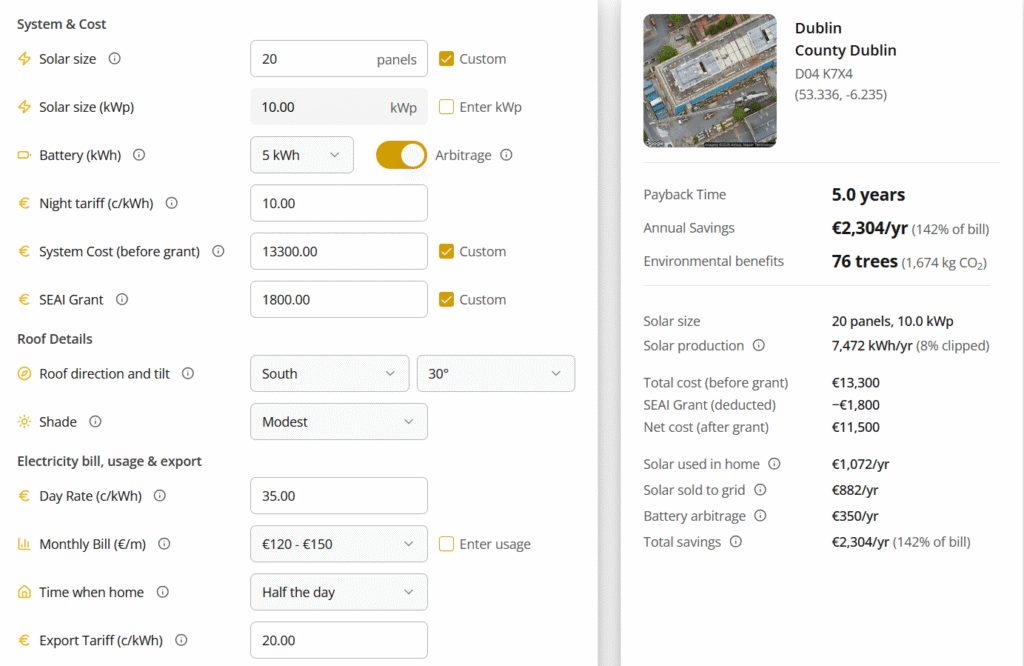
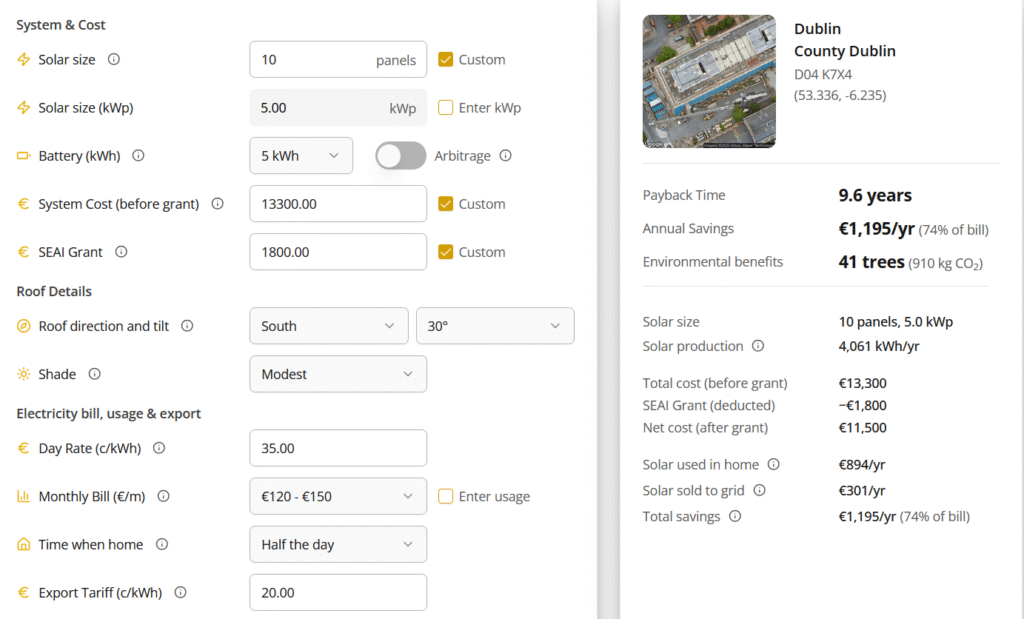
The AirPV calculator uses location-based PVGIS solar data. Users can input their consumption patterns into the calculator, such as their average monthly electricity bill, the times they are home and the export tariff. They can also input information about their roof, such as how much shading is present and the direction and tilt of the roof.
The clipping concept also applies to large-scale farms and McKechnie said he is working on a paper about this.
McKechnie knows all this stuff having spent years as a solar consultant for utility-scale installations. In the past few years, he has seen AirPV’s user base grow from a few thousand hobbyists, reflecting the broader uptake of home solar and storage in Ireland.
“There’s a lot of misinformation, and I’m trying to bring some of the rigor of the utility-scale into the residential segment, that’s the motto of the business,” he said.
“An installer could tell you your system is going to cost you €20,000 and the payback time will be two years and some homeowners will actually believe that and go ahead with it and get ripped off, but you can just put the numbers into the tool and see what’s sensible,” he pointed out, adding “The idea is that you do this before you actually approach the installers and while you’re still thinking about installing your system.”
The data for the lead generation, meanwhile, comes directly from live pricing via the installers’ websites. Homeowners simply enter their Eircode (Irish zip code) and this generates tailored quotes by a series of installers, all presented in an easy-to-digest layout showing annual savings, net cost and warranty, as well as the next available time the installer is available to visit the home. Users can compare quotes based on payback period, the number of panels and output. The homeowner can submit their contact details to an installer they’re interested in reaching out to. The Meitheal scheme AirPV is running works on a similar principle.
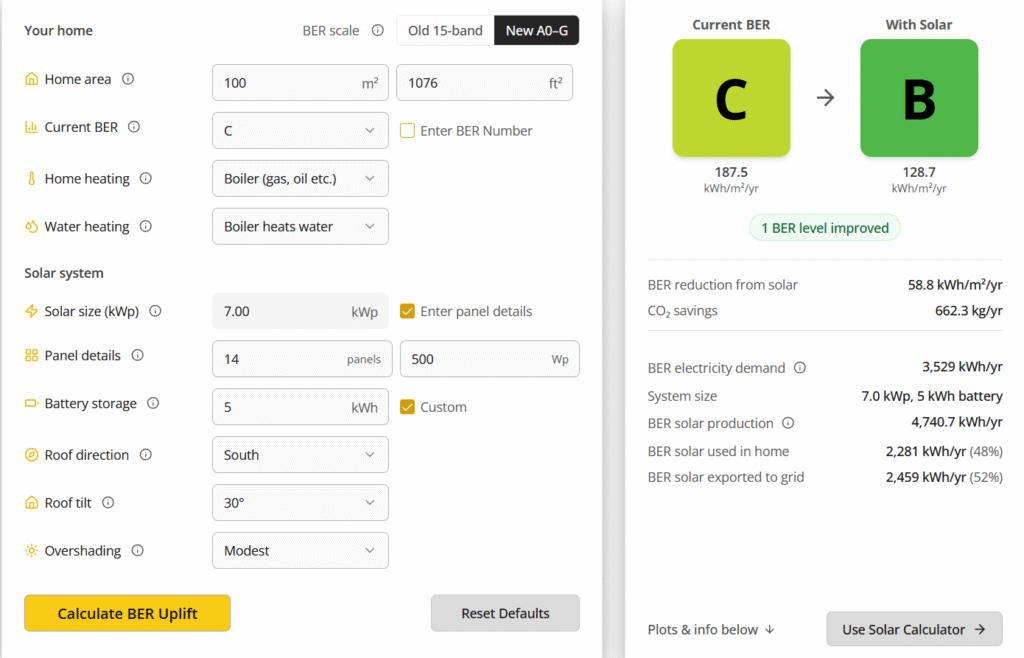
McKechnie has also developed a building energy rating (BER) calculator that tells homeowners how their home solar and battery can affect their BER.
Source link