


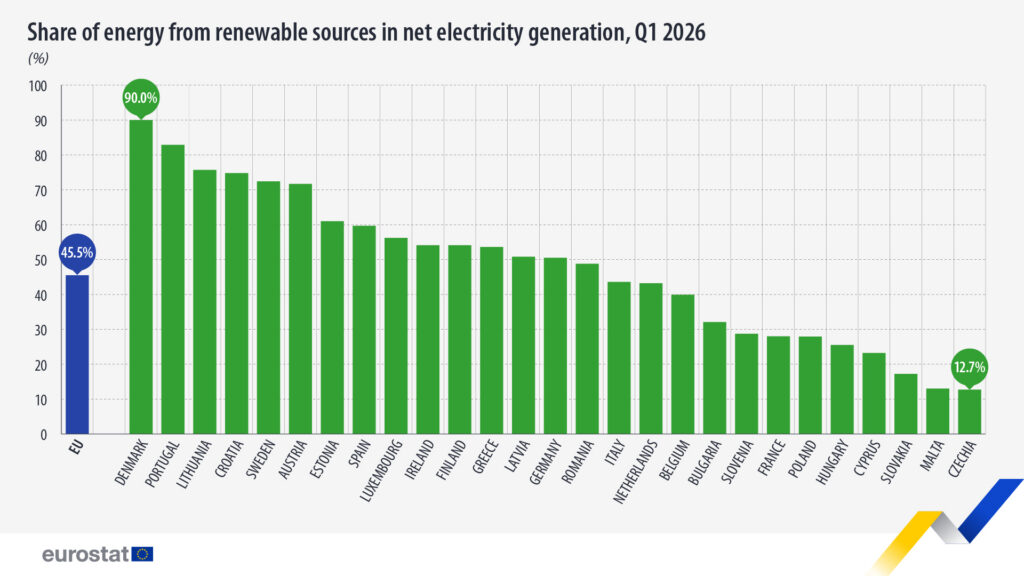
Renewable energy sources accounted for 45.5% of electricity generated in the EU during the first quarter of 2026 (Q1 2026), according to data published by Eurostat, the official statistical office of the European Union.
The figure is an increase on the first quarter of 2025 (Q1 2025), when the share was 42.7%.
Solar accounted for 17.3% of renewable electricity in the EU during Q1 2026. The percentage makes solar the third largest form of renewable electricity in the bloc, behind wind and hydro power.
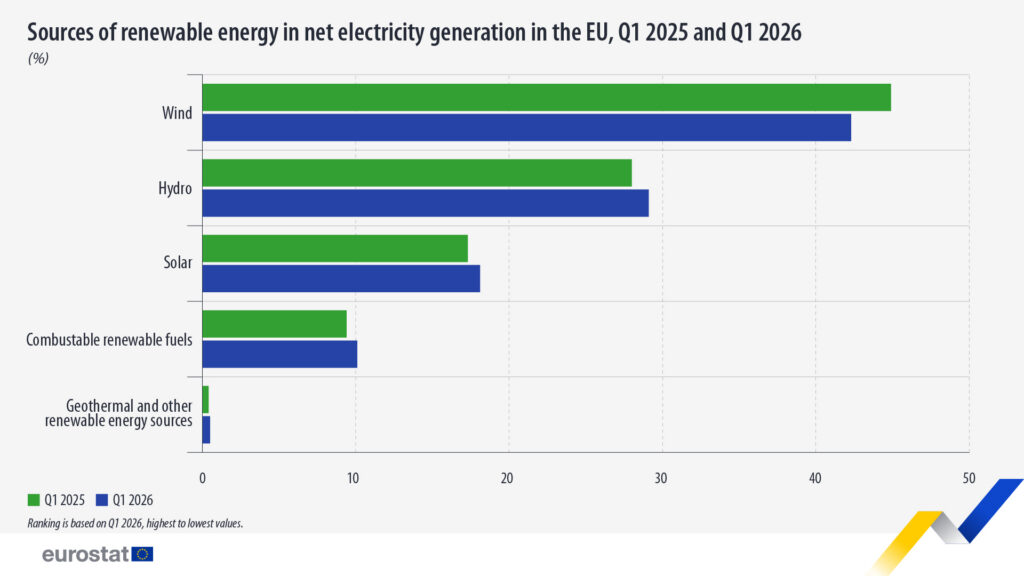
Eurostat’s database adds that solar generated 58.8 TWh of electricity in Q1 2026, comprising 10.8 TWh in January, 15 TWh in February and 33 TWh in March.
For comparison, solar generated 55.3 TWh of electricity in Q1 2025, with 10.5 TWh in January 2025, 16.5 TWh in February 2025 and 28.3 TWh in March 2025.
Total net electricity generation across all sources in Q1 2026 reached around 746.6 TWh, compared to 718.3 TWh in Q1 2025.
Eurostat’s analysis adds that among EU countries, the highest share of electricity from renewable sources in Q1 2026 was generated in Denmark, at 90%, mostly from wind energy. Portugal ranked second, at 82.9%, thanks mostly to hydro energy, with Lithuania in third, at 75%, generated mostly by wind.
On the other end of the scale, Slovakia, Malta and Czechia recorded the lowest shares of electricity from renewables in Q1 2026, with 17.2%, 13% and 12.7%.
Solar generated a record 369 TWh of electricity across the EU in 2025, according to figures compiled by Ember, equivalent to a record 13% share.
Renewables generated 47.7% of the total energy mix across the bloc last year, 0.2% down on 2024. Despite the decrease, solar and wind generated more energy in the EU than fossil fuels for the first time in history.
Source link