
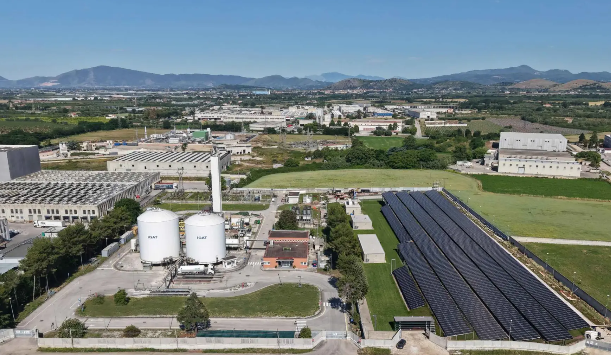
SIAD Group has inaugurated a 2 MW proton exchange membrane (PEM) electrolyzer for renewable hydrogen production at its IGAT plant in Pignataro Maggiore, near Caserta, southern Italy. The facility, which specializes in the production of nitrogen, oxygen and argon, will use the electrolyzer to produce renewable hydrogen, which will then be compressed to pressures of up to 500 bar for distribution to industrial customers. “The plant is powered exclusively by a photovoltaic field with a capacity of 2.37 MW and a battery storage system with a capacity of 1 MW,” said the Bergamo-based chemical and engineering group. SIAD said the project represents an investment of more than €12 million ($13.4 million), including €8 million in funding under Italy’s National Recovery and Resilience Plan (PNRR). The company said the project will integrate renewable electricity generation, storage, electrolysis and high-pressure hydrogen compression at a single industrial site, with the hydrogen intended to support the decarbonization of applications in which direct electrification is difficult.
Oregon State University researchers have published an academic paper on the role of metal-organic frameworks (MOFs) in photocatalytic hydrogen production directly from water without electricity, aiming to address inefficient charge separation and reliance on metal cocatalysts. The researchers presented a family of MOFs, BVR-19-M, constructed from divalent transition metal ions (M = Mg2+, Mn2+, Cu2+, Zn2+, Cd2+) and the aliphatic amino acid L-cystine. “Among them, BVR-19-Zn exhibits the highest photocatalytic activity, enabled by the zinc’s filled d-orbitals and the redox-active disulfide l-cystine ligand, promoting intraligand charge transfer (ILCT),” said the researchers in the study “Intraligand Charge Transfer in Metal-Organic Frameworks Facilitates Radical Anion-Mediated Hydrogen Evolution,” published in the Journal of the American Chemical Society. The academics explained that the disulfide (S–S) bridges within BVR-19-Zn undergo transient homolytic cleavage upon light irradiation, generating a thiyl radical and thiolate anion pair that mediate charge separation and drive hydrogen evolution without a cocatalyst.
The Spanish government has decided to accelerate the authorization process for the first three sections of the country’s renewable hydrogen backbone network, developed by Enagás. The 300 MW Onuba electrolyzer project in Huelva will receive €303.75 million, while the 500 MW Catalina electrolysis project in Teruel has been awarded €245 million and the 100 MW Petronor electrolyzer project in Vizcaya has received €160 million. “It is expected that Enagás will soon request administrative authorization for all the sections that will constitute the future renewable hydrogen backbone network: Mérida-Salamanca, Salamanca-León, León-Llanera, Llanera-Reocín, Arrigorriaga-Haro, Haro-Zaragoza, Tivissa-Salzadella, Salzadella-Paterna, Paterna-Montesa, Montesa-Cartagena, and Almendralejo-Puertollano,” said the Spanish government, adding that it has awarded more than €3 billion.
The German government has published its third funding call for project proposals under its Funding Guideline for International Hydrogen Projects. The deadline for submissions is Dec. 17, 2026. German companies can receive up to €30 million ($33.75 million) per project for the 2027-30 period. “Major requirements are that the project is carried out outside the European Economic Area and Switzerland and ensures significant German and European value creation. Funding is still subject to the approval of the federal budget 2027,” said Germany’s Federal Ministry for Economic Affairs and Energy (BMWE).
Plug Power has signed a 280 MW electrolyzer supply agreement with Arcadia eFuels for Project Endor in Denmark. The deal includes a cooperation agreement covering Arcadia eFuels’ future projects. Project Endor is located at the Port of Vordingborg on Denmark’s south coast. “Once built, it will use renewable grid power to run 280 MW of Plug electrolyzers, producing roughly 110 tons of renewable hydrogen a day. Arcadia eFuels will combine that hydrogen with captured carbon dioxide to make jet fuel that works in standard aircraft,” said the US-based company.
Thyssenkrupp Nucera has secured another chlor-alkali technology order in China, valuing the contract in the “low double-digit million-euro range.” The German company said the project will expand its installed base in northwestern China, a major hub for large-scale chlor-alkali production. The contract covers licensing, engineering, procurement services, the supply of key equipment, and commissioning support. “The new order marks the first contract awarded to thyssenkrupp nucera by Hongniu Lanzhou and may lay the foundation for a long-term strategic collaboration,” said the Dortmund-based company.
Source link